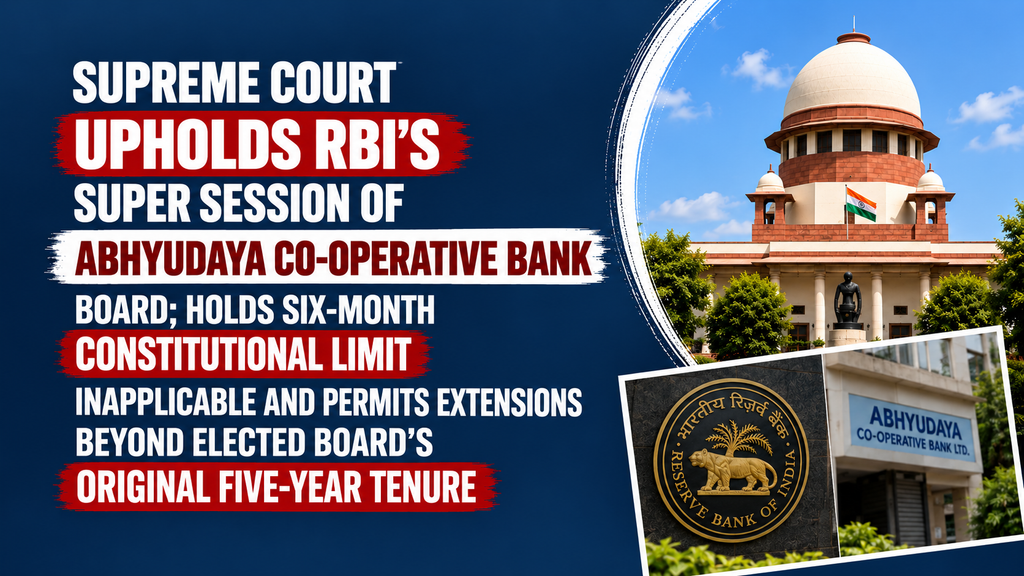
Supreme Court Upholds RBI’s Supersession of Abhyudaya Co-operative Bank Board; Holds Six-Month Constitutional Limit Inapplicable and Permits Extensions Beyond Elected Board’s Original Five-Year Tenure

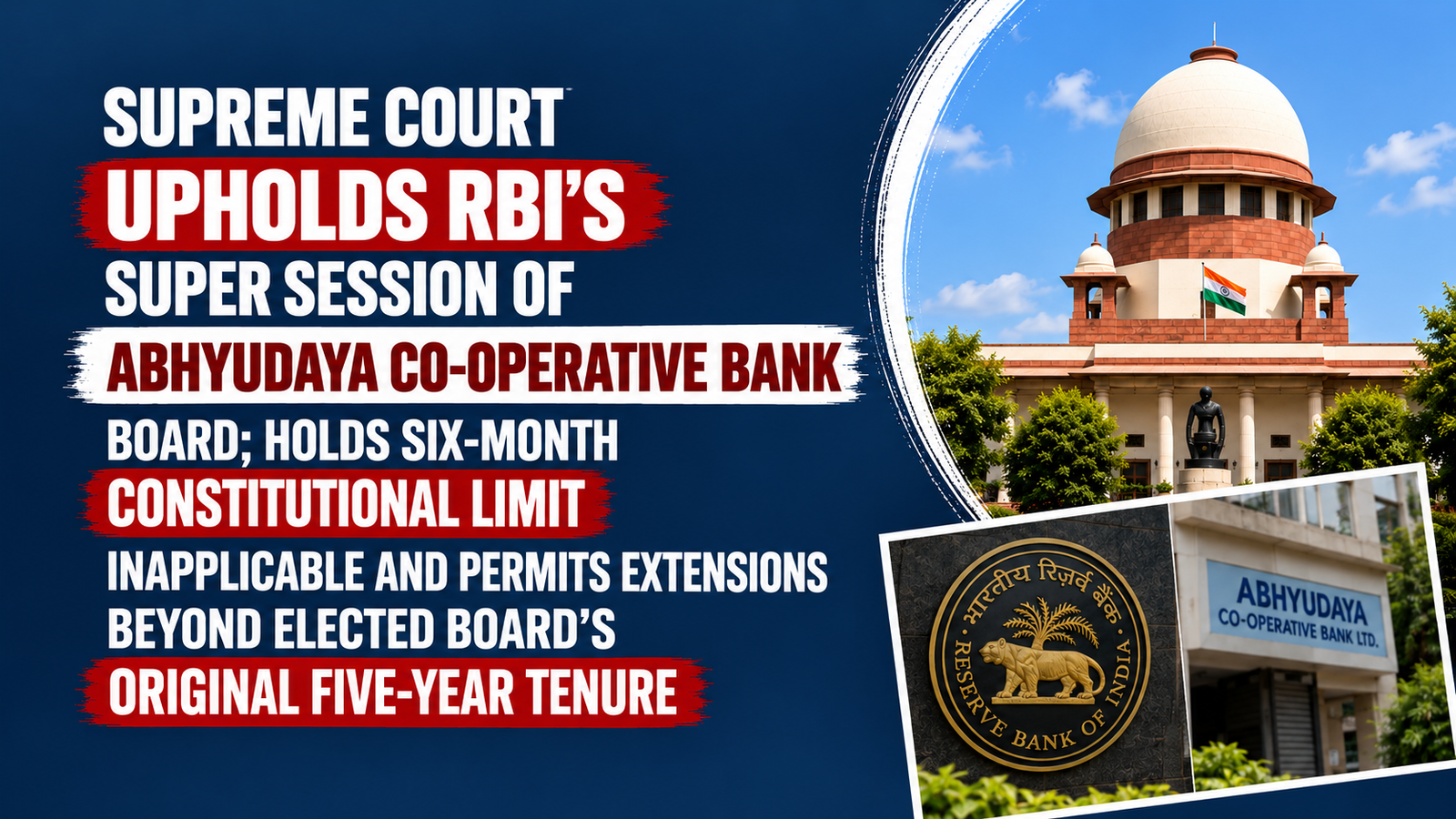
Supreme Court Protects RBI’s Regulatory Authority Over Distressed Co-operative Banks; Holds Democratic Governance Cannot Create Supervisory Vacuum Endangering Depositors and Banking Stability
Facts
Abhyudaya Co-operative Bank was initially registered under the Maharashtra Co-operative Societies Act, 1960, became a bank in 1965, and was declared a Scheduled Bank in 1988. Following amalgamation with banks in Gujarat and Karnataka, it became a multi-State co-operative bank governed by the Banking Regulation Act, 1949.
The appellants were elected to its Board of Directors in May 2019 for a statutory five-year term. On 24 November 2023, RBI invoked Sections 36AAA(1) and (2), read with Section 56 of the Banking Regulation Act, and superseded the Board for one year, appointing an Administrator.
RBI cited three reasons: the Bank’s financial health had deteriorated to a dangerous level; supersession was necessary to protect depositors and prevent collapse; and professional management was required to restore the Bank’s financial health.
While the directors’ challenge was pending before the Bombay High Court, their elected term expired on 24 May 2024. RBI subsequently extended the supersession from 24 November 2024. The Bombay High Court upheld RBI’s action and dismissed the writ petitions. During the Supreme Court appeals, RBI passed a third order extending supersession from 24 November 2025.
Issues
The Supreme Court formulated two principal questions:
- Whether RBI’s power under Section 36AAA(1) of the Banking Regulation Act to supersede the Board of a multi-State co-operative bank is restricted by the six-month ceiling under Article 243ZL(1) of the Constitution.
- Whether supersession can be extended beyond the original elected tenure of the Board.
Appellants’ Arguments
The appellants contended that RBI could not extend supersession beyond the tenure of the elected Board. Once their five-year tenure expired, there was effectively no Board left to supersede, making RBI’s second and third extension orders legally unsustainable.
They further argued that successive supersession orders violated the democratic constitutional framework contained in Articles 243ZL and 243ZT, and that the six-month limitation under Article 243ZL continued to apply to multi-State co-operative banks.
They also argued that consultation contemplated under the proviso to Section 36AAA(1) was mandatory and had admittedly not been undertaken.
RBI’s Arguments
RBI contended that Section 36AAA expressly permits supersession for an aggregate period of up to five years and that the original tenure of the superseded Board has no bearing on the duration of regulatory intervention.
RBI argued that the third proviso to Article 243ZL(1) specifically preserves the application of the Banking Regulation Act to co-operative societies engaged in banking.
It further submitted that consultation under Section 36AAA(1) applies to a co-operative bank registered with the Registrar of Co-operative Societies of a State and not to a multi-State co-operative bank such as Abhyudaya Bank.
Analysis of the Law
1. Article 243ZL Does Not Restrict RBI to Six Months
Article 243ZL ordinarily provides that a co-operative society’s Board cannot remain superseded or suspended for more than six months.
However, the third proviso specifically provides that where a co-operative society carries on the business of banking, the Banking Regulation Act, 1949 “shall also apply.”
Section 36AAA of the Banking Regulation Act empowers RBI, for recorded reasons and in the public interest, depositor interest or proper management of the bank, to supersede a co-operative bank’s Board for a period that may be extended from time to time, subject to an aggregate ceiling of five years.
The Supreme Court interpreted “shall also apply” as additive and non-restrictive. It held that the third proviso effectively incorporates the Banking Regulation Act into the constitutional framework applicable to multi-State co-operative banks.
The Court went further and characterised the third proviso as an independent substantive provision, rather than merely an exception restricting Article 243ZL.
Accordingly, RBI’s Section 36AAA power is not confined to six months.
2. Depositor Protection Overrides an Artificially Truncated Regulatory Period
The Court emphasised the distinctive public-interest character of banking. Banks hold the savings and often the life earnings of depositors, requiring specialised regulatory supervision by RBI.
Section 36AAA therefore enables RBI to intervene where a bank’s management threatens depositors, financial stability or proper management.
The Court held that limiting RBI’s regulatory intervention to six months could create a supervisory vacuum and prevent RBI from having sufficient time to restore a distressed bank to financial health. The constitutional provision should therefore be construed consistently with depositor protection and financial discipline.
3. Supersession Can Continue Beyond the Elected Board’s Original Tenure
The appellants’ Board term expired on 24 May 2024. However, Section 36AAA permits an existing supersession order to be extended from time to time, subject to the five-year aggregate ceiling.
The Court held that once the Board is validly superseded, its powers vest in the Administrator. Under Section 36AAA(7), the Administrator must call a general meeting to elect new directors upon expiry of the supersession period specified by RBI, not merely upon expiry of the superseded directors’ original tenure.
Therefore, the tenure of the erstwhile Board becomes irrelevant to the continuation of a valid supersession.
The Court expressly held that an order under Section 36AAA can be extended beyond the term for which the original Board was elected.
4. No Consultation With State Government Required
The Court rejected the consultation argument.
The proviso to Section 36AAA(1) requires consultation only where the co-operative bank is registered with the Registrar of Co-operative Societies of a State.
Abhyudaya Bank was admittedly a multi-State co-operative bank, and therefore that consultation requirement did not apply.
Precedent Analysis
Union of India v. Rajendra N. Shah
The decision was relevant to the constitutional status and operation of Part IXB. The Court noted that Part IXB survives constitutionally in relation to multi-State co-operative societies.
Pandurang Ganpati Chaugule v. Vishwasrao Patil Murgud Sahakari Bank Ltd.
This Constitution Bench precedent was particularly significant. Although it dealt with SARFAESI, the Supreme Court noted that paragraph 94 specifically recognised that the Banking Regulation Act applies to multi-State co-operative societies engaged in banking.
The appellants’ attempt to distinguish it was therefore rejected.
Kishansing Tomar v. Municipal Corporation of Ahmedabad
Relied upon by the appellants in support of the constitutional importance of timely democratic elections. However, the Court ultimately held that the specialised Banking Regulation Act regime applicable to multi-State co-operative banks governed the supersession period.
Statutory Interpretation Authorities
The Court relied upon principles concerning incorporation by reference and the function of provisos, including Mary Roy v. State of Kerala, Ram Sarup v. Munshi, State of Rajasthan v. Leela Jain, DMRC v. Tarun Pal Singh and S. Sundaram Pillai v. V.R. Pattabiraman.
Court’s Reasoning
The judgment reconciles two competing considerations: democratic governance of co-operative societies and RBI’s specialised responsibility for depositor protection and banking stability.
The Court held that Parliament itself resolved that tension through the third proviso to Article 243ZL by expressly preserving application of the Banking Regulation Act to co-operative societies carrying on banking business.
Consequently:
- the six-month constitutional ceiling does not restrict RBI’s Section 36AAA power for multi-State co-operative banks;
- RBI can extend supersession from time to time up to an aggregate maximum of five years;
- expiry of the original Board’s elected tenure does not terminate a valid supersession; and
- elections become necessary upon expiration of the RBI-specified supersession period, subject to the statutory five-year outer limit.
Conclusion
The Supreme Court found no infirmity in the Bombay High Court’s judgment and dismissed the appeals without costs.
The ruling therefore confirms RBI’s authority to maintain an Administrator over a multi-State co-operative bank beyond the six-month period in Article 243ZL and even beyond the original elected Board’s tenure, provided the aggregate supersession remains within the five-year statutory ceiling under Section 36AAA.
Case Details
Case: Sandeep S. Ghandat & Ors. v. Reserve Bank of India & Ors.
Citation: 2026 INSC 955
Court: Supreme Court of India
Case Number: Civil Appeal Nos. 5351–5352 of 2025
Bench: Justice Pamidighantam Sri Narasimha and Justice Alok Aradhe
Judgment by: Justice Alok Aradhe
Date: 3 September 2026
Result: Appeals dismissed; RBI’s supersession of Abhyudaya Co-operative Bank’s Board and its subsequent extensions upheld; no order as to costs.