Supreme Court Awards Widow ₹50.81 Lakh for Husband’s Fatal Car-Bus Accident; Rejects 50% Contributory Negligence and Holds KSRTC Bus Driver Solely Responsible for Crash

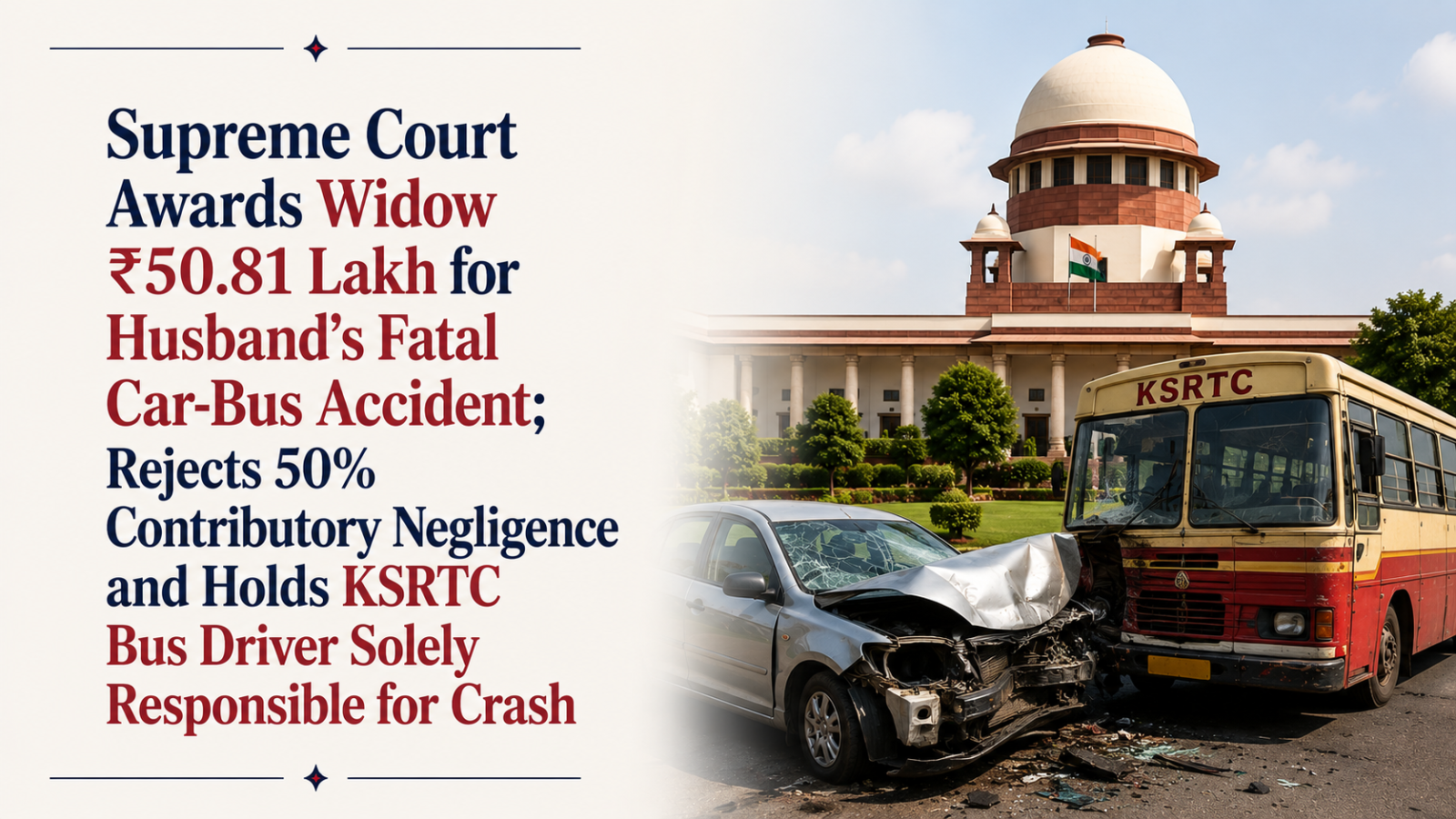
Supreme Court Awards Widow ₹50.81 Lakh in Fatal KSRTC Crash; Holds Motor Accident Negligence Must Be Decided on Preponderance of Probabilities, Not Criminal Standard
Facts
The case arose from a fatal road accident at about 1:20 a.m. on 14 October 2005 on NH-48 near Kunigal, Karnataka. A Hyundai Santro driven by Nandan Shet collided with a heavy passenger vehicle operated by the Karnataka State Road Transport Corporation (KSRTC). Nandan Shet, his mother Geetha Shet, and family friend Mahesh died in the accident, while Nandan’s wife, Reena, survived with injuries. Nandan was approximately 30 years old, a Mechanical Engineering graduate working in the software field and associated with Geetha Technologies.
Reena instituted separate motor accident claims for the death of her husband, the death of her mother-in-law, and her own injuries. The police had registered FIR No. 275 of 2005 and chargesheeted the KSRTC bus driver. He was subsequently acquitted by the criminal court by giving him the benefit of doubt.
The Motor Accident Claims Tribunal held that the accident occurred because of the rash and negligent driving of the KSRTC bus driver. However, because Reena herself was employed as an Associate Manager with Accenture, the Tribunal awarded no amount towards loss of dependency for her husband’s death and granted only ₹1.50 lakh under other heads.
On appeal, the Karnataka High Court assessed compensation for the husband’s death at ₹14,35,267 but attributed 50% contributory negligence to Nandan Shet, reducing the payable amount to ₹7,17,634 with 6% interest. It also reduced the amounts awarded in the claims concerning the mother-in-law’s death and Reena’s injuries.
Reena approached the Supreme Court.
Issues
The Supreme Court principally considered:
- Whether the High Court was justified in attributing 50% contributory negligence to deceased Nandan Shet.
- What evidentiary value should be given to the FIR, chargesheet and other police records in MACT proceedings.
- Whether the KSRTC bus driver’s criminal acquittal could affect the determination of civil negligence under the Motor Vehicles Act.
- Whether an accident-site sketch showing the post-collision position of vehicles could independently establish contributory negligence.
- Whether the additional evidence concerning Nandan Shet’s qualifications, business and earnings should have been accepted despite being produced belatedly.
- What constituted “just compensation” for his death and what income should realistically be attributed to him.
Appellant’s Arguments
Reena, appearing in person, challenged the High Court’s finding of 50% contributory negligence. She argued that the High Court had improperly excluded or diminished the significance of the FIR and chargesheet and relied excessively upon the accident-site sketch.
She relied upon the statement of the KSRTC bus conductor, who had been sitting beside the bus driver and whose version attributed the accident to rash and negligent driving of the bus. She argued that there was no credible evidence establishing negligence on her husband’s part.
On compensation, she contended that the amounts awarded were grossly inadequate. She sought consideration of additional documents relating to her husband’s educational qualifications, Geetha Technologies, invoices, banking records and other evidence showing his earning capacity.
She also sought appropriate compensation for her mother-in-law’s death and her own injuries.
Respondents’ Arguments
KSRTC argued that the High Court had correctly attributed contributory negligence and that the compensation already awarded was adequate.
It relied particularly upon the accident-site sketch and contended that Nandan Shet himself was responsible for the collision. It further argued that fixing even ₹20,000 per month as his notional income was generous because there was insufficient documentary evidence supporting the claim that he earned ₹1 lakh to ₹1.5 lakh per month.
The insurer supported the finding of contributory negligence and disputed its liability, including on the ground that the deceased was allegedly not covered under the insurance policy. The Supreme Court, however, found the insurer’s objections to exoneration untenable.
Analysis of the Law
The Supreme Court reiterated that motor accident claims are governed by the civil standard of preponderance of probabilities, not the criminal standard of proof beyond reasonable doubt.
It identified four important principles:
- A police chargesheet creates a prima facie case concerning negligence.
- An acquittal in criminal proceedings does not displace prima facie civil liability.
- A scene sketch depicting the vehicles’ post-impact positions cannot, without adequate supporting evidence, establish contributory negligence.
- A High Court cannot overturn a reasoned MACT finding without properly marshalling the entire oral and documentary evidence under the applicable civil standard.
The Court stressed that criminal culpability and civil negligence are distinct inquiries. An acquittal under criminal law cannot dictate the outcome of a compensation proceeding under the Motor Vehicles Act because the standards of proof materially differ.
Precedent Analysis
The Supreme Court relied upon ICICI Lombard General Insurance Co. Ltd. v. Rajani Sahoo & Ors. for the evidentiary relevance of police investigation records, including FIRs and chargesheets, in MACT proceedings.
It referred to Mathew Alexander v. Mohd. Shafi & Anr. to reinforce the distinction between criminal proceedings and motor accident compensation proceedings and the different standards governing them.
The Court relied upon Sunita v. Rajasthan State Road Transport Corporation and Mangla Ram v. Oriental Insurance Co. Ltd. in considering the evidentiary limitations of accident-site sketches and post-impact vehicle positions. A lighter vehicle may be pushed or dragged by a heavier vehicle after impact; therefore, its final position cannot automatically establish that it was being driven on the wrong side of the road.
It also referred to Geeta Dubey v. United India Insurance Co. Ltd., reiterating that Section 166 claims are determined on the touchstone of preponderance of probabilities and that an appellate court must properly assess the complete evidentiary record before reversing the Tribunal.
Court’s Reasoning
The Supreme Court found that the High Court had committed a fundamental error in treating the bus driver’s criminal acquittal as an “honourable acquittal.” In fact, he had been acquitted merely by receiving the benefit of doubt.
The High Court had also failed to adequately consider the claimant’s eyewitness evidence, the FIR and chargesheet against the KSRTC driver, the circumstances of the road curve and KSRTC’s failure to examine its bus conductor, Suresh, despite his presence beside the driver during the accident.
Most importantly, the Court held that the High Court had incorrectly inferred negligence from the Santro’s position in the site sketch. The relevant consideration was the point of impact, not merely where the vehicles ultimately came to rest after being dragged following the collision.
The Supreme Court therefore set aside the finding of contributory negligence and restored the Tribunal’s finding that the accident occurred solely because of the rash and negligent driving of the KSRTC bus driver.
Additional Evidence and Compensation
The Court also disagreed with the High Court’s refusal to accept Reena’s additional evidence merely because it was produced belatedly.
It noted that she had married Nandan only about three months before the accident and had suffered severe personal trauma. The litigation had continued for approximately 21 years. Given the beneficial and welfare-oriented character of the Motor Vehicles Act and the statutory requirement to award “just compensation,” the documents ought to have been received under Order XLI Rule 27(1)(b) CPC.
The additional evidence demonstrated that Nandan held a Mechanical Engineering degree, had software certifications in Oracle and Visual Basic, had worked in the software sector, and had transitioned towards operating an independent IT enterprise. Banking records, quotations, purchase orders and invoices corroborated his business activity.
The Court rejected both extremes: it did not accept the claimant’s assertion that Nandan earned ₹1 lakh–₹1.5 lakh per month, but equally found the High Court’s figure of ₹20,000 unrealistically low.
Considering his qualifications, software experience and entrepreneurial activities in Bangalore, the Supreme Court fixed his realistic monthly income at ₹70,000 as of October 2005.
As reflected in the compensation table on page 22 of the judgment, the Court calculated ₹50,10,376 towards substantive loss to estate, ₹52,000 for spousal consortium and ₹19,500 for funeral and transportation expenses, producing total compensation of ₹50,81,876.
Conclusion
The Supreme Court rejected the High Court’s finding of 50% contributory negligence and restored the Tribunal’s finding that the KSRTC bus driver was solely responsible for the accident.
In the principal appeal concerning Nandan Shet’s death, the Court enhanced the compensation to ₹50,81,876, together with 6% interest per annum from the date of filing the claim petition until realisation.
The connected appeals relating to the mother-in-law’s death and Reena’s injuries were disposed of by removing the apportionment of liability and making the amounts exclusively payable by KSRTC.
Case Details
Case: Reena v. The Managing Director, Karnataka State Road Transport Corporation & Others
Court: Supreme Court of India
Case Number: Civil Appeal Nos. 10755–10758 of 2026; 2026 INSC 889
Judge: Justice S.V.N. Bhatti and Justice N.V. Anjaria; judgment authored by Justice S.V.N. Bhatti
Date: 19 August 2026
Result: Appeals partly/fully allowed as specified; 50% contributory negligence set aside; KSRTC bus driver held solely negligent; ₹50,81,876 awarded for husband’s death with 6% interest; liability in connected claims made exclusively payable by KSRTC.