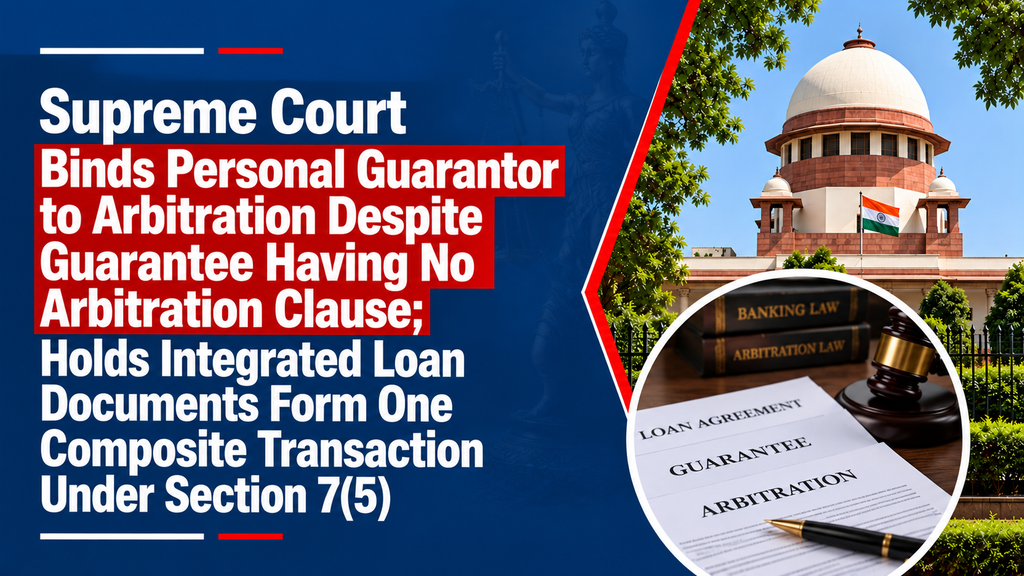
Supreme Court Binds Personal Guarantor to Arbitration Despite Guarantee Having No Arbitration Clause; Holds Integrated Loan Documents Form One Composite Transaction Under Section 7(5)

Personal Guarantee Need Not Contain Separate Arbitration Clause: Supreme Court Holds Loan Agreement’s Arbitration Clause Binding Where Guarantee Is Expressly Integrated
Facts
The National Skill Development Corporation (“NSDC”), a not-for-profit company providing financial assistance for skill training, was the implementing agency for establishing Pradhan Mantri Kaushal Kendras (PMKKs) across India. Pursuant to its Request for Proposal dated 29 July 2016, Surya Wires Private Limited and Disha Education Society were allotted districts for jointly establishing Model Training Centres.
On 20 December 2016, the parties executed a cluster of interconnected documents, including a Service Level Agreement, a Loan Agreement for ₹7,17,63,197, and several Facility Agreements. Respondent No. 2, the Managing Director/Authorised Representative of Surya Wires, executed a Personal Guarantee on 27 December 2016. A second materially identical set of agreements was executed on 18 August 2017 for an additional loan of ₹2,13,83,194, along with another Personal Guarantee by Respondent No. 2.
Following repayment defaults, NSDC issued loan recall notices on 29 October 2021. It subsequently commenced arbitration before the Indian Council of Arbitration on 21 June 2022 for recovery of amounts due under the two Loan Agreements.
Respondent Nos. 2, 3, 5 and 7 invoked Section 16 of the Arbitration and Conciliation Act, 1996, contending that they were not personally signatories to the Loan Agreements. The Sole Arbitrator accepted their objection and directed their deletion from the arbitral proceedings.
NSDC challenged the deletion of Respondent No. 2 before the Delhi High Court. The High Court upheld the Arbitrator’s decision, principally because the Personal Guarantees themselves contained no arbitration clause and there was no sufficient incorporation of the arbitration clause contained in the Loan Agreements.
NSDC consequently approached the Supreme Court.
Issues
The central question was:
Where parties structure a single commercial transaction through several interconnected agreements, can an arbitration clause contained in one agreement bind a party under another expressly integrated agreement that does not independently contain an arbitration clause?
More specifically, the Court had to determine whether the arbitration clause in the Loan Agreements stood incorporated into Respondent No. 2’s Personal Guarantees under Section 7(5) of the Arbitration and Conciliation Act, 1996.
Petitioner/Appellant’s Arguments
NSDC argued that Clause 11.2 of the Loan Agreements, when read with their definitions, schedules and other contractual provisions, demonstrated that the arbitration clause was incorporated into the Personal Guarantees.
The Personal Guarantees were not independent collateral transactions. Rather, they were expressly defined as “Facility Agreements” and constituted mandatory pre-disbursement conditions under the Loan Agreements.
Accordingly, where the Personal Guarantee was expressly made an integral part of the Loan Agreement, Section 7(5) operated to incorporate the arbitration clause into the guarantee. NSDC contended that the High Court had adopted an excessively technical and restrictive interpretation of Section 7(5).
NSDC relied, inter alia, upon M.R. Engineers and Contractors Pvt. Ltd. v. Som Datt Builders Ltd., Inox Wind Ltd. v. Thermocables Ltd. and Cox and Kings Ltd. v. SAP India Pvt. Ltd.
Respondent’s Arguments
Respondent No. 2 argued that only four of the seven instruments executed between the parties contained arbitration clauses and that the Loan Agreements’ arbitration clause had never been incorporated into the Personal Guarantees.
He contended that the matter involved distinct contracts and parties rather than a standard-form contractual arrangement. While accepting that a non-signatory could in an appropriate case be bound by arbitration, he argued that the necessary mutual intention had to emerge from the contractual language and could not simply be presumed from commercial proximity.
Reliance was placed upon, among others, S.N. Prasad v. Monnet Finance Ltd., NBCC (India) Ltd. v. Zillion Infraprojects Pvt. Ltd. and Adavya Projects Pvt. Ltd. v. Vishal Structures Pvt. Ltd.
Analysis of the Law
The Supreme Court examined Section 7(5), which provides that a contractual reference to another document containing an arbitration clause can constitute an arbitration agreement where the reference is such as to make the arbitration clause part of the contract.
Referring to M.R. Engineers, the Court reiterated that incorporation ordinarily requires:
- a clear reference to the document containing the arbitration clause;
- an intention to incorporate that clause; and
- an arbitration clause capable of application to disputes arising under the relevant contract.
The Court also considered the Constitution Bench judgment in Cox and Kings, which recognises that Section 7 does not necessarily prevent non-signatories from being bound by an arbitration agreement. In a composite transaction involving multiple agreements, courts and tribunals must examine whether the agreements are consequential or follow-up agreements to the principal contract.
The Supreme Court stressed that modern arbitration must accommodate the commercial reality of complex multi-party and multi-contract transactions, while continuing to respect the foundational requirements of consent and party autonomy.
Precedent Analysis
M.R. Engineers v. Som Datt Builders
The judgment provided the foundational test governing incorporation of arbitration agreements by reference under Section 7(5). A mere general reference to another contract will ordinarily not incorporate its arbitration clause; the contractual arrangement must demonstrate the requisite intention.
Inox Wind Ltd. v. Thermocables Ltd.
The Court noted the distinction between a general reference to an earlier contract and a reference to standard-form terms. A general reference to an earlier contract ordinarily does not suffice, whereas reference to standard-form conditions can incorporate the arbitration provision contained therein.
Cox and Kings Ltd. v. SAP India Pvt. Ltd.
The Constitution Bench recognised that “parties” under Sections 2(1)(h) and 7 can encompass signatories as well as non-signatories. The conduct of a non-signatory and the overall structure of a composite transaction may demonstrate consent to arbitration.
Ajay Madhusudan Patel v. Jyotrindra S. Patel
The Court reiterated that the intention of a non-signatory to be bound can be assessed from surrounding circumstances, including its participation in the negotiation, performance and termination of the underlying contract.
ASF Buildtech v. Shapoorji Pallonji
The Court relied upon the principle that arbitration law must remain responsive to modern commercial arrangements involving multiple parties and contracts without compromising consent and party autonomy.
Court’s Reasoning
The decisive factor was the contractual architecture created by the parties.
The Loan Agreements expressly defined “Facility Agreements/Facility Documents” to include agreements, instruments, undertakings and deeds executed in connection with the project. Schedule IV specifically identified Personal Guarantees as Facility Agreements.
Further, Clause 12.1 stipulated that the Facility Agreements would be deemed part of the Loan Agreement as though their provisions had been set out in the agreement itself.
The Supreme Court therefore found that the Personal Guarantees were not independent or severable collateral contracts. They were expressly made an “integral and inseparable part” of the Loan Agreements and brought within the same legal and arbitral framework.
The conclusion was reinforced by the fact that execution of the Facility Agreements was a pre-disbursement condition. The Loan Agreements and Personal Guarantees were executed contemporaneously and were designed to operate as components of one composite commercial transaction. The Court therefore found the intention to integrate the Personal Guarantees into the Loan Agreements to be explicit rather than merely inferential.
Significantly, Respondent No. 2’s failure to sign the Loan Agreements in his personal capacity was held not to be decisive. He had personally furnished the guarantees as a condition precedent to the loans, and the guarantees could not remain integrated with the Loan Agreements for determining liability while simultaneously being severed from them solely for dispute resolution.
Conclusion
The Supreme Court held that the arbitration clause contained in Clause 11.2 of the Loan Agreements was incorporated into the Personal Guarantees under Section 7(5) of the Arbitration and Conciliation Act, 1996.
Respondent No. 2 was therefore bound to submit to arbitration concerning disputes arising from those guarantees.
The Court consequently quashed and set aside both:
- the Delhi High Court judgment dated 28 January 2026; and
- the Sole Arbitrator’s order dated 23 October 2024,
insofar as they permitted Respondent No. 2’s deletion from the arbitration.
The appeal was allowed, with no order as to costs.
Case Details
Case: National Skill Development Corporation v. Surya Wires Private Limited & Ors.
Court: Supreme Court of India
Case Number: 2026 INSC 977; Civil Appeal arising out of SLP (C) No. 10030 of 2026
Judge: Justice Pamidighantam Sri Narasimha and Justice Alok Aradhe
Date: 8 September 2026
Result: Appeal allowed; Personal Guarantor held bound by arbitration; Delhi High Court judgment and Sole Arbitrator’s Section 16 order set aside insofar as they deleted Respondent No. 2 from the arbitral proceedings