Supreme Court Cancels Nigerian Accused’s Bail in 5-Kg Heroin Case After He Absconds; Issues Nationwide Surety Verification Rules for Foreigners Facing Commercial NDPS Charges

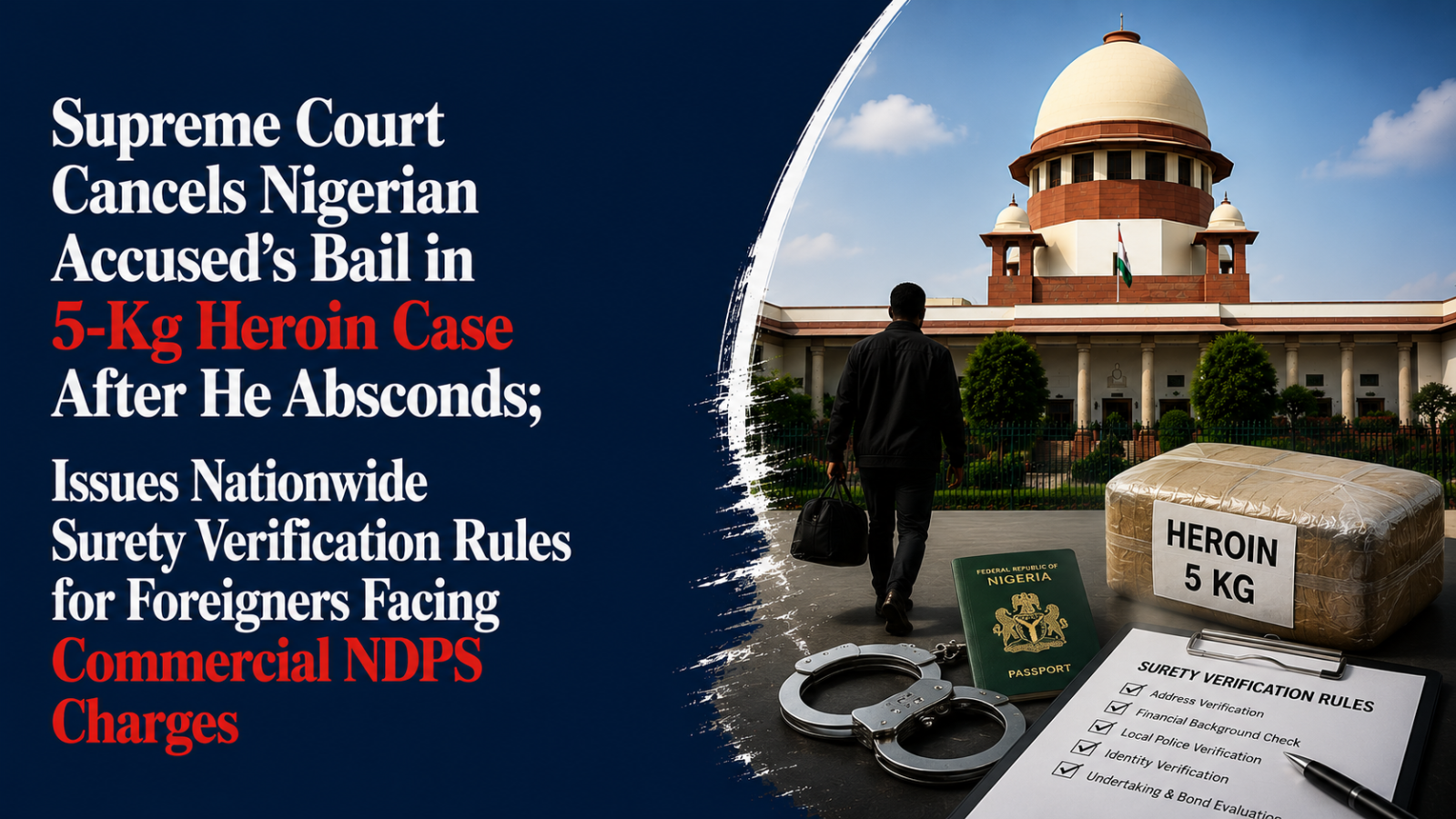
Supreme Court Cancels Nigerian Accused’s Bail in 5-Kg Heroin Case After He Absconds; Issues Nationwide Surety Verification Rules for Foreigners Facing Commercial NDPS Charges
Facts
The respondent, Chidiebere Kingsley Nawchara, was arrested on 16 March 2023 after approximately 4,935 grams of heroin was recovered from Damodar Surya Rama Prasad Dubey at Chhatrapati Shivaji Maharaj International Airport, Mumbai, on his return from Addis Ababa. The prosecution alleged that the consignment was ultimately intended to reach the respondent through Hekatoli Sumi.
The charge-sheet relied not merely upon statements of co-accused but also upon forensic material recovered from WhatsApp chats. The chats allegedly showed that the respondent had shared Dubey’s photograph, contact details and address with Sumi and instructed her to collect the drug consignment.
The Special NDPS Court at Greater Mumbai rejected his bail application on 12 September 2024, noting allegations that he was the mastermind of the trafficking operation, had a previous NDPS conviction, allegedly committed the present offence after being released on bail in that earlier case, and was linked to an international drug trafficking syndicate.
The Bombay High Court subsequently granted him regular bail on 5 May 2025, principally relying upon the absence of recovery directly from him, Tofan Singh, the character of the co-accused statements and his incarceration of more than two years.
After his release, however, the respondent became untraceable. A Look Out Notice was issued, and the Supreme Court directed Maharashtra authorities to secure his arrest.
Investigation into his bail surety revealed a still more serious problem: the surety’s residential address was non-existent, the purported employer stated that no such person had ever worked there, and the bank account details supplied by the surety also proved false. This prompted the Supreme Court to expand the proceedings into a broader examination of fake sureties and bail safeguards, particularly for foreign nationals charged under the NDPS Act.
Issues
The principal issues were:
- Whether the Bombay High Court was justified in granting bail to the respondent in a commercial-quantity NDPS case without recording the satisfaction mandated by Section 37(1)(b)(ii) of the NDPS Act.
- Whether long incarceration by itself could justify bail despite the respondent’s prior NDPS conviction, alleged repeat offending and the substantial quantity of heroin involved.
- Whether the respondent’s subsequent absconding warranted cancellation of bail.
- How courts should approach bail applications by foreign nationals accused of offences involving commercial quantities under the NDPS Act.
- What safeguards were necessary to prevent the use of fake or non-existent sureties.
- Whether a uniform verification framework, central database and digital system were required for accused persons and sureties in such cases.
Petitioner’s/Appellant’s Arguments
The Union of India challenged the Bombay High Court’s order granting bail.
Its principal contention was that the High Court had not satisfied the statutory twin conditions under Section 37 NDPS Act. In a commercial-quantity case, the Court must have reasonable grounds for believing both that the accused is not guilty and that he is unlikely to commit an offence while on bail.
The Union emphasised the respondent’s previous NDPS conviction, the allegation that he committed the present offence while already on bail in the earlier narcotics case, the approximately five-kilogram heroin quantity, his alleged role in an international syndicate and incriminating WhatsApp material.
It further relied upon the respondent’s conduct after release: he became untraceable despite the bail conditions and could not be apprehended even after a Look Out Notice was issued.
The Union and enforcement agencies also placed extensive suggestions before the Court concerning passports, FRRO registration, physical verification of addresses and sureties, databases, financial disclosures and mechanisms to prevent foreign accused from absconding.
Respondent’s Arguments
The respondent had relied before the High Court upon the fact that no narcotic substance was directly recovered from him.
His case was that the prosecution primarily rested upon statements of co-accused, attracting the principle in Tofan Singh v. State of Tamil Nadu, and that the WhatsApp material did not sufficiently establish the required live link for continued incarceration.
He also relied upon having undergone more than two years of custody, while commencement and completion of the trial were said to be unlikely within the immediate future.
The broader legal position advanced in support of bail was that constitutional protection under Article 21, including the right to speedy trial, remains applicable even under special statutes.
Analysis of the Law
The Supreme Court undertook an extensive examination of bail under special criminal statutes including the PMLA, UAPA and NDPS Act.
It reiterated that the general principle of “bail is the rule” cannot be mechanically transplanted into special statutory regimes without respecting the specific restrictions enacted by Parliament.
For commercial-quantity NDPS offences, Section 37 requires the Court to be satisfied that there are reasonable grounds for believing that the accused is not guilty and not likely to commit any offence while on bail.
At the same time, these requirements do not altogether extinguish Article 21. The Court recognised that constitutional considerations such as prolonged incarceration and delayed trials may remain relevant, but they must operate within the framework of the special statute, not by ignoring or overriding Section 37.
The Supreme Court observed that the Bombay High Court did not explain how it reached the conclusion that there were reasonable grounds for believing that the respondent was not guilty. Nor did it discuss whether he was unlikely to commit another offence.
The respondent’s prior conviction was especially material because the present offence was allegedly committed after he had already obtained bail in another NDPS matter.
Precedent Analysis
The Court surveyed a substantial body of bail jurisprudence.
It referred to Mohd. Muslim v. State (NCT of Delhi) for the proposition that the Section 37 satisfaction is prima facie and does not require a meticulous trial-level examination of evidence. At the same time, the statutory conditions cannot simply be bypassed.
The Court relied on State of Punjab v. Sukhwinder Singh, which held that although the right to speedy trial under Article 21 is fundamental, in commercial-quantity NDPS matters it must be harmoniously applied with Section 37. Delay alone cannot override the statutory twin conditions.
The judgment also discussed Tofan Singh, but distinguished the proposition concerning inadmissibility of Section 67 statements from other independent material available at the bail stage, including forensic WhatsApp evidence.
The Court further discussed precedents concerning bail generally, Article 21, foreign nationals and surety requirements, while stressing that bail conditions must remain reasonable, proportionate and capable of compliance.
Court’s Reasoning
The Supreme Court found several deficiencies in the High Court’s approach.
First, the High Court had failed to adequately address the respondent’s prior NDPS conviction and the allegation that the present offence had been committed while he was already on bail for a similar offence.
Second, while long incarceration could be relevant under Article 21, the respondent had been in custody for approximately two and a half years in a case involving nearly 5 kg of heroin, with allegations of repeat trafficking. The Court held that these circumstances required a much greater degree of scrutiny before bail could be granted.
Third, because the respondent had a previous NDPS conviction, the Court examined Section 31A. The judgment noted that approximately 5 kg of heroin was involved, while the relevant statutory threshold referred to for heroin was 1 kg. The possible penal consequences therefore materially affected the bail assessment.
Fourth, the Court held that the statutory undertrial-release protections under Section 436A CrPC/Section 479 BNSS did not assist the respondent in the circumstances considered by the Court.
Most decisively, after being released, the respondent could not be traced despite a Look Out Notice and efforts by the authorities. The Supreme Court stated plainly that “he jumped the bail.” Consequently, the matter had ceased to be merely an appeal against grant of bail and had become one for cancellation because the bail conditions themselves had been violated. The Court therefore cancelled the bail granted by the Bombay High Court.
The discovery that the surety was fake then led the Court to address the systemic problem of unreliable sureties.
Conclusion
The Supreme Court cancelled the bail granted to Chidiebere Kingsley Nawchara after finding that he had violated the conditions of release and absconded.
Beyond the individual case, the Court issued extensive directions applicable where:
- the accused is a foreign national; and
- the case involves commercial quantity under the NDPS Act.
The principal directions include:
- The foreign accused’s passport must be deposited with the jurisdictional Court, which may restrict international travel without prior permission.
- The accused must register with the FRRO within one week of release.
- Ordinarily, two sureties of like amount must be furnished, subject to relaxation by a reasoned judicial order where securing two sureties is genuinely difficult.
- Sureties must be verified within three days and before release.
- The accused’s residential address and Indian contact information must also be physically re-verified within three days before release.
- The accused must disclose his or her source of income/funds and Indian bank accounts.
- The Investigating Officer must inform the accused’s Embassy about the alleged offence.
- The Ministry of Law and Justice and NIC must establish a centralised database containing particulars of foreign NDPS accused and persons standing surety for them.
- Officials responsible for verification may face a departmental inquiry if a supposedly verified surety is later found fake.
- A lien/charge equal to the surety amount must be created on the surety’s property, capable of realisation where appropriate.
- High Courts must take steps through their IT Committees to create digital portals for speedy authentication of property and financial documents.
- A new Form 47A is to be inserted after Form 47 under the BNSS framework.
The appeal was ultimately disposed of in these terms.
Case Details
Case: Union of India v. Chidiebere Kingsley Nawchara & Ors.
Court: Supreme Court of India
Case Number: Criminal Appeal arising out of SLP (Crl.) No. 14185 of 2025; 2026 INSC 870
Judge: Justice Sanjay Karol and Justice Augustine George Masih
Date: 17 August 2026
Result: Bail granted to the respondent cancelled after he absconded; Supreme Court issued nationwide directions governing bail, surety verification and monitoring of foreign nationals accused in commercial-quantity NDPS cases