Supreme Court Refers Arbitration Pre-Deposit Validity to Larger Bench; Questions 10% Contractor-Only Security Clause Under Article 14, Section 18 and Right to Sue

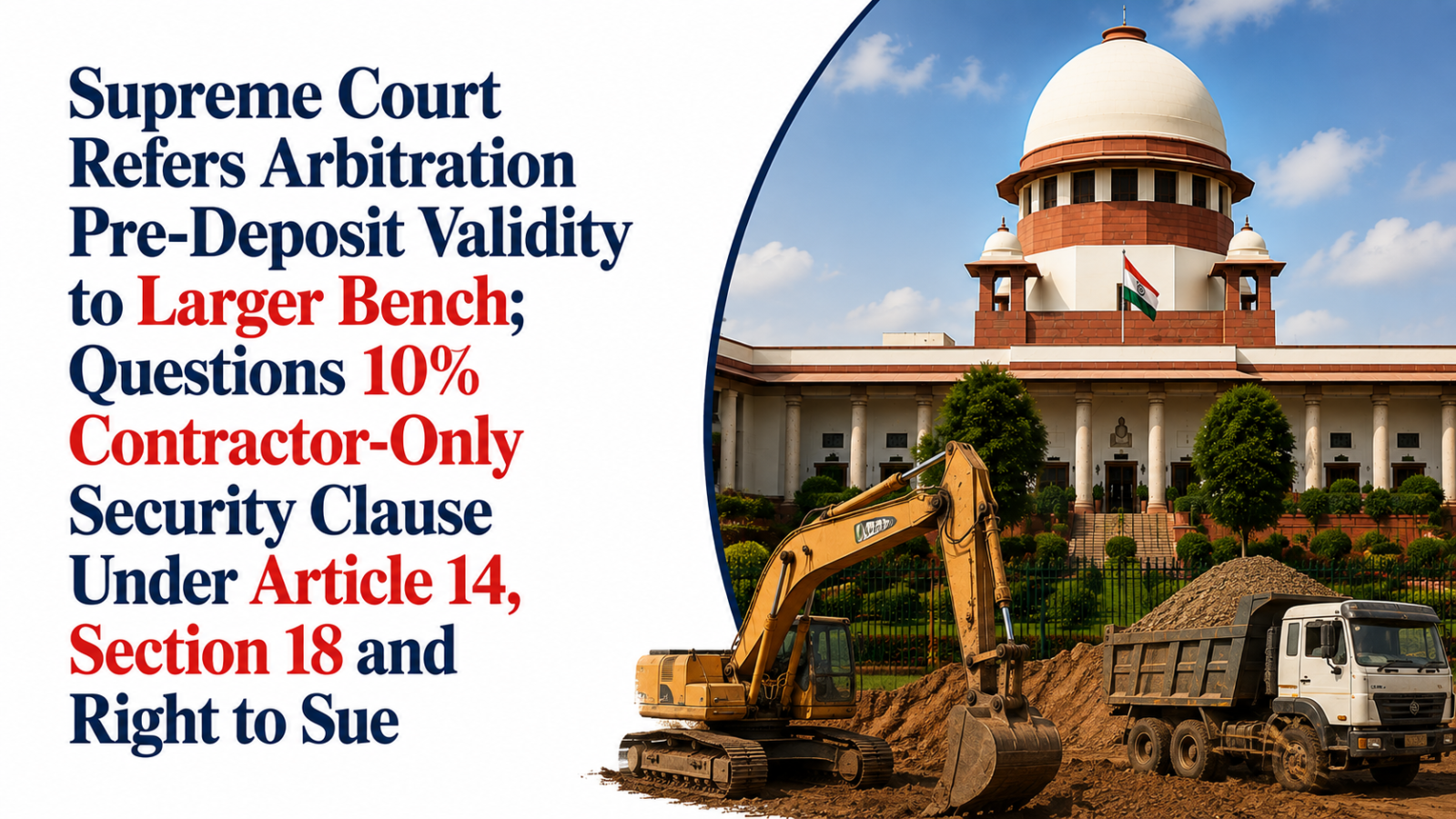
Supreme Court Refers 10% Arbitration Pre-Deposit Clause to Larger Bench; Questions Whether Contractor-Only Security Requirement Unfairly Restricts Access to Arbitration
Facts
The respondent, Haryana State Industrial and Infrastructure Development Corporation Ltd., invited e-tenders on 7 November 2016 for execution of storm-water drainage systems and contingent works at Sector 35, Udyog Vihar, Phase VII, Gurugram. The appellant, M/s Santosh Associate Private Limited, was awarded the contract on 17 May 2017 for ₹5,14,11,635.
The contract contained Clause 25-A(vii), under which a contractor invoking arbitration was required to furnish a security deposit before the reference could be maintained. For claims of ₹1 lakh and above, the required deposit was 10% of the claim amount. The deposit was refundable after adjustment of costs, if any, awarded against the claimant.
During execution, site-related difficulties resulted in a substantial reduction in the scope of work, and the contract value was revised to ₹2,40,93,059 in January 2021. Disputes subsequently arose concerning final settlement of payments.
On 8 August 2024, the Punjab and Haryana High Court appointed Justice (Retd.) Surender Gupta as Sole Arbitrator under Section 11(6) of the Arbitration and Conciliation Act, 1996.
The respondent thereafter filed an application under Section 16, contending that the arbitration reference was not maintainable because the appellant had failed to deposit 10% of its claim amount. The Sole Arbitrator accepted the objection and directed the appellant to make the deposit within 15 days. When the appellant refused, its entire claim was dismissed.
The Commercial Court, Gurugram dismissed the appellant’s appeal under Section 37(2), holding that the Arbitrator’s view was plausible and supported by S.K. Jain v. State of Haryana.
The appellant therefore approached the Supreme Court.
Issues
The central issue was whether an arbitration clause requiring only the contractor to make a substantial pre-deposit before invoking arbitration is legally valid.
More specifically, the Court considered:
- Whether a contractor-only pre-deposit requirement violates Section 18 of the Arbitration Act, which mandates equal treatment of parties.
- Whether such pre-deposit clauses discourage arbitration and undermine the objective of alternative dispute resolution.
- Whether a substantial pre-deposit violates Article 14, the right to sue and Section 28 of the Indian Contract Act, 1872.
- Whether pre-deposit has any rational nexus with preventing frivolous claims.
- Whether the clause remains valid merely because the deposit is refundable.
- Whether S.K. Jain v. State of Haryana continues to remain a valid and binding precedent.
Petitioner’s/Appellant’s Arguments
The appellant argued that Clause 25-A(vii) was unconstitutional and violated Article 14 because the contractor alone was required to furnish the security deposit while the State entity was subjected to no corresponding obligation.
It was argued that the 10% deposit had no rational nexus with preventing frivolous claims because frivolousness had not yet been determined at the stage when arbitration was invoked. Any abuse could instead be dealt with through an award of costs under Section 31(8).
For its claim of approximately ₹1.77 crore, the appellant would have been required to deposit ₹17.70 lakh. It pointed out that this amount substantially exceeded the ad valorem court fee of approximately ₹7.16 lakh that would have been payable had the same dispute been filed as a civil suit in Haryana.
The appellant further contended that S.K. Jain did not resolve the Article 14 issue and should be treated as sub silentio on that question.
Reliance was placed upon ICOMM Tele Ltd. v. Punjab State Water Supply, Lombardi Engineering Ltd. v. Uttarakhand Jal Vidyut Nigam Ltd., and the Constitution Bench decision in CORE v. ECI-SPIC-SMO-MCML (JV) to argue that party autonomy cannot validate contractual provisions offending constitutional guarantees of fairness and equality.
Respondent’s Arguments
HSIIDC contended that S.K. Jain remained binding, particularly because it was a three-Judge Bench decision.
According to the respondent, S.K. Jain had expressly upheld refundable pre-deposit clauses as a legitimate mechanism for discouraging frivolous or inflated claims.
The respondent sought to distinguish ICOMM Tele on the basis that the clause there involved forfeiture of a portion of the deposit depending on the result of arbitration, whereas the present clause was essentially refundable after adjustment of costs.
It argued that Lombardi Engineering itself recognised that S.K. Jain and ICOMM Tele dealt with materially different clauses and therefore did not overrule S.K. Jain.
Accordingly, the respondent maintained that the Arbitrator and Commercial Court had correctly applied the binding precedent.
Analysis of the Law
The Supreme Court first examined the apparently competing lines of precedent.
In S.K. Jain, a three-Judge Bench had upheld a contractor-only pre-deposit requirement, holding that a security deposit proportionate to the amount claimed acted as a balancing mechanism against frivolous and inflated claims. The present Bench observed that it was prima facie difficult to accept the proposition that Article 14 had never been considered there.
However, ICOMM Tele, decided by a two-Judge Bench, held that mandatory pre-deposit before arbitration could discourage ADR and defeat the objective of declogging courts. It also found that requiring 10% of the claim before any determination of frivolousness lacked a rational nexus with preventing frivolous claims.
In Lombardi Engineering, a three-Judge Bench held that party autonomy cannot extend to contractual provisions violating fundamental rights, but simultaneously held that S.K. Jain and ICOMM Tele were not in conflict because the clauses concerned were materially different.
The Constitution Bench in CORE subsequently reaffirmed that Section 18 is mandatory and non-derogable and applies throughout the arbitration process. It also approvingly summarised ICOMM Tele and Lombardi on the proposition that excessive and disproportionate pre-deposit requirements could violate Article 14 and defeat the object of arbitration.
Precedent Analysis
The Court considered itself bound by judicial discipline.
Because S.K. Jain was decided by a three-Judge Bench, the present two-Judge Bench could not simply overrule it, even though it stated that it was prima facie in agreement with the reasoning in ICOMM Tele.
Further, Lombardi Engineering had expressly held that there was no conflict between S.K. Jain and ICOMM Tele, while neither Lombardi nor the Constitution Bench decision in CORE had declared S.K. Jain to be bad law.
The present Bench therefore held that it could not itself declare S.K. Jain to be sub silentio or no longer binding.
The Court consequently considered a larger Bench reference necessary to resolve the continuing uncertainty.
Court’s Reasoning
The Court introduced an additional dimension concerning the right to sue.
It observed that a person ordinarily has a right to institute a suit unless expressly prohibited by statute. Section 28 of the Contract Act renders void agreements that absolutely restrain a party from enforcing contractual rights through ordinary legal proceedings, while arbitration operates as a recognised statutory exception.
The Court then made an important prima facie observation: an arbitration clause cannot impose a pre-deposit condition so onerous that the right to sue becomes illusory or nugatory.
A substantial percentage-based deposit could suppress otherwise legitimate claims, discourage invocation of arbitration and undermine the very purpose of ADR.
Nevertheless, because S.K. Jain remained a binding three-Judge Bench precedent, the two-Judge Bench could not finally strike down the clause itself.
It therefore concluded that the question required consideration by a larger Bench.
Conclusion
The Supreme Court did not finally decide the validity of the 10% pre-deposit clause.
Instead, it referred the broader questions concerning contractor-only arbitration deposits to a larger Bench.
The questions referred include whether such clauses violate Section 18 of the Arbitration Act, Article 14 and Section 28 of the Contract Act; whether they discourage ADR; whether they genuinely curb frivolous claims; whether refundability saves their validity; and whether S.K. Jain remains good law.
The Registry was directed to place the Civil Appeal before the Chief Justice of India for appropriate directions regarding constitution of a larger Bench.
Case Details
Case: M/s Santosh Associate Private Limited v. Haryana State Industrial and Infrastructure Development Corporation Ltd.
Court: Supreme Court of India
Case Number: Civil Appeal arising out of SLP (C) No. 31245 of 2025; 2026 INSC 872
Judge: Justice Manoj Misra and Justice Manmohan
Date: 17 August 2026
Result: Matter referred for consideration by a larger Bench; Registry directed to place the appeal before the Chief Justice of India for appropriate directions.