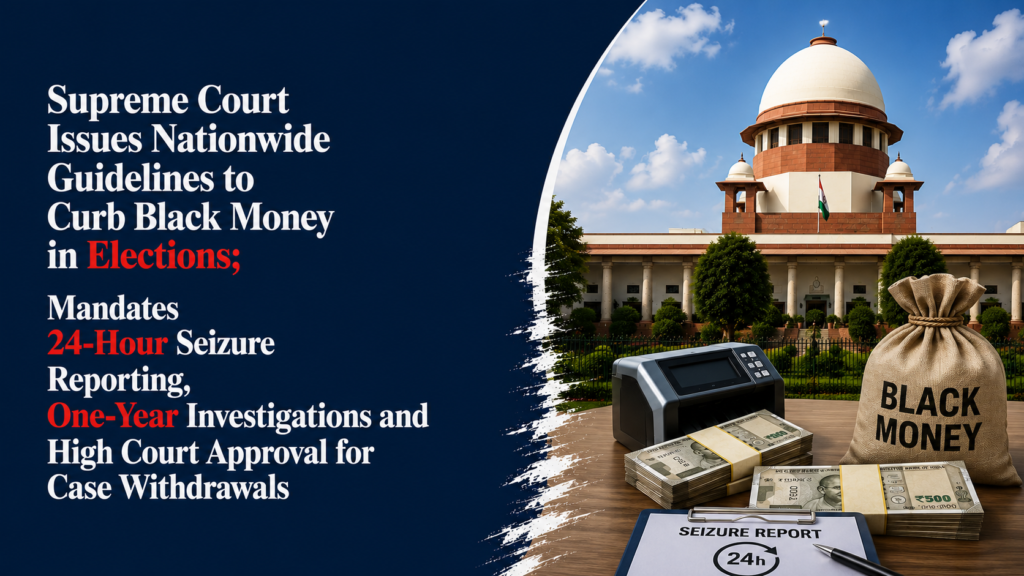
Supreme Court Issues Nationwide Guidelines to Curb Black Money in Elections; Mandates 24-Hour Seizure Reporting, One-Year Investigations and High Court Approval for Case Withdrawals

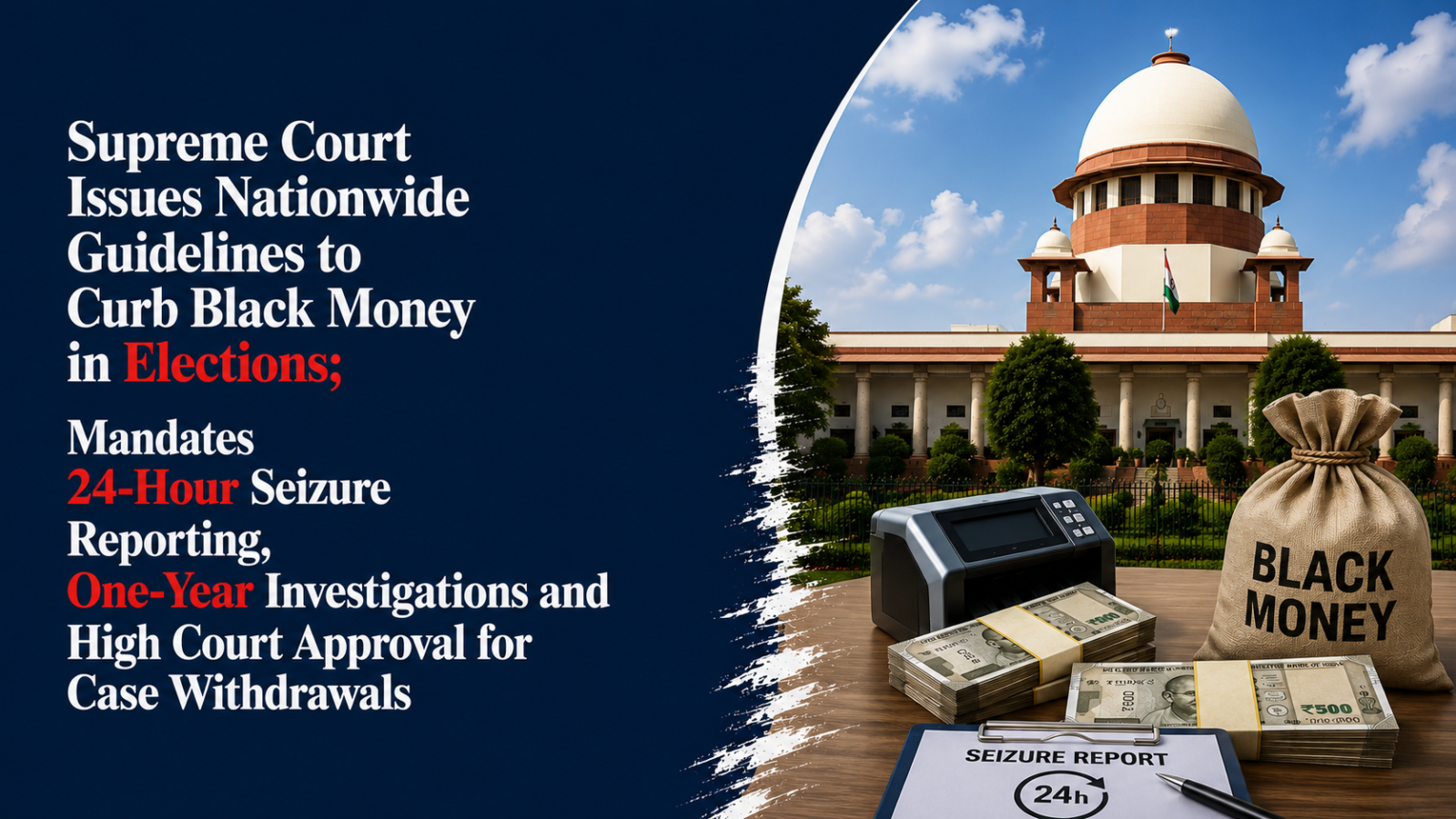
Supreme Court Tightens Action Against Electoral Black Money; Orders Quick Cash-Seizure Reporting, Time-Bound Investigations and High Court Scrutiny Before Withdrawing Election Cases
Facts
The proceedings arose from the 2014 Lok Sabha bye-election for the Bellary constituency in Karnataka. The respondent, Prathik Parasrampuria, was a candidate in that election. Acting on an anonymous message alleging that he had hoarded counterfeit currency for bribing voters, an Election Commission flying squad raided his residence and business premises.
During the raid, authorities seized ₹20,48,355 in cash, along with a laptop, cheque books, loose cheque leaves and a pen drive. Crime No. 0107 of 2014 was thereafter registered on 11 April 2014 under Sections 171E and 188 IPC, alleging possession of money intended for payment to voters.
The Karnataka High Court, by its order dated 12 February 2015, quashed the FIR, principally because the complaint did not specify whom the respondent intended to bribe or the manner in which the alleged bribery was proposed to be carried out. The State of Karnataka challenged that decision before the Supreme Court.
The Supreme Court proceedings subsequently assumed a much wider dimension. The Court sought information from the Election Commission regarding procedures governing flying squads, searches, seizures and prosecution of election-related offences. All States and Union Territories were eventually impleaded, and the Court considered the broader problem of black money and illegal inducements affecting electoral integrity.
Amici Curiae were appointed, and the Court examined suggestions concerning cash seizures, release of seized money, real-time tracking, FIR registration, effective investigation and prosecution, and withdrawal of election-related criminal cases.
Issues
The principal issues before the Supreme Court were:
- How should election authorities exercise their powers of search and seizure of cash and assets without unnecessarily prejudicing ordinary citizens?
- What safeguards should ensure a demonstrable connection between seized cash/assets and a suspected electoral offence?
- How can investigations and prosecutions arising from election offences be prevented from remaining pending indefinitely?
- What role should the Election Commission play in monitoring such investigations?
- Whether special or designated courts should ensure speedy disposal of criminal cases involving candidates, MPs and MLAs.
- Whether election-related criminal cases against candidates can be withdrawn merely following a change in political dispensation.
- What directions are necessary to curb the influence of black money, bribery and illegal inducements upon free and fair elections.
Petitioner’s/Appellants’ Arguments
The State of Karnataka challenged the High Court’s decision to quash the election-related FIR.
The broader position emerging during the proceedings was that effective enforcement mechanisms were necessary because election offences, particularly those involving cash distribution and voter inducement, directly affect the integrity of elections.
The Election Commission placed extensive material before the Court regarding its Standard Operating Procedures governing flying squads, Static Surveillance Teams, election expenditure monitoring and cash seizures.
The Commission also highlighted a systemic problem: election-related criminal cases are prosecuted by State Governments, and there had been instances where States sought to withdraw such cases after a change in government, including cases involving serious allegations such as electoral bribery.
Respondent’s Arguments
The respondent had successfully contended before the Karnataka High Court that the allegations did not contain sufficient particulars to constitute the alleged bribery offence — particularly because the complaint did not identify the voters intended to be bribed or explain the proposed mode of bribery.
During the Supreme Court proceedings, attention was also drawn to the existing Election Commission guidelines governing flying squads and election seizures.
The broader concern underlying the respondent’s position was that wide electoral enforcement powers could not translate into arbitrary seizure merely because an individual possessed substantial cash during an election period.
Analysis of the Law
The Supreme Court began from the constitutional proposition that democracy, rule of law and free and fair elections are inseparably connected. Electoral choice ceases to be genuinely free when it is distorted through external inducements, particularly illicit or undeclared money.
The Court examined the Election Commission’s authority under Article 324 of the Constitution. It recognised that the Commission possesses wide powers over the superintendence, direction and control of elections, including responsibility for maintaining electoral integrity and controlling inducements such as cash, liquor and free food. However, those powers are not unlimited and must operate consistently with legislation enacted by Parliament.
The Court observed that controlling black money in elections forms part of the Election Commission’s responsibility and noted that the corrosive effect of money power upon elections has repeatedly been recognised by courts, governmental committees and electoral reform reports.
Importantly, the Court sought to balance effective election enforcement with protection against arbitrary seizure.
Under the Election Commission’s SOPs, seizure cannot follow merely because cash is found. There must be suspicion of an offence or circumstances indicating that the cash is likely to be used to induce electors. Searches and seizures are also subject to procedural safeguards including panchnamas, videography and involvement of appropriate officers.
The Supreme Court consequently emphasised that the officer must record reasons establishing the suspected electoral nexus behind the seizure.
Precedent Analysis
The judgment undertakes an extensive survey of constitutional and election-law precedents.
In Indira Nehru Gandhi v. Raj Narain, the Court recalled that democracy forms part of the Constitution’s basic structure and necessarily contemplates elections that are genuinely free and fair.
In Mohinder Singh Gill v. Chief Election Commissioner, the Court recognised the Election Commission’s responsibility for maintaining the integrity of elections, including controlling distribution of electoral inducements.
At the same time, A.C. Jose v. Sivan Pillai establishes that Article 324 does not confer unrestricted plenary authority where Parliament or the State Legislature has already occupied the field by legislation.
The Court relied substantially upon Union of India v. Association for Democratic Reforms for the proposition that Article 324 operates as a reservoir of power where legislation is silent and permits the Election Commission to act to secure free and fair elections.
On withdrawal of prosecutions, the Court referred particularly to K. Ajith and Ashwini Kumar Upadhyay v. Union of India. The latter had required High Court permission for withdrawal of criminal cases concerning sitting MPs and MLAs.
The Supreme Court extended the principle to candidates in a particular election cycle, reasoning that a mere change in political dispensation should not permit election-related prosecutions to disappear.
Court’s Reasoning
The Court considered black money and electoral inducements to be a structural threat to democratic choice rather than merely an ordinary law-and-order problem.
At the same time, the Court recognised that election enforcement cannot operate on unfettered subjective suspicion. A person carrying cash should not automatically be treated as participating in electoral bribery.
Accordingly, whenever cash or assets are seized, the responsible authority must record written reasons demonstrating a prima facie nexus between the property seized and the suspected election offence and report the seizure within 24 hours to the competent District Magistrate, Additional District Magistrate or Court.
The Court was equally concerned with delayed investigations. An election-related investigation remaining pending for several years harms both sides: the public deserves to know whether a candidate engaged in illegal electoral practices, while an innocent candidate should not indefinitely carry the stigma of being under investigation.
The Court therefore directed investigating officers to endeavour to complete investigations within one year, with reasons for any delay being communicated to the Election Commission. Quarterly investigation reports must also be supplied to the Commission.
For cash detected by Static Surveillance Teams exceeding ₹10 lakh, information must be forwarded to the Income Tax authorities.
The Court further directed High Courts to consider designating courts for prompt disposal of criminal cases involving candidates, sitting MPs and MLAs.
Most significantly, withdrawal of cases against candidates arising from a particular election cycle now requires approval of the concerned High Court. This was intended to prevent election prosecutions from being politically extinguished following changes in government.
Conclusion
The Supreme Court issued the following operative nationwide directions:
- 24-hour reporting of seizures: Cash or asset seizures must be reported within 24 hours to the competent DM/ADM/Court, accompanied by written reasons showing a prima facie nexus with the suspected electoral offence.
- One-year investigation target: Election-related FIR investigations should, as far as possible, be completed within one year. Delay must be explained and communicated to the Election Commission.
- Quarterly monitoring: Investigating officers must submit quarterly investigation status reports to the Election Commission through the designated Nodal Officer.
- ₹10 lakh threshold: Cash exceeding ₹10 lakh detected by Static Surveillance Teams must be reported to Income Tax authorities.
- Expedited candidate cases: High Courts may designate courts for prompt hearing and disposal of cases involving candidates, sitting MPs and MLAs.
- High Court approval for withdrawal: Election-cycle criminal cases against candidates cannot be withdrawn without approval of the concerned High Court.
- Existing cases: Courts were directed to make every effort to bring the substantial number of pending election-related prosecutions to their logical conclusion expeditiously.
The Election Commission and respective State Governments were directed to file compliance reports by 18 November 2026.
Case Details
Case: The State of Karnataka & Anr. v. Prathik Parasrampuria
Court: Supreme Court of India
Case Number: Criminal Appeal arising out of SLP (Crl.) No. 3549 of 2016; 2026 INSC 868
Judge: Justice Sanjay Karol and Justice Nongmeikapam Kotiswar Singh
Date: 17 August 2026
Result: Supreme Court issued binding nationwide directions governing election-related cash seizures, investigation, prosecution and withdrawal of cases, and directed compliance reports by 18 November 2026.