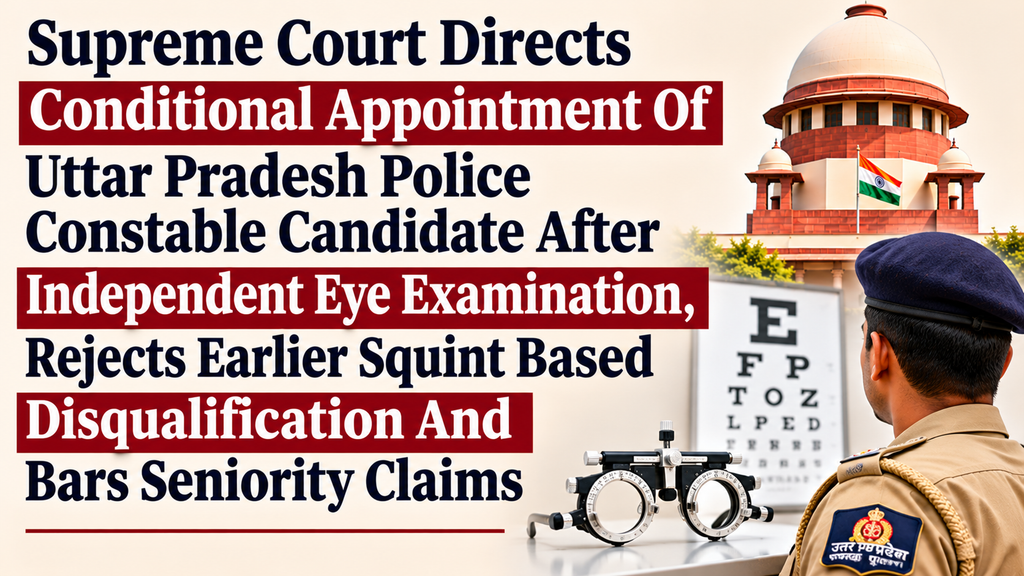
Supreme Court Directs Conditional Appointment Of Uttar Pradesh Police Constable Candidate After Independent Eye Examination, Rejects Earlier Squint Based Disqualification And Bars Seniority Claims

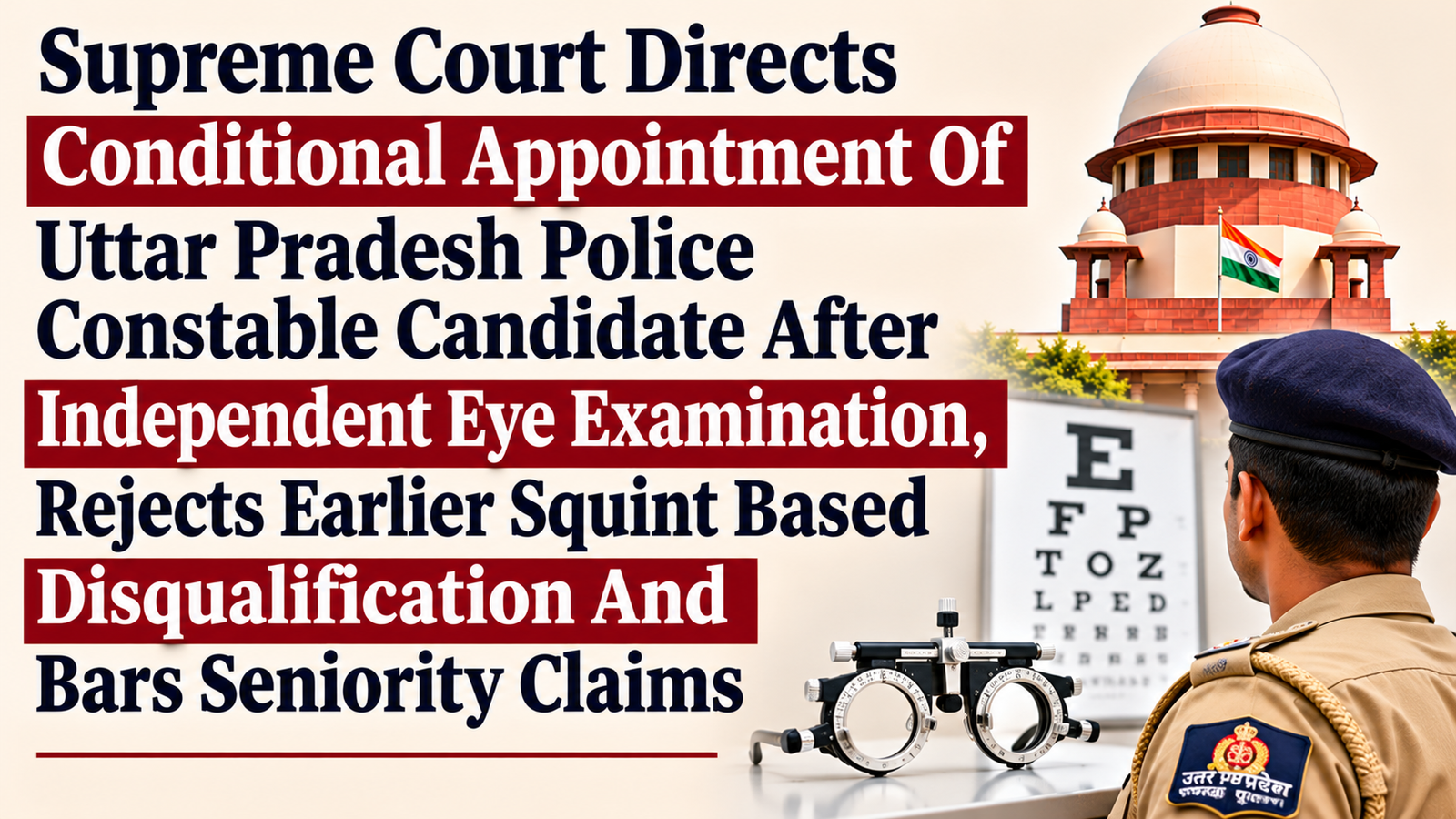
Supreme Court Overturns Medical Rejection Of Woman Police Constable Aspirant After Expert Board Confirms Normal Vision, Orders Appointment Subject To Eligibility Without Any Seniority Advantage
Facts
Akanksha Devi applied for the U.P. Police Constable Civil Direct Recruitment, 2023. She successfully completed document verification and the physical standards test at Kanpur Dehat on 28 December 2024, and was shortlisted for further selection. At the medical examination on 22 April 2025, she was reportedly told orally that she was unfit owing to a squint. A divisional medical board examining her on 25 April 2025 under Rule 15(6)(d) of the U.P. Police Constable and Head Constable Service Rules, 2015, as amended in 2017, again pronounced her unfit. No written rejection order or endorsement was furnished. Two doctors whom she independently consulted reported normal visual parameters, prompting her 16 May 2025 request for fresh medical examination. After that request and her High Court challenge failed, she appealed to the Supreme Court.
Issues
Whether the recruitment authorities’ medical rejection could stand despite contradictory ophthalmic assessments and the absence of a furnished rejection endorsement; whether an independent expert medical evaluation warranted relief notwithstanding completion of the recruitment process; and what conditions, particularly concerning eligibility and seniority, should govern any ensuing appointment.
Petitioner’s Arguments
The appellant maintained that she had cleared the preceding recruitment stages and had been unfairly excluded solely on an alleged eye defect. She relied upon assessments by doctors at G.S.V.M. Medical College and UHM District Hospital, Kanpur, who reported normal vision and colour perception, raising doubt about the original boards’ conclusions. She sought a fresh examination by an independent competent institution. The case centred on reliable medical assessment, rather than a request to dispense with prescribed recruitment standards.
Respondent’s Arguments
The judgment records that the State recruitment process had already concluded, the reason given by the High Court for declining to direct another examination. It does not separately reproduce detailed oral submissions by the respondents in the Supreme Court. The initial medical board and divisional review board had both classified the candidate as unfit for squint; those findings formed the administrative basis for withholding further appointment consideration. The dispute therefore concerned the weight to be given to those findings against subsequent specialist evaluations.
Analysis of the Law
The dispute arose under the medical fitness component of the 2023 police constable recruitment and the review mechanism prescribed by Rule 15(6)(d) of the relevant 2015 Service Rules, as amended. The Supreme Court did not abolish medical standards or declare every form of squint compatible with police service. Instead, it ordered an independent specialist assessment to resolve conflicting opinions in this candidate’s case. The final relief preserved the ordinary requirement of eligibility and expressly protected the relative seniority of persons appointed earlier. The completed recruitment process was not treated as an automatic bar to rectifying a medical-assessment error.
Precedent Analysis
The Court referred to an analogous procedural step taken in SLP (Civil) No. 17704 of 2025, where it had constituted a medical board to assess a candidate’s fitness. Following that approach, its order of 15 September 2026 required King George’s Medical University, Lucknow, to convene ophthalmology specialists and examine Akanksha Devi. The judgment supplies no case name or detailed merits holding for the earlier proceeding and cites no further reported precedent. It is therefore best read as a fact-specific application of independent medical verification, not a general exemption from visual-fitness requirements.
Court’s Reasoning
The four-doctor medical board examined the candidate on 8 October 2026 and submitted its report dated 16 October 2026. It recorded best-corrected distance vision of 6/6 and near vision of N6 in each eye, with ocular movement and multiple other parameters within normal limits. Its orthoptic opinion also noted exophoria progressing to intermittent exotropia with good control, a deviation of about five to eight degrees, and stereopsis when controlled. The Supreme Court accepted the specialists’ assessment of proper or normal vision as sufficiently undermining her earlier exclusion. In the peculiar circumstances, the Court considered her deprived of a legitimate opportunity despite having successfully completed earlier tests.
Conclusion
The Supreme Court set aside the impugned High Court order and allowed the civil appeal. It directed the respondents to issue an appointment order or call letter for the Police Constable (Civil Police) post if Akanksha Devi was otherwise entitled to appointment. It expressly ruled that she could not claim seniority over candidates already appointed. The decision turns on the independent ophthalmic report and individual recruitment history; it neither orders unconditional appointment nor grants backdated service or seniority benefits.
Case: Akanksha Devi v. State of U.P. & Ors.
Court: Supreme Court of India, Civil Appellate Jurisdiction
Case Number: Civil Appeal No. 14041 of 2026 (SLP (C) No. 14082/2026); 2026 INSC 1184
Judge: Justices Aravind Kumar (author) and Vipul M. Pancholi
Date: 2 November 2026
Result: Appeal allowed; conditional appointment/call letter directed; no seniority over existing appointees.