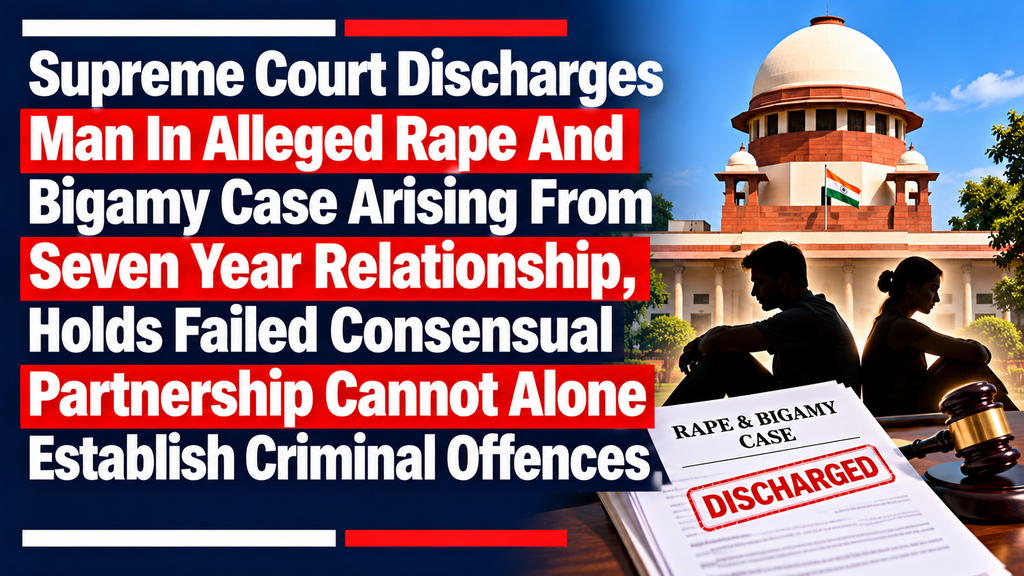
Supreme Court Discharges Man In Alleged Rape And Bigamy Case Arising From Seven Year Relationship, Holds Failed Consensual Partnership Cannot Alone Establish Criminal Offences

Supreme Court Sets Aside Kerala High Court Order, Finds No Prima Facie Rape, Cheating Or Marriage Offences After Woman Already Knew Of Partner’s Existing Marriage
Facts
The complainant, previously divorced, alleged that she and Santhosh Kumar N.P. underwent a temple marriage in Mysuru in 1996 and cohabited until 2003. She said he had presented himself as a bachelor and she consented to intimacy believing they were lawfully married. She initiated domestic-violence proceedings in 2008, in which he acknowledged an earlier marriage and two children; those proceedings were dismissed. Her first private criminal complaint was dismissed for non-prosecution in 2011. A second complaint led to Kadirur Police FIR No. 503/2011 for IPC Sections 376, 420, 493, 494 and 495. The Sessions Court refused discharge in 2015; the Kerala High Court affirmed in May 2025. The appellant approached the Supreme Court.
Issues
Whether FIR and charge-sheet materials disclosed grave suspicion or the essential ingredients of rape, cheating, deceit-induced cohabitation or bigamy sufficient to refuse discharge under Section 227 CrPC; and whether the complainant’s early knowledge of the appellant’s existing marriage and continued cohabitation negated the alleged deception.
Petitioner’s Arguments
The appellant contended the relationship lasted nearly seven years by mutual choice and that, within months of the asserted ceremony, his brother told the complainant of his subsisting marriage. She nonetheless continued to live with him. He disputed proof of any valid temple marriage, cited the dismissal of domestic-violence proceedings and the earlier complaint, and argued that a second, substantially similar complaint was an attempt to use criminal prosecution after the relationship failed. He maintained that no property was delivered, no effective second marriage was shown, and no ingredient of the charged offences arose.
Respondent’s Arguments
The complainant submitted that the first complaint had been dismissed only for non-prosecution and did not bar a police case founded on the second complaint and investigation. She asserted that repeated assurances of bachelorhood and marriage induced her belief in a lawful union, notwithstanding information from his brother. A joint post-office account, a Mysuru tenancy agreement and IVF forms signed by the appellant as husband were relied upon as supporting that belief. She also asserted isolation and pressure explaining the delayed complaint.
Analysis of the Law
Section 227 CrPC requires discharge if the record does not disclose sufficient ground to proceed; the judge may sift evidence to test prima facie or grave suspicion but must not conduct a mini-trial. IPC Section 376(2)(n) concerns repeated rape, not simply repeated intercourse during a consensual relationship. Section 420 requires dishonest inducement concerning delivery of property or valuable security. Section 493 requires deceit inducing belief in lawful marriage and cohabitation on that basis. Sections 494 and 495 require a legally relevant second marriage, with concealment of the first for Section 495. Each statutory ingredient must be supported by the allegations.
Precedent Analysis
In Union of India v. Prafulla Kumar Samal, (1979) 3 SCC 4, the Supreme Court held that a discharge court may examine broad probabilities and basic infirmities, discharging when evidence raises suspicion rather than grave suspicion. Sajjan Kumar v. CBI, (2010) 9 SCC 368, reiterates that a court is not a mere mouthpiece of the prosecution and must verify whether the materials, taken at face value, disclose each alleged offence. Neither authority permits full adjudication of trial evidence at the charge stage; both require meaningful judicial scrutiny of the threshold for prosecution.
Court’s Reasoning
Justice B.V. Nagarathna, writing for the Bench, found that the complainant knew of the earlier marriage within months yet continued cohabiting for years. Her long-standing relationship could not be retrospectively treated as repeated rape solely because it ended acrimoniously. The FIR alleged no dishonest inducement to deliver property under Section 420. Documents describing the appellant as husband did not establish the solemnisation of a valid second marriage; particulars of essential ceremonies were lacking, defeating Sections 494 and 495. Nor did the record sufficiently show sustained cohabitation in a deceit-induced belief in lawful marriage under Section 493. The Court expressly distinguished genuine cases of coercion or foundational deceit and cautioned against criminalising merely regretted intimacy.
Conclusion
The Supreme Court allowed the criminal appeals, set aside the Kerala High Court’s common order and the Trial Court’s refusal of discharge, and discharged Santhosh Kumar N.P. of all offences alleged under IPC Sections 376, 420, 493, 494 and 495. This is a discharge ruling, not an acquittal after trial. The decision protects the distinction between genuinely vitiated consent and a consensual adult relationship that later fails, while preserving criminal liability where the factual and statutory ingredients of sexual violence or deceit are actually made out.
Case: Santhosh Kumar N.P. v. State–Station House Officer, Kadirur Police & Anr.
Court: Supreme Court of India
Case Number: Criminal Appeals arising from SLP (Crl.) Nos. 10173–10174 of 2025; 2026 INSC 1179
Judge: Justices B.V. Nagarathna (author) and R. Mahadevan
Date: 30 October 2026
Result: Appeals allowed; High Court and Trial Court orders set aside; appellant discharged of all alleged IPC offences.