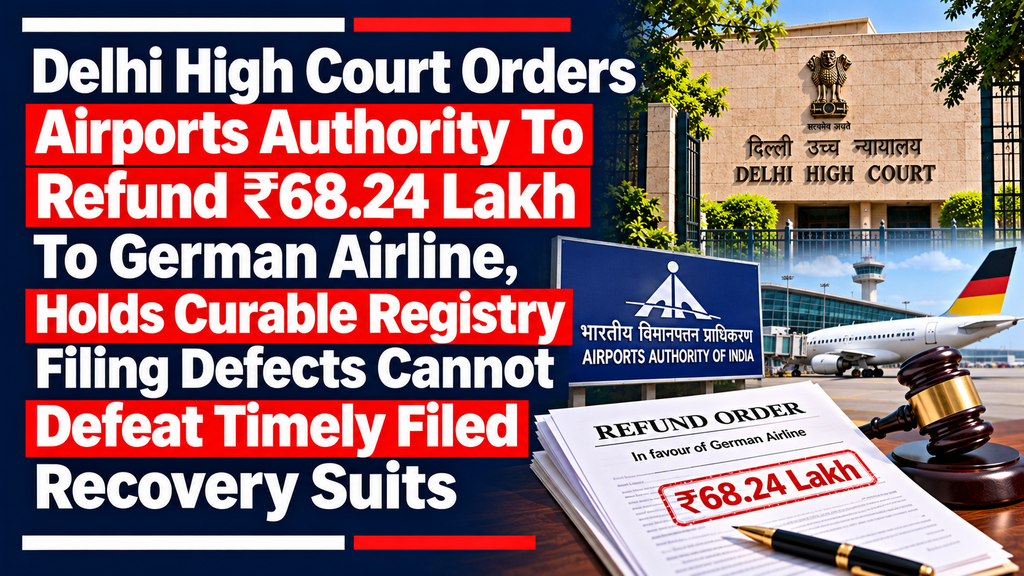
Delhi High Court Orders Airports Authority To Refund ₹68.24 Lakh To German Airline, Holds Curable Registry Filing Defects Cannot Defeat Timely Filed Recovery Suits


Delhi High Court Overturns Limitation Dismissal In LTU Airline Refund Dispute, Decrees ₹68.24 Lakh With Six Percent Interest And Dismisses Airports Authority Separate Cross Objections
Facts
German airline LTU Lufttransport Unternehmen GmbH, subsequently merged into Air Berlin PLC & Co. Luftverkehrs KG, mistakenly remitted USD 4,35,540 against an Airports Authority of India (AAI) overflight invoice for ₹4,35,540 in April 2006. AAI acknowledged a net excess credit of ₹1,46,33,653.71 on 5 July 2007, but refunded only ₹78,09,000 in October 2007. LTU sued to recover the remaining ₹68,24,653.71 with interest. Its plaint was presented on 6 October 2010, returned for filing objections, and registered on 16 October 2010. Although the trial court found the debt proved, it dismissed the suit as time-barred, treating the corrected filing as the date of institution. LTU appealed; AAI cross-objected to the findings on authorisation and the underlying debt.
Issues
Whether curable Registry objections relating to vakalatnama, court fee and duplicate documents made the original plaint non-est for limitation; whether LTU validly instituted and pursued the suit through authorised representatives; whether AAI proved adjustment of the disputed ₹68.24 lakh against other regional dues; and what interest, if any, was payable.
Petitioner’s Arguments
LTU submitted that the suit was instituted on 6 October 2010, before limitation expired on 8 October 2010 following AAI’s part payment, and that curing procedural defects related back to the original presentation. The re-filing occurred on 8 October; outstanding objections were resolved on 16 October following the Court vacation. The airline maintained that AAI’s 5 July 2007 acknowledgment proved the excess balance and that 18 Western Region invoices had already been paid, while three alleged invoices had not been furnished. It also relied on valid powers of attorney and challenged AAI’s inconsistent, unproved accounts and uncontracted interest demands.
Respondent’s Arguments
AAI argued that deficiencies in the vakalatnama, court fee and duplicate filing rendered the initial presentation ineffective, making registration on 16 October 2010 the controlling date. Through cross-objections under Order XLI Rule 22 CPC, it disputed LTU’s corporate authorisation and claimed the ₹68.24 lakh had already been adjusted against outstanding Western Region route-navigation charges. AAI argued that LTU’s admission of receiving 18 invoices shifted the burden of proving their payment to the airline; its Northern Region acknowledgment did not settle dues in other regions.
Analysis of the Law
Section 19 of the Limitation Act permits a fresh limitation period on qualifying part payment; on the Court’s computation, the three-year period expired on 8 October 2010. Section 26 and Order IV Rule 1 CPC govern institution by presentation of a plaint, while Orders VI and VII specify pleading essentials. Procedural objections must be distinguished from an unintelligible or sham filing. Section 149 CPC expressly permits later payment of deficient court fees with retrospective effect. Section 3 of the Limitation Act still requires dismissal of genuinely delayed suits. Section 4 did not itself extend time here because the limitation period expired before the Court vacation. Interest was assessed separately from the disputed principal.
Precedent Analysis
Vidyawati Gupta v. Bhakti Hari Nayak, (2006) 2 SCC 777, and Uday Shankar Triyar v. Ram Kalewar Prasad Singh, (2006) 1 SCC 75, establish that curable procedural defaults should not defeat substantive rights. Mannan Lal v. Chhotaka Bibi, (1970) 1 SCC 769, explains Section 149 CPC’s relation-back effect; Alka Kasana and D.C. Sankhla distinguish re-filing from fresh institution. The Delhi High Court Full Bench in Pragati Construction Consultants v. Union of India, 2025:DHC:717-FB, requires scrutiny of cumulative defects and any mala fide attempt merely to stop limitation. United Bank of India v. Naresh Kumar, (1996) 6 SCC 660, supports corporate authorisation and ratification.
Court’s Reasoning
Justice Neena Bansal Krishna found that LTU’s originally presented plaint stated a comprehensible cause of action, relief and jurisdiction; Registry objections did not alter its substance or show a merely token filing. It was presented within time and promptly re-filed, with remaining objections cured after the vacation. As to the merits, AAI’s regional accounting witness lacked first-hand knowledge, its tabulations were unsupported, and he acknowledged no principal balance shown as owing. Receipt of invoices was not an admission that they remained unpaid; AAI failed to prove the asserted adjustment. LTU’s powers of attorney and the successor company’s conduct established authority. The Court awarded 6% simple interest as reasonable, rather than the 12% claimed.
Conclusion
The appeal was allowed. The limitation dismissal was reversed, the finding of valid corporate authorisation sustained, and AAI’s cross-objections dismissed. LTU obtained a money decree for ₹68,24,653.71 with simple interest at 6% per annum from 5 July 2007 until realisation. The judgment distinguishes genuinely defective or abusive filings from rectifiable procedural irregularities, which ordinarily relate back to timely presentation. It also rejects unsupported set-off claims founded on inconsistent internal account statements.
Case: LTU Lufttransport Unternehmen GmbH (merged into Air Berlin PLC & Co. Luftverkehrs KG) v. Airports Authority of India
Court: High Court of Delhi, New Delhi
Case Number: RFA 277/2022 (caption); CM APPL. 46845/2022; CNR DLHC010249402022
Judge: Justice Neena Bansal Krishna
Date: 30 October 2026 (reserved 20 July 2026)
Result: Appeal allowed; ₹68,24,653.71 decreed with 6% simple interest from 05.07.2007; cross-objections dismissed.