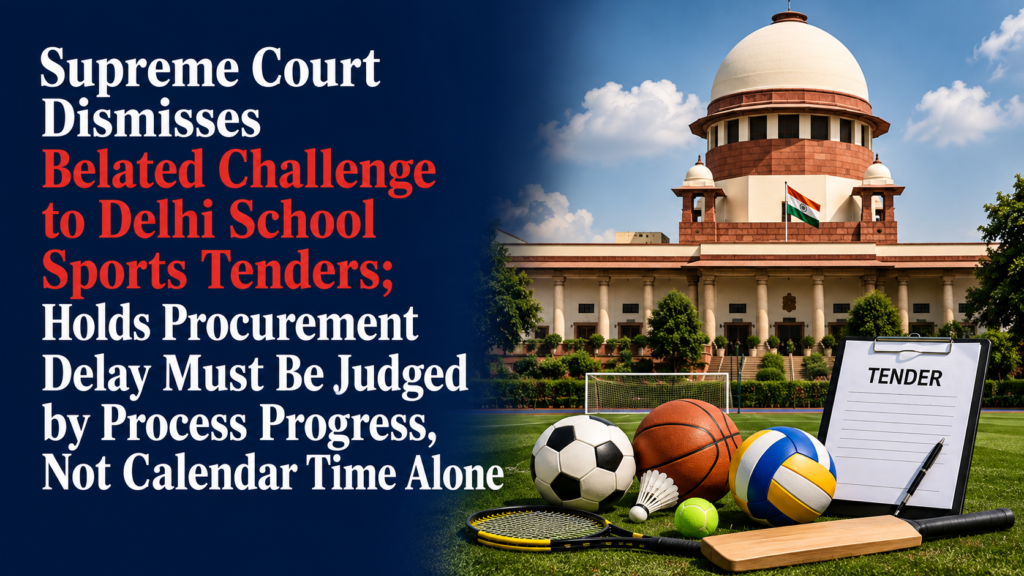
Supreme Court Dismisses Belated Challenge to Delhi School Sports Tenders; Holds Procurement Delay Must Be Judged by Process Progress, Not Calendar Time Alone

upreme Court Leaves Delhi Office-Warehouse Tender Clause Open for Future Challenge but Dismisses Present Appeals Due to Belated Approach
Facts
The appeals arose from seven tenders floated by the Directorate of Education, Government of NCT of Delhi, for procurement of sports goods and outdoor gymnasium equipment for government schools and sports centres. Six Sports Equipment Tenders were floated in November and December 2025, while a separate Outdoor Gym Equipment Tender was floated in January 2026.
The appellants challenged several tender conditions as allegedly arbitrary and exclusionary. These included past-performance requirements, minimum average turnover, denial of certain Micro and Small Enterprise relaxations, a requirement of maintaining an office and warehouse in Delhi/NCR for the previous three years, physical sample submission and two-stage technical evaluation.
Clause 2.17 of the Sports Equipment Tenders specifically required bidders to have a fully functional office in Delhi and warehouse in Delhi/NCR for the preceding three years. The appellants argued that this geographically excluded otherwise eligible suppliers.
They also contended that mandatory physical sampling was expensive and burdensome. Before the Supreme Court, they stated that the aggregate cost of furnishing samples across the five surviving tenders was approximately ₹94 lakh.
The Delhi High Court dismissed the challenge. It examined the Outdoor Gym Tender on merits but declined to rule on the validity of the six Sports Equipment Tender clauses because the challenge was substantially delayed, the tender process had advanced and the appellants had not participated in those tenders.
Before the Supreme Court, the appellants abandoned their challenge to two tenders that had already been awarded and confined the appeals to the remaining five Sports Equipment Tenders.
Issues
The principal issues before the Supreme Court were:
- Whether the challenge to the remaining tender conditions should be entertained despite the appellants approaching the Court after the tender process had substantially progressed.
- Whether delay in public procurement litigation should be assessed merely by calendar time or by reference to the stage reached in the procurement process.
- Whether conditions relating to past performance, MSE relaxation, physical sampling and Delhi office/warehouse requirements were sufficiently arbitrary or exclusionary to warrant interference.
- Whether the three-year Delhi office and warehouse requirement under Clause 2.17 was comparable to the local-experience condition struck down in Vinishma Technologies Pvt. Ltd. v. State of Chhattisgarh.
- Whether interference at the financial evaluation stage would prejudice competing bidders and the larger public interest.
Petitioner’s Arguments
The appellants argued that denial of MSE relaxations violated the applicable MSME procurement policy and that compulsory physical sample submission was contrary to GeM disclaimer clauses.
They submitted that the sampling condition was particularly onerous because supplying samples for the five pending Sports Equipment Tenders would entail an aggregate expenditure of approximately ₹94 lakh. They also challenged the past-performance threshold as excessively restrictive.
As regards Clause 2.17, the appellants contended that requiring a bidder to have maintained an office in Delhi and a warehouse in Delhi/NCR for three years bore no rational nexus with the procurement objective.
They pointed out that an earlier 2022 tender for similar goods did not contain this requirement and merely required GST registration in Delhi.
Reliance was placed upon Vinishma Technologies Pvt. Ltd. v. State of Chhattisgarh, 2025 INSC 1182, where a tender condition tying eligibility to prior supplies made specifically to Chhattisgarh Government agencies had been struck down as discriminatory.
The appellants also argued that their writ petition was not belated because technical evaluation was still underway when they approached the High Court, and they had first pursued representations and pre-bid objections before resorting to litigation.
Respondent’s Arguments
The respondents emphasised that the procurement had reached an advanced stage. Two tenders had already been awarded and the remaining five had reached financial evaluation.
Accordingly, interference would prejudice compliant bidders and adversely affect public interest.
On MSE concessions, the respondents submitted that EMD exemption was available upon furnishing appropriate documentation and that several MSEs had in fact participated, with one tender even being awarded to a registered MSE.
Regarding Clause 2.17, the authorities explained that around 500 varieties of sports equipment had to be supplied in bulk, often at short notice. Prompt installation, servicing, maintenance and replacement were essential because the goods were intended for schoolchildren.
According to the respondents, the clause did not require a bidder to be headquartered in Delhi; it only required functional operational infrastructure in Delhi/NCR. Therefore, an outside bidder could qualify by establishing the prescribed infrastructure.
Physical sampling was defended as necessary because quality, durability, workmanship and safety could not adequately be assessed merely from online descriptions.
Analysis of the Law
The Supreme Court placed considerable emphasis on the special nature of public procurement litigation.
It held that delay in tender matters cannot be measured merely by counting calendar days. What matters is how far the tender process has progressed during that period, whether competing interests have crystallised and what public consequences would follow from judicial intervention.
The Court observed that tender schedules operate within compressed and purpose-bound timelines. A period of four months may appear short in ordinary litigation, but in procurement it may cover the entire transition from invitation to evaluation and selection.
Accordingly, judicial discretion must be exercised with considerable restraint so that parties who wait on the sidelines cannot disrupt a substantially completed procurement process.
The Court further distinguished between a challenge to the terms of a tender and a challenge to evaluation of a particular bid.
Where the complaint is that a tender condition itself is arbitrary or unconstitutional, the cause for challenge arises immediately upon publication of that condition. Nothing further needs to be discovered.
A bidder who claims that a tender condition excludes it must therefore approach the Court at the earliest possible stage.
Precedent Analysis
Vinishma Technologies Pvt. Ltd. v. State of Chhattisgarh
The appellants relied principally on Vinishma Technologies Pvt. Ltd. v. State of Chhattisgarh, 2025 INSC 1182.
In Vinishma, the impugned tender required bidders to have supplied sports goods worth at least ₹6 crore specifically to State Government agencies in Chhattisgarh during the preceding three financial years.
The Supreme Court had struck down that condition because it artificially excluded otherwise financially sound and technically competent suppliers merely because they lacked prior dealings with Chhattisgarh Government agencies.
The Court, however, distinguished the present case.
Clause 2.17 did not condition eligibility upon prior supplies made in Delhi. Instead, it required operational infrastructure — a functional office in Delhi and warehouse in Delhi/NCR — because supplies could be required at short notice and timely inspection, maintenance, servicing and replacement were considered necessary for equipment used by schoolchildren.
The Supreme Court consequently held that Vinishma did not decisively govern the present dispute.
Importantly, however, the Court did not finally uphold Clause 2.17 on merits. Because the challenge was belated, it expressly left the clause’s validity open for examination in an appropriate future case.
Court’s Reasoning
The Court noted that the relevant Sports Equipment Tenders had been floated on 22 December 2025 and the last date for bids was 13 January 2026.
The writ petition was filed only on 1 April 2026, by which stage one tender had already been awarded and the remaining tenders had moved beyond document verification into technical evaluation. By the time the Supreme Court considered the matter, the five remaining tenders had reached financial evaluation.
The Court held that the appellants had known the eligibility conditions from the outset. Their problem was therefore not lack of knowledge, but lack of diligence.
The fact that they had made representations or issued legal notices did not excuse the delay because they knew from the beginning that they did not satisfy the disputed eligibility requirements.
The Supreme Court also attached weight to the rights and interests of other bidders. Those bidders had complied with all requirements, undergone technical scrutiny and reached the verge of financial evaluation.
Stopping the tender process at that stage to accommodate parties who had delayed approaching the Court would be unfair to those compliant bidders.
The Court additionally stressed the larger public dimension.
The tenders involved sports and gym equipment worth approximately ₹34 crore, intended for around 16 lakh school students. A substantial portion of the procurement had already been stalled because of litigation.
Thus, the dispute could not be treated merely as a commercial contest between competing suppliers.
Conclusion
The Supreme Court found no merit in the appeals primarily because the challenge to the tender conditions had been brought at a substantially advanced stage of the procurement process.
The Court held that the belated approach reflected a lack of bona fides and declined to undertake a final merits examination of the disputed tender clauses.
It specifically left the validity of Clause 2.17 — the three-year Delhi office and Delhi/NCR warehouse requirement — open for determination in an appropriate future case.
The Court found no ground to interfere with the Delhi High Court judgment and accordingly dismissed both civil appeals, with no order as to costs.
Case Details
Case: M/s Utkarsh Enterprises & Ors. v. Union of India & Ors. with M/s Philips International v. Union of India & Ors.
Court: Supreme Court of India
Case Number: Civil Appeal Nos. 10772 and 10773 of 2026, arising out of SLP (C) Nos. 16792 and 18491 of 2026; 2026 INSC 881
Judge: Justice K.V. Viswanathan and Justice Arun Palli; judgment authored by Justice Arun Palli.
Date: 18 August 2026
Result: Appeals dismissed. Supreme Court refused to interfere with the Delhi school sports-equipment tender process due to delay and advanced procurement stage; validity of Clause 2.17 expressly left open