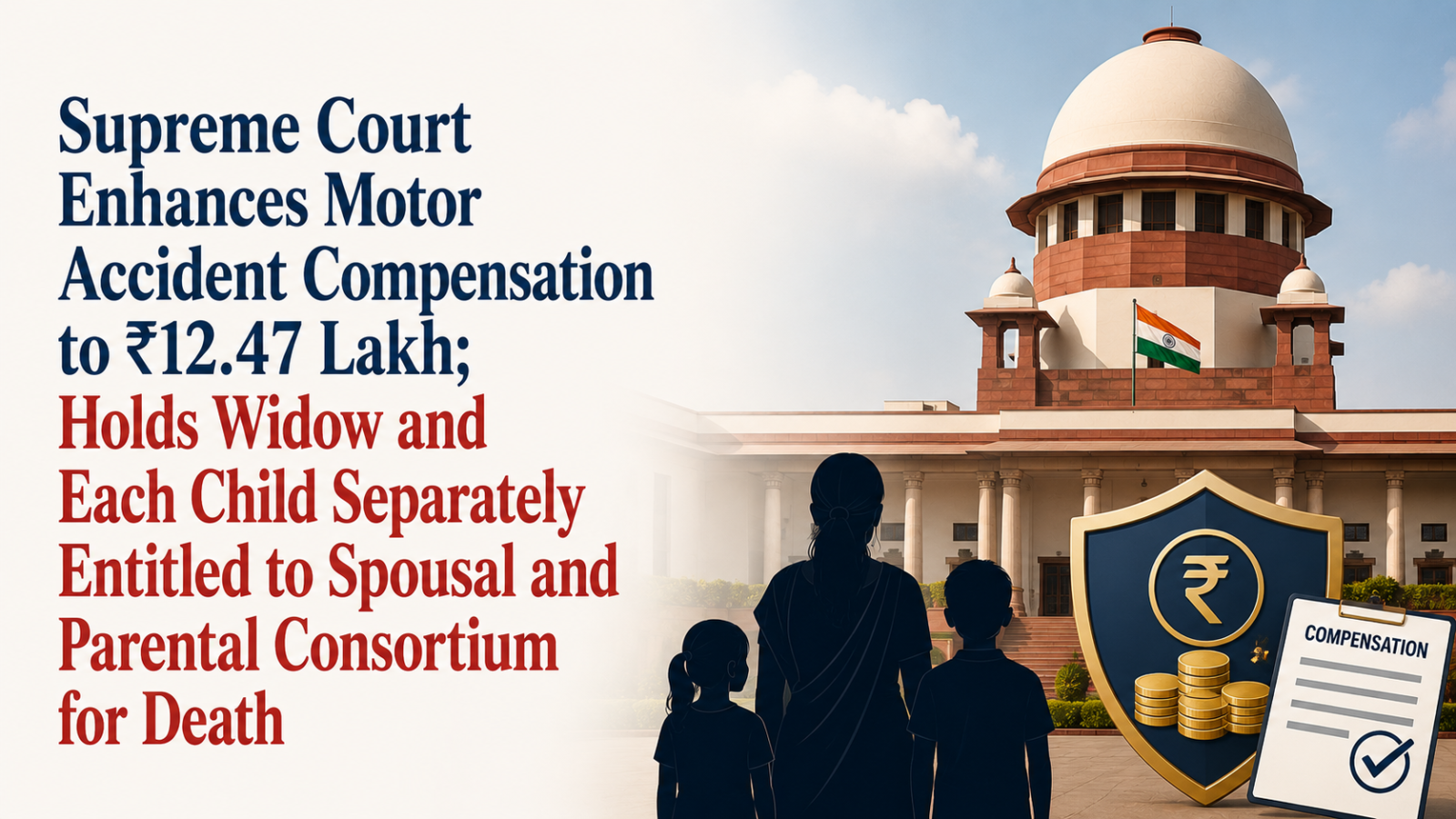
Supreme Court Enhances Motor Accident Compensation to ₹12.47 Lakh; Holds Widow and Each Child Separately Entitled to Spousal and Parental Consortium for Death

Supreme Court Orders Additional Compensation for Road Accident Victim’s Family; Recognises Separate Spousal and Parental Consortium and Applies Periodic 10% Enhancement
Facts
The Supreme Court considered an appeal filed by Sameem Begum and her three children, the wife and legal heirs of Shaik Janimiya, challenging the compensation awarded for his death in a motor accident. The appeal arose from the Telangana High Court’s judgment dated 30 June 2022, which had enhanced the Motor Accident Claims Tribunal’s award from ₹8.44 lakh to ₹11,00,672.
On 23 June 2012, Shaik Janimiya was walking at Malkajgiri when a car bearing registration No. AP-29-AK-3717, allegedly being driven rashly and negligently at high speed, struck him. He sustained injuries and subsequently died while undergoing treatment at Raghavendra Hospital. A criminal case was registered against the driver.
The deceased was 48 years old and employed as private security personnel. His family claimed that he earned ₹9,000 per month.
The Tribunal awarded ₹8,44,000 with interest at 7.5% per annum. On appeal, the Telangana High Court increased the compensation to ₹11,00,672, principally by recalculating loss of dependency after adding future prospects.
The family approached the Supreme Court, contending principally that the compensation under parental consortium had not been correctly awarded to the deceased’s three children. They also sought calculation of dependency on a monthly income of ₹9,000 instead of ₹7,000.
Although notice had initially been issued only on the question of parental consortium, the Supreme Court examined both spousal and parental consortium and also considered the income issue.
Issues
The principal issues before the Supreme Court were:
- Whether the deceased’s wife was separately entitled to spousal consortium.
- Whether each of his three children was separately entitled to parental consortium.
- Whether consortium constitutes an independent and indispensable conventional head while determining “just compensation” under the Motor Vehicles Act.
- What amount should be awarded to each claimant towards consortium in light of Pranay Sethi and subsequent precedent.
- Whether the deceased’s monthly income should be assessed at ₹9,000 as claimed by the family or ₹7,000 as accepted by the Tribunal.
- Whether the total compensation required further enhancement.
Appellants’ Arguments
The appellants argued that the Tribunal and High Court had failed to properly compensate the deceased’s children for loss of parental consortium.
They contended that the deceased had been working as a Chief Security Incharge and earned approximately ₹9,000 per month including allowances, and therefore loss of dependency should also have been recalculated on that basis.
The family sought appropriate compensation separately for the wife and children under the recognised categories of consortium.
Respondents’ Position
The judgment records appearance and hearing of counsel for the respondents but does not separately reproduce any substantial detailed counter-arguments on consortium.
On the income question, the Supreme Court found that the Tribunal had correctly relied upon the evidence of PW3, the Director of the deceased’s employer, who stated that his salary was ₹7,000 per month.
The Court therefore rejected the attempt to calculate compensation on ₹9,000 monthly income and retained ₹7,000 as the proved monthly income.
Analysis of the Law
Legal Representatives and Dependency
The Supreme Court first examined the broader entitlement of legal representatives to motor accident compensation.
It referred to Manjuri Bera v. Oriental Insurance Co. Ltd., where it was held that the right of a legal representative to seek compensation does not depend exclusively upon actual financial dependency. The devolution of the deceased’s estate is also legally relevant.
The Court also discussed National Insurance Co. Ltd. v. Birender, where even major, married and earning sons were held capable of maintaining claims as legal representatives, although the quantum under dependency-related heads would depend upon the evidence regarding actual dependency.
Thus, entitlement as a legal representative and proof of financial dependency are related but conceptually distinct questions.
Consortium Is an Independent Head of Compensation
The Supreme Court emphasised that consortium forms part of the conventional heads of motor accident compensation and is integral to awarding just compensation.
It is not restricted merely to financial dependency.
Consortium compensates for the non-pecuniary loss suffered because of the destruction of familial relationships, companionship, care, affection, guidance and protection.
The Court recognised three distinct categories:
- Spousal consortium — compensation to a surviving spouse for loss of companionship, affection, cooperation and marital relationship.
- Parental consortium — compensation to a child for loss of parental aid, affection, protection, discipline, guidance and training.
- Filial consortium — compensation to parents for the loss of a child.
Children Are Separately Entitled to Parental Consortium
The deceased’s three children were aged between 18 and 21 years.
The Supreme Court specifically found that they were dependants and legal representatives of the deceased and were therefore legitimately entitled to parental consortium.
The Tribunal had committed a “manifest error” by awarding merely ₹5,000 consortium to the wife and nothing towards parental consortium to the children.
The High Court had also failed to correct the error because it awarded ₹77,000 collectively under conventional heads instead of determining consortium properly for each eligible claimant.
Quantum of Consortium
Applying National Insurance Co. Ltd. v. Pranay Sethi and Magma General Insurance Co. Ltd. v. Nanu Ram, the Supreme Court held that each eligible claimant was entitled to ₹40,000 as consortium.
The Court further applied the principle that the conventional amount should be enhanced by 10% after every three years.
Accordingly, the Court determined consortium at:
Widow – Spousal Consortium: ₹48,400
Child 1 – Parental Consortium: ₹48,400
Child 2 – Parental Consortium: ₹48,400
Child 3 – Parental Consortium: ₹48,400
Total Consortium: ₹1,93,600.
Precedent Analysis
Manjuri Bera v. Oriental Insurance Company Ltd.
The Supreme Court relied upon Manjuri Bera for the proposition that the entitlement of a legal representative to seek compensation does not disappear merely because actual dependency is absent.
The right to compensation must be understood in the broader statutory context of legal representation and devolution of the deceased’s estate.
National Insurance Co. Ltd. v. Birender
In Birender, the Court recognised that even major, married and earning children remain legal representatives capable of maintaining a motor accident compensation claim.
Actual dependency may affect quantum but does not by itself eliminate their status as legal representatives.
Gujarat State Road Transport Corporation v. Ramanbhai Prabhatbhai
This judgment explained that a legal representative ordinarily means a person who represents the deceased’s estate or upon whom the estate devolves.
The Motor Vehicles Act therefore permits legal representatives suffering because of an accidental death to claim compensation under the appropriate heads.
Rajesh v. Rajbir Singh
The Court referred to Rajesh while explaining the concept of consortium as compensation for non-pecuniary loss arising from deprivation of companionship, affection, comfort, care, protection and other elements of the marital relationship.
National Insurance Co. Ltd. v. Pranay Sethi
Pranay Sethi standardised conventional compensation and fixed the base amount for loss of consortium at ₹40,000, while providing for enhancement of conventional amounts by 10% every three years.
The Supreme Court applied that escalation principle to the present case.
Magma General Insurance Co. Ltd. v. Nanu Ram
Magma was important because it expressly recognised consortium as encompassing spousal, parental and filial consortium.
This enabled the Court to separately compensate the widow and each child for the distinct relational loss suffered by them.
Court’s Reasoning
The Supreme Court held that the wife and three children could not be treated as collectively suffering a single compensable loss of consortium.
Each suffered a legally recognised relational loss.
The widow lost the companionship and support of her spouse and was entitled to spousal consortium.
Each child separately lost parental care, guidance, affection, protection and support and was therefore entitled to parental consortium.
The Court described consortium in its different categories as an “important and indispensable head” necessary to arrive at just motor accident compensation.
At the same time, the Court refused to interfere with the finding that the deceased earned ₹7,000 per month because that figure was supported by the testimony of the employer’s Director.
The Court therefore retained the High Court’s ₹10,23,672 loss-of-dependency calculation, while separately correcting the conventional heads.
Recalculation of Compensation
The Supreme Court recalculated the compensation as follows:
| Head | Amount |
| Loss of dependency | ₹10,23,672 |
| Spousal consortium to wife | ₹48,400 |
| Parental consortium to three children | ₹1,45,200 |
| Total consortium | ₹1,93,600 |
| Funeral expenses | ₹15,000 |
| Loss of estate | ₹15,000 |
| Total Compensation | ₹12,47,272 |
This calculation is also expressly set out in the table on page 15 of the judgment.
The High Court had awarded ₹11,00,672. The Supreme Court therefore granted an additional ₹1,46,600, carrying 7.5% interest from the date of filing of the claim petition until realisation.
The insurer was directed to deposit the additional amount with the Tribunal within six weeks.
Upon deposit, the amount was directed to be distributed among the four claimants in equal proportion, with payment directly credited to their respective bank accounts after verification.
Conclusion
The Supreme Court held that the widow and each of the three children of a deceased motor accident victim were separately entitled to consortium.
It found that both the Tribunal and High Court had failed to properly award compensation under this head.
The Court accordingly enhanced the total compensation from ₹11,00,672 to ₹12,47,272, granting an additional ₹1,46,600 with 7.5% interest.
The High Court judgment was modified to this extent and the appeal was allowed.
Case Details
Case: Sameem Begum and Others v. K. Venkat Swamy and Another
Court: Supreme Court of India
Case Number: Civil Appeal of 2026 arising out of SLP (C) No. 18553 of 2023
Judges: Justice Nongmeikapam Kotiswar Singh and Justice N.V. Anjaria
Date: 14 August 2026
Result: Appeal allowed; compensation enhanced from ₹11,00,672 to ₹12,47,272, with ₹1,46,600 additional compensation carrying 7.5% interest from the claim petition date.