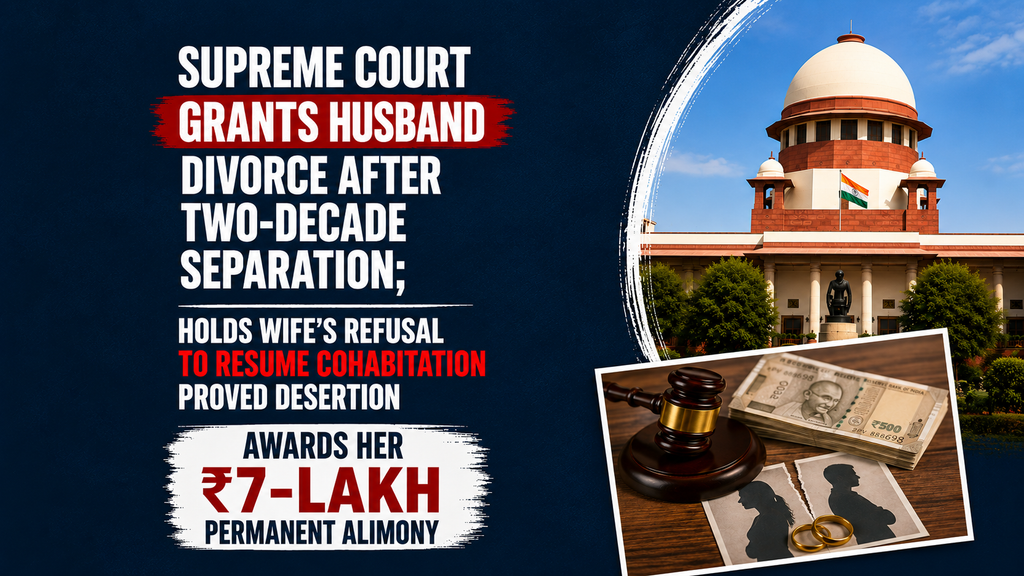
Supreme Court Grants Husband Divorce After Two-Decade Separation; Holds Wife’s Refusal to Resume Cohabitation Proved Desertion and Awards Her ₹7-Lakh Permanent Alimony

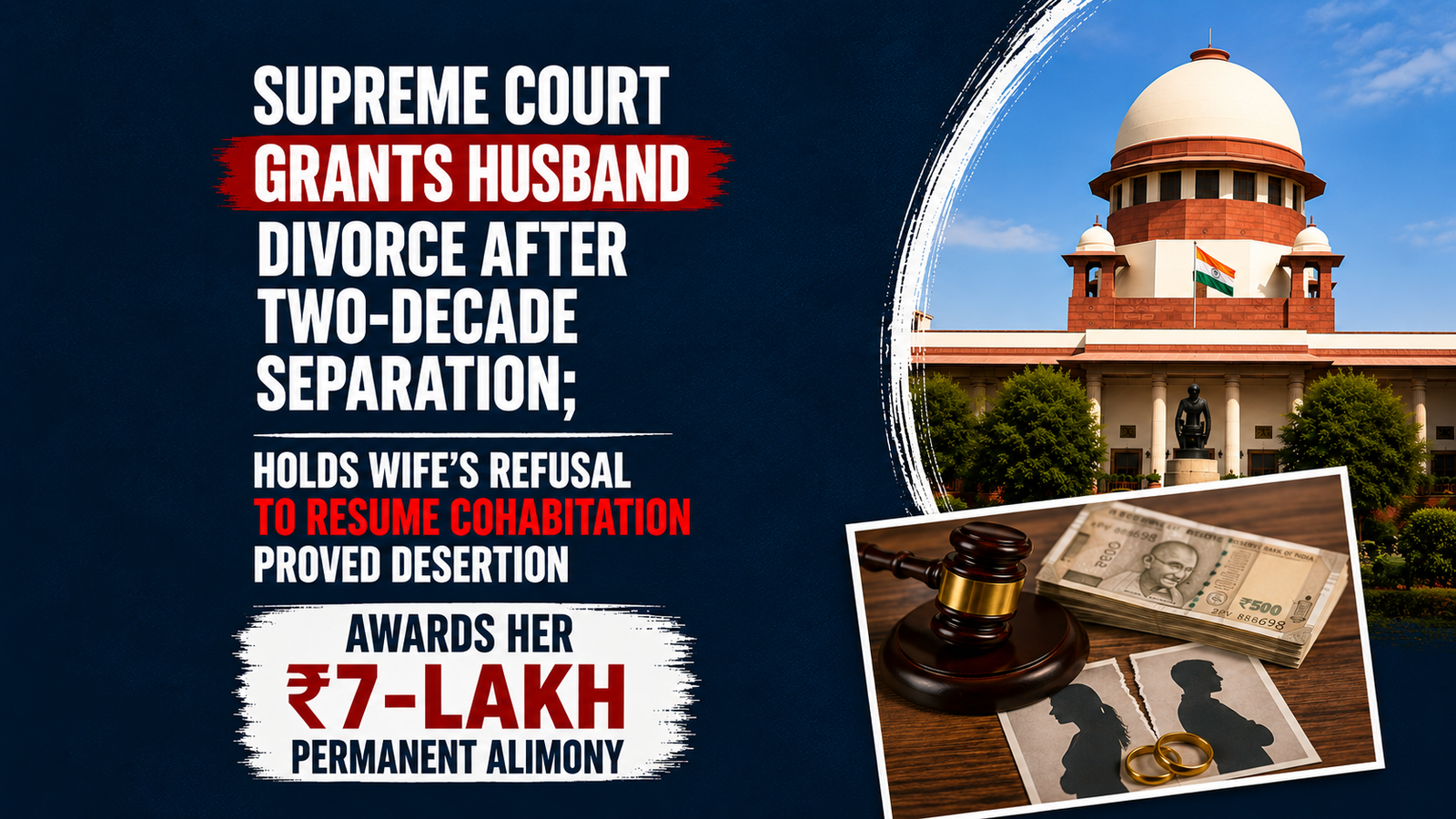
Supreme Court Grants Divorce After Parties Lived Apart Since 2005; Holds Mere Claim of Willingness Cannot Defeat Conduct Showing Intentional Desertion
Facts
Bijendra and Rekha married on 23 June 2003. According to the husband, the relationship deteriorated soon after marriage. He alleged that Rekha insulted him because of his educational background, repeatedly refused to live with him and that the marriage was never consummated.
On 30 November 2005, Rekha returned to her parental home. Bijendra went there on 15 December 2005 to bring her back, but she did not resume cohabitation. The parties thereafter remained continuously separated and had no children.
Bijendra filed a divorce petition under Section 13 HMA in 2007 on grounds of desertion and mental cruelty.
The Trial Court rejected the cruelty allegations as unproved. On desertion, although it found that Rekha had been living separately since 15 December 2005, it nevertheless dismissed the divorce petition.
The High Court also dismissed Bijendra’s appeal. It held that mere physical separation did not establish desertion because the husband had failed to prove animus deserendi, i.e. an intention on the wife’s part to permanently end cohabitation.
Issues
The principal issue was whether Rekha’s conduct amounted to desertion under Section 13(1)(ib) of the Hindu Marriage Act, 1955.
The Court also considered whether a spouse’s bare assertion that she remained willing to perform matrimonial obligations could outweigh her actual conduct over a prolonged period, and whether the long duration of separation had relevance in assessing whether the marriage had effectively broken down.
Appellant’s Arguments
Bijendra argued that the Trial Court had expressly found that Rekha deserted him from 15 December 2005, and she never challenged that finding by appeal or cross-objection.
He contended that once continuous desertion for the statutory period was established, Section 13(1)(ib) entitled him to divorce.
He further submitted that seeking restitution of conjugal rights is not a statutory precondition for a deserted spouse to seek divorce.
According to him, both the factum of separation and the intention to desert were proved because Rekha refused to return to the matrimonial home despite his efforts.
Respondent’s Arguments
Rekha supported the High Court’s judgment and argued that the evidence did not establish the essential ingredients of desertion.
She maintained that she had not intended to permanently abandon the marriage and that the High Court had correctly applied the principles governing desertion laid down in Lachman Utamchand Kirpalani v. Meena.
Analysis of the Law
The Supreme Court noted that the parties had indisputably been living separately since 15 December 2005.
It therefore focused on whether the second essential element—animus deserendi—was established.
The Court reiterated that desertion requires more than mere physical separation.
For the deserting spouse, two elements are necessary:
- factum of separation; and
- intention to permanently end cohabitation.
For the deserted spouse, there must be:
- absence of consent; and
- absence of conduct providing reasonable cause for the other spouse to leave.
Desertion is a continuing course of conduct and may be inferred from the entire factual matrix.
Precedent Analysis
Savitri Pandey v. Prem Chandra Pandey, (2002) 2 SCC 73
The Court relied upon Savitri Pandey for the settled definition of desertion as the intentional permanent forsaking and abandonment of one spouse by the other without consent and without reasonable cause.
It reiterated that desertion is not merely withdrawal from a place but withdrawal from the matrimonial relationship itself.
Lachman Utamchand Kirpalani v. Meena
This decision was referred to for the classic two-part test of desertion: physical separation plus animus deserendi.
The Supreme Court applied that test but disagreed with the High Court’s factual inference.
Naveen Kohli v. Neelu Kohli, (2006) 4 SCC 558
The Court referred to Naveen Kohli to recognize the practical reality of a marriage that has remained broken for a prolonged period.
Where parties have been separated for a substantial length of time and the relationship is beyond repair, preserving the legal tie may only prolong misery.
Shilpa Sailesh v. Varun Sreenivasan, (2023) 14 SCC 231
The Court cited Shilpa Sailesh for the proposition that prolonged separation is a significant factor in assessing whether the matrimonial bond has become incapable of restoration.
However, the Court clarified that it was not dissolving the marriage under Article 142 on the ground of irretrievable breakdown. The appeal was decided on the statutory ground of desertion under Section 13(1)(ib).
Court’s Reasoning
The Supreme Court held that Rekha’s bare statement that she was willing to perform her marital obligations was insufficient when her actual conduct demonstrated otherwise.
The evidence showed that Bijendra and a witness had gone to bring Rekha back to the matrimonial home, but she refused to return without reasonable cause.
The Court therefore found that the High Court had erred in concluding that there was no intention to desert. Rekha’s conduct demonstrated that she had actively chosen to abandon the matrimonial relationship.
The Court also noted that:
- there were no children from the marriage;
- all reconciliation attempts had failed; and
- the parties had remained separated for approximately two decades.
In those circumstances, forcing continuation of the marriage would not serve the ends of justice.
The Supreme Court therefore held that desertion was proved.
At the same time, it declined to interfere with the concurrent findings rejecting the allegation of cruelty. Thus, divorce was granted only on the ground of desertion, not cruelty.
Conclusion
The Supreme Court partly allowed the appeal.
It set aside the High Court’s finding that desertion had not been proved and restored the Trial Court’s factual conclusion on desertion.
The marriage solemnized on 23 June 2003 was dissolved by a decree of divorce under Section 13(1)(ib) HMA.
The Court directed Bijendra to pay Rekha ₹7 lakh as permanent alimony within three months. If payment was delayed beyond three months, the amount would carry 9% annual interest.
The finding rejecting cruelty was left undisturbed.
Case Details
Case: Bijendra v. Rekha
Citation: 2026 INSC 939
Court: Supreme Court of India
Case Number: Civil Appeal No. 10249 of 2014
Bench: Justice Prashant Kumar Mishra and Justice Shree Chandrashekhar
Judgment by: Justice Prashant Kumar Mishra
Date: 2 September 2026
Result: Appeal partly allowed; marriage dissolved on ground of desertion under Section 13(1)(ib) HMA; cruelty finding left untouched; wife awarded ₹7 lakh permanent alimony, with 9% interest if unpaid within three months.