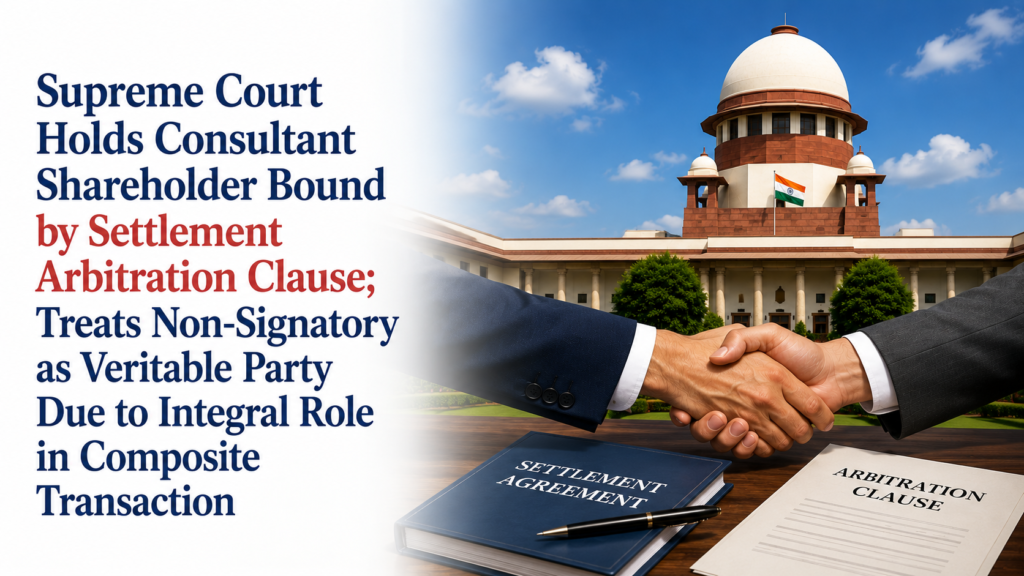
Supreme Court Holds Consultant Shareholder Bound by Settlement Arbitration Clause; Treats Non-Signatory as Veritable Party Due to Integral Role in Composite Transaction

Supreme Court Holds Non-Signatory Shareholder Bound by Arbitration Clause; Applies ‘Veritable Party’ Principle
Facts
KKH Finvest Pvt. Ltd. entered into a Memorandum of Settlement (MoS) dated 9 May 2022 to acquire complete control of Sensorise Digital Services Pvt. Ltd. and its sister concern by purchasing the entire shareholding of the promoters, management team, consultants and other shareholders for ₹8 crore. Although Ashiesh Shukla, a consultant shareholder holding 1,480 equity shares, was not a signatory to the MoS, he executed a separate Share Purchase Agreement (SPA) on the same day for transfer of his shares.
After disputes arose, arbitration proceedings commenced under the MoS. While the Delhi High Court held that several management team members who had executed similar SPAs were “veritable parties” to the arbitration agreement, it excluded Ashiesh Shukla on the ground that his SPA contained a clause stating that the transfer of shares was independent of the remaining clauses of the SPA and the MoS. KKH Finvest challenged that finding before the Supreme Court.
Issues
- Whether Ashiesh Shukla, though a non-signatory to the MoS, could be treated as a veritable party to the arbitration agreement contained therein.
- Whether the clause in his Share Purchase Agreement excluding connection with the remaining clauses of the MoS prevented reference of disputes to arbitration.
- Whether the Delhi High Court erred in distinguishing Ashiesh Shukla from other similarly situated shareholders.
Appellants’ Arguments
The appellants contended that Ashiesh Shukla’s participation was indispensable for implementation of the MoS because complete transfer of the company’s shareholding could not be achieved unless he also transferred his shares.
It was argued that his Share Purchase Agreement expressly acknowledged that it was executed pursuant to the MoS and that the settlement amount paid to him formed part of the overall ₹8 crore consideration contemplated by the MoS. The appellants further submitted that his agreement was materially identical to those executed by the management team members whom the High Court had already held to be veritable parties. Accordingly, there was no legal basis for treating Ashiesh Shukla differently.
Respondent’s Arguments
Ashiesh Shukla relied upon Clause 16 of his Share Purchase Agreement, which stated that the transfer and sale of his shares would be conclusive, independent, mutually exclusive and unconnected with the remaining clauses of the SPA and the MoS.
It was contended that this clause demonstrated the parties’ intention that he would not be bound by the arbitration agreement contained in the MoS. Since his SPA did not contain an independent arbitration clause, he argued that disputes involving him could not be referred to arbitration.
Analysis of the Law
The Supreme Court examined the doctrine governing non-signatories to arbitration agreements, particularly the concept of a “veritable party.” The Court reiterated that a person who has not signed an arbitration agreement may nevertheless be bound where the surrounding circumstances demonstrate an intention to participate in and be governed by the underlying contractual arrangement.
The Court emphasised that the most important consideration is the non-signatory’s participation in the performance of the underlying contract. Other relevant factors include the legal relationship between the parties, the composite nature of the transaction, commonality of subject matter and whether performance of the contract would remain incomplete without the participation of the non-signatory.
Precedent Analysis
The Court principally relied upon:
- Cox and Kings Ltd. v. SAP India Pvt. Ltd., which recognised that a non-signatory may be treated as a veritable party where its conduct, legal relationship and participation in the underlying transaction demonstrate an intention to be bound by the arbitration agreement.
- ONGC Ltd. v. Discovery Enterprises Pvt. Ltd., reiterating that factors such as composite transactions, commonality of subject matter and participation in contractual performance must be considered holistically while determining whether a non-signatory is bound by an arbitration agreement.
Court’s Reasoning
The Supreme Court found that the High Court overlooked a crucial factual circumstance. The clause relied upon to exclude Ashiesh Shukla from arbitration was identical to clauses contained in the Share Purchase Agreements executed by the four management team members whom the High Court had nevertheless referred to arbitration.
The Court further observed that Ashiesh Shukla’s Share Purchase Agreement itself expressly acknowledged that it was executed pursuant to the MoS, that the buyer was acquiring the shares of the management team and other shareholders under the settlement, and that the consideration paid to him formed part of the overall settlement amount contemplated by the MoS.
The Court held that transfer of Ashiesh Shukla’s shares was indispensable to fulfil the objective of the MoS, namely acquisition of 100% ownership of the company by KKH Finvest. Since his obligations formed an integral part of the composite transaction, he clearly satisfied the test of a veritable party laid down in Cox and Kings. Consequently, there was no valid basis to exclude him from the arbitration proceedings while referring other similarly situated shareholders.
Conclusion
The Supreme Court allowed the appeal and set aside the Delhi High Court’s finding excluding Ashiesh Shukla from arbitration. The Court held that, although he was not a signatory to the Memorandum of Settlement, his participation in the composite transaction and performance of obligations under the Share Purchase Agreement made him a veritable party to the arbitration agreement. The disputes involving him were accordingly referred to the same sole arbitrator already adjudicating the related disputes, with all merits left open for determination in arbitration.
Case Details
Case: KKH Finvest Pvt. Ltd. & Anr. v. Ashiesh Shukla & Ors.
Court: Supreme Court of India
Case Number: Civil Appeal of 2026 arising out of SLP (C) No. 4222 of 2025
Judges: Hon’ble Mr. Justice Sanjay Kumar and Hon’ble Mr. Justice Sanjeev Sachdeva
Date: 05 August 2026
Result: Appeal allowed; Ashiesh Shukla held to be a veritable party to the Memorandum of Settlement and referred to arbitration before Hon’ble Mr. Justice T.S. Thakur (Retd.), with all issues left open for determination by the arbitral tribunal.