Supreme Court Holds Customising Imported Xerox Modules Does Not Amount to Manufacture; Dismisses Excise Demand on Warehouse ‘Kitting’ Activity

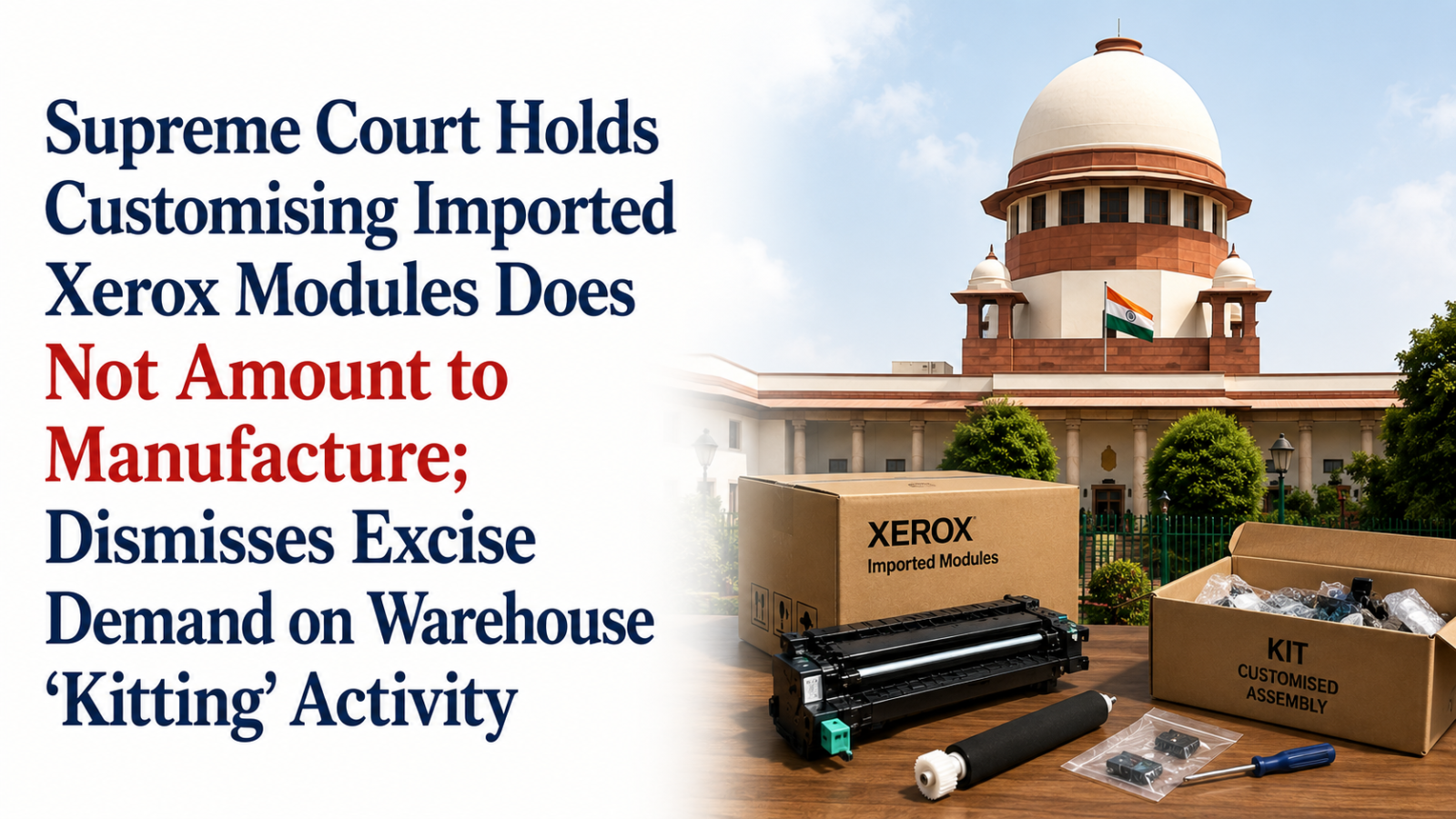
Supreme Court Holds Kitting of Imported Xerox Modules Is Not Manufacture; Dismisses Central Excise Demand
Facts
The Revenue challenged orders of the Customs, Excise and Service Tax Appellate Tribunal (CESTAT) setting aside excise demands raised against M/s Xerox India Ltd. The dispute concerned the activities undertaken by the assessee at its warehouses in Hyderabad and Rampur, where imported photocopier modules and components, received in Complete Knocked Down (CKD) or Semi Knocked Down (SKD) condition, were grouped and configured according to customer requirements before dispatch.
The Revenue alleged that these activities amounted to “manufacture” under Section 2(f) of the Central Excise Act, 1944, read with Note 6 to Section XVI of the Central Excise Tariff Act, 1985, and consequently demanded excise duty exceeding ₹17.86 crore, along with interest and penalties. The assessee maintained that it merely carried out “kitting” of already imported complete machines and that no manufacturing process was involved. After the Tribunal allowed the assessee’s appeals, the Revenue approached the Supreme Court.
Issues
- Whether grouping, configuring and fitting imported Xerox modules according to customer specifications amounted to “manufacture” under Section 2(f) of the Central Excise Act, 1944.
- Whether Note 6 to Section XVI of the Central Excise Tariff Act was attracted to the assessee’s activities.
- Whether the Revenue was justified in demanding excise duty on the warehouse operations undertaken by the assessee.
Appellant’s Arguments
The Revenue argued that the assessee imported modules and components incapable of independent functioning and assembled or configured them into complete photocopier machines according to customer specifications. According to the Revenue, this irreversible assembly transformed ineffective components into functional, marketable photocopiers and therefore constituted manufacture under Section 2(f).
It was further contended that the imported goods were incomplete articles possessing the essential character of finished machines, thereby attracting Note 6 to Section XVI. Reliance was also placed upon decisions such as Narne Tulaman Manufacturers, BPL India Ltd., and Quippo Energy Ltd., where assembly of components had been held to amount to manufacture. The Revenue also alleged suppression and mischaracterisation of the manufacturing activity as “kitting” to evade excise duty.
Respondent’s Arguments
The assessee submitted that the imported goods had already been classified, assessed and subjected to customs duty and countervailing duty as complete machines under Tariff Heading 8471. It argued that the warehouse activity merely involved grouping, plugging and packing imported modules according to customer requirements without creating any new product.
According to the assessee, no physical assembly resulting in a new commercially distinct commodity took place. The imported photocopiers retained their identity throughout, and the activities amounted only to “kitting” for transportation and customer convenience. Consequently, neither Section 2(f) nor Note 6 to Section XVI was attracted.
Analysis of the Law
The Supreme Court undertook an extensive review of its jurisprudence on the concept of “manufacture” under Section 2(f) of the Central Excise Act. The Court reiterated that manufacture requires the emergence of a new and distinct commercial commodity possessing a different name, character or use. Mere processing, value addition, packaging or adaptation does not amount to manufacture unless the original commodity loses its identity.
The Court summarised earlier decisions and reaffirmed that manufacture lies between two limits. At one end, processes leaving the commodity commercially unchanged cannot constitute manufacture irrespective of labour or expense involved. At the other, even a relatively simple process may amount to manufacture if it results in a new, marketable product with a distinct commercial identity.
The Court also explained that Note 6 to Section XVI applies only where an incomplete or unfinished article having the essential character of a finished article is converted into a complete article. Both conditions must be established before the deeming fiction can operate.
Precedent Analysis
The Supreme Court comprehensively analysed earlier decisions, including:
- Union of India v. Delhi Cloth & General Mills Co. Ltd., laying down the classic test that manufacture requires emergence of a new commercial commodity with a distinct name, character and use.
- Narne Tulaman Manufacturers Pvt. Ltd. v. Collector of Central Excise, holding that assembly of distinct components may amount to manufacture where a new commercially distinct product emerges.
- BPL India Ltd. v. Commissioner of Central Excise, recognising manufacture where imported SKD kits were assembled into fully functional products.
- Satnam Overseas Ltd., Servo-Med Industries Pvt. Ltd., Quippo Energy Ltd., and Alupro Building Systems, explaining the distinction between manufacture and mere processing, packaging or installation.
After reviewing these authorities, the Court held that the facts of the present case were materially distinguishable because the imported goods had already been treated as complete machines and no new commercial commodity emerged through the assessee’s warehouse activities.
Court’s Reasoning
The Court agreed with the Tribunal that the Revenue failed to establish that any physical assembly converting incomplete machines into complete photocopiers actually took place at the assessee’s warehouses. The evidence showed only customer-specific grouping, plugging and pinning of already imported modules before dispatch.
The Court emphasised that the Revenue had itself treated the imported goods as complete machines while levying customs duty and countervailing duty under Tariff Heading 8471. Having done so, it could not subsequently contend that the same goods were incomplete articles for the purpose of invoking Note 6 to Section XVI.
The Court also observed that the Revenue had not even inspected the assessee’s premises to establish the alleged manufacturing activity and had failed to produce any evidence demonstrating physical assembly. In modern times, the Revenue could easily have documented the process if manufacture had in fact occurred. Since the Tribunal’s findings were supported by the evidence and were not shown to be perverse, the Supreme Court found no reason to interfere.
Conclusion
The Supreme Court dismissed the Revenue’s appeals and affirmed the Tribunal’s decision. It held that the assessee’s activities of unpacking, grouping, plugging and pinning imported Xerox modules according to customer specifications amounted only to “kitting” and did not result in manufacture under Section 2(f) of the Central Excise Act. The Court further held that Note 6 to Section XVI was inapplicable because the imported goods had already been assessed as complete machines and no conversion from incomplete to complete articles had been established.
Case Details
Case: Commissioner of Central Excise, Hyderabad-IV v. M/s Xerox India Ltd. & Ors.
Court: Supreme Court of India
Case Numbers: Civil Appeal Nos. 5939–5941 of 2010 with Civil Appeal Nos. 11870–11872 of 2018
Judges: Hon’ble Mr. Justice S.V.N. Bhatti and Hon’ble Mr. Justice N.V. Anjaria
Date: 05 August 2026
Result: Revenue’s appeals dismissed; CESTAT orders upheld; assessee’s warehouse “kitting” activities held not to constitute manufacture under Section 2(f) of the Central Excise Act.