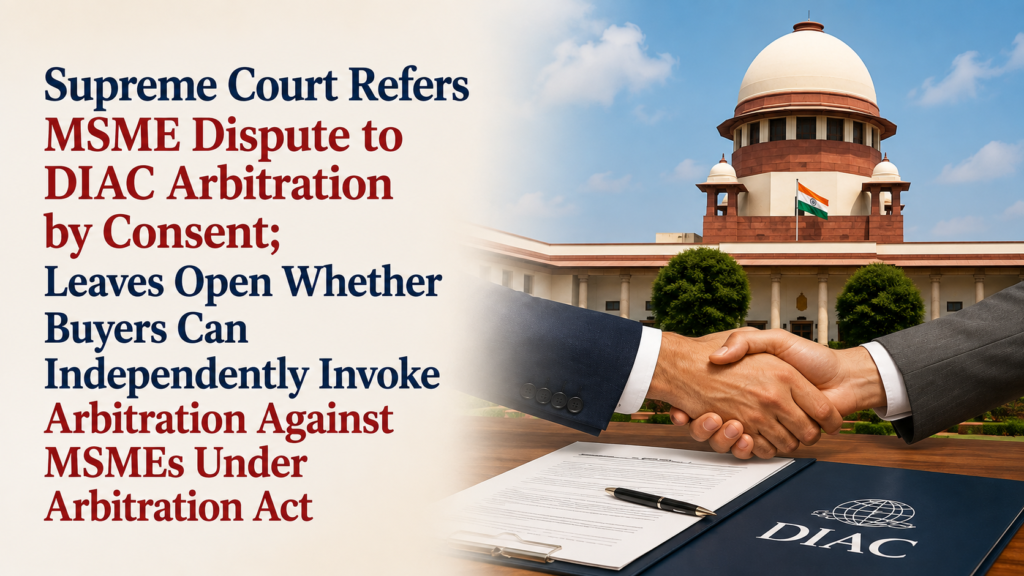
Supreme Court Refers MSME Dispute to DIAC Arbitration by Consent; Leaves Open Whether Buyers Can Independently Invoke Arbitration Against MSMEs Under Arbitration Act

Supreme Court Appoints DIAC Arbitration for MSME Dispute; Declines to Decide Buyer’s Independent Right to Invoke Arbitration
Facts
The appeal before the Supreme Court arose from a dispute between M/s Patel Infrastructure Limited and M/s Aditya Construction, a Micro and Small Enterprise (MSME). The principal legal issue raised was whether a buyer of goods or services from an MSME could independently invoke arbitration under the Arbitration and Conciliation Act, 1996, instead of pursuing the mechanism provided under the Micro, Small and Medium Enterprises Development Act, 2006 (MSMED Act).
During the hearing, the appellant relied upon decisions of the Delhi High Court and the Calcutta High Court supporting its contention. However, during the course of arguments, the respondent MSME expressed its willingness to resolve the dispute through arbitration administered by the Delhi International Arbitration Centre (DIAC) under the Arbitration and Conciliation Act, 1996.
Issues
- Whether a buyer dealing with an MSME can independently invoke arbitration under the Arbitration and Conciliation Act, 1996 for its claims against the MSME.
- Whether the dispute should instead be referred to arbitration by consent of the parties.
- Whether the Supreme Court should decide the larger legal question in the present case.
Appellant’s Arguments
The appellant argued that a buyer of goods or services supplied by an MSME is entitled to independently invoke arbitration under the Arbitration and Conciliation Act, 1996 for its claims against the MSME.
In support of this proposition, reliance was placed upon:
- Uniseven Engineering and Infrastructure Pvt. Ltd. v. Micro and Small Enterprises Facilitation Council, District (South) & Anr. (Delhi High Court); and
- Essar Oil and Gas Exploration and Production Ltd. v. Gargi Travels Pvt. Ltd. (Calcutta High Court),
which were cited to support the appellant’s contention regarding maintainability of such arbitration proceedings.
Respondent’s Arguments
On instructions, the respondent MSME informed the Supreme Court that it had no objection to resolving the disputes through arbitration conducted under the Arbitration and Conciliation Act, 1996.
The respondent proposed that the arbitrator be appointed through the Delhi International Arbitration Centre (DIAC) and suggested New Delhi as the venue of arbitration, considering that the appellant’s registered office was situated in Ahmedabad, Gujarat, while the respondent carried on business from Basti, Uttar Pradesh.
Analysis of the Law
The Supreme Court noted that the appeal raised an important question of law concerning the interaction between the MSMED Act, 2006 and the Arbitration and Conciliation Act, 1996, namely whether a buyer can independently invoke arbitration against an MSME outside the statutory mechanism under the MSMED Act.
However, since both parties voluntarily agreed to resolve their disputes through arbitration before DIAC, the Court found it unnecessary to decide the larger legal issue in the present proceedings. The Court expressly clarified that the legal question remained open for determination in an appropriate future case.
Precedent Analysis
The Supreme Court recorded the appellant’s reliance upon:
- Uniseven Engineering and Infrastructure Pvt. Ltd. v. Micro and Small Enterprises Facilitation Council, District (South) & Anr. (Delhi High Court, decided on 5 July 2023); and
- Essar Oil and Gas Exploration and Production Ltd. v. Gargi Travels Pvt. Ltd. (Calcutta High Court, decided on 20 April 2023),
but deliberately refrained from examining or expressing any opinion on those decisions, since the appeal itself was disposed of by consent.
Court’s Reasoning
The Supreme Court accepted the respondent’s fair offer to submit the disputes to arbitration through the Delhi International Arbitration Centre. It observed that accepting the parties’ consensus would bring an early resolution to the dispute without requiring adjudication of the broader legal controversy.
Accordingly, the Court requested DIAC to appoint a suitable arbitrator under the Arbitration and Conciliation Act, 1996. It fixed New Delhi as the venue of arbitration and directed the appellant to approach DIAC within two weeks from receipt of the certified copy of the order.
At the same time, the Court specifically clarified that the important legal issue concerning a buyer’s right to independently invoke arbitration against an MSME was left open for consideration in an appropriate future case.
Conclusion
The Supreme Court disposed of the appeal by consent, directing that the disputes between the parties be referred to arbitration through the Delhi International Arbitration Centre under the Arbitration and Conciliation Act, 1996. The Court fixed New Delhi as the venue of arbitration and expressly left open the important question of law regarding whether a buyer can independently invoke arbitration against an MSME under the Arbitration and Conciliation Act outside the framework of the MSMED Act, 2006.
Case Details
Case: M/s Patel Infrastructure Limited v. M/s Aditya Construction
Court: Supreme Court of India
Case Number: Civil Appeal arising out of SLP (C) No. 3250 of 2026
Judges: Hon’ble Mr. Justice Sanjay Kumar and Hon’ble Mr. Justice Sanjeev Sachdeva
Date: 05 August 2026
Result: Appeal disposed of by consent; DIAC requested to appoint an arbitrator under the Arbitration and Conciliation Act, 1996; venue fixed at New Delhi; question of law regarding a buyer’s independent right to invoke arbitration against an MSME left open.