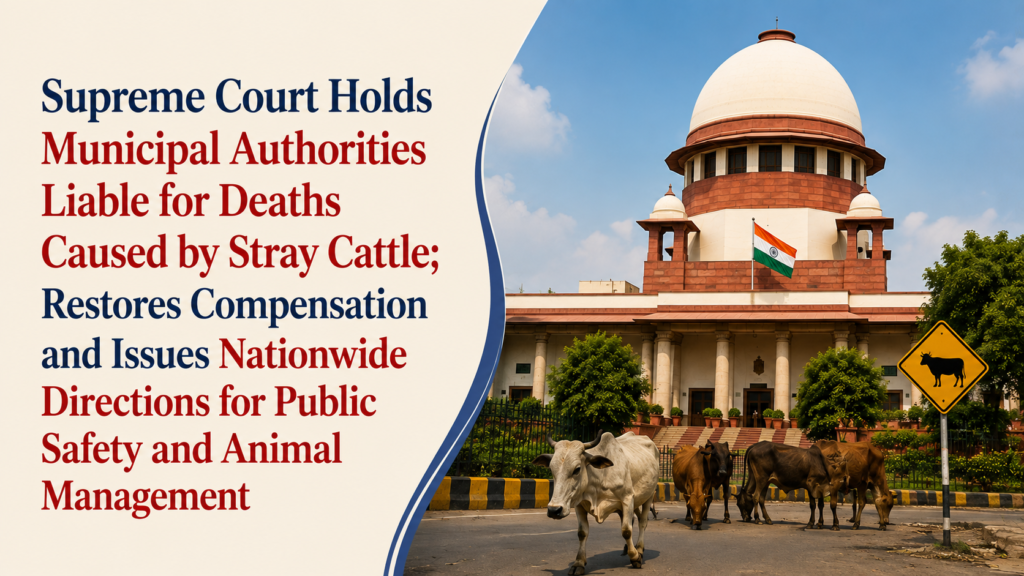
Supreme Court Holds Municipal Authorities Liable for Deaths Caused by Stray Cattle; Restores Compensation and Issues Nationwide Directions for Public Safety and Animal Management

Supreme Court Holds Municipal Authorities Liable for Death Caused by Stray Bull; Restores Compensation to Victim’s Widow
Facts
The appellant, Nisha, is the widow of Vijay Kumar, who suffered a fatal head injury after being attacked by a stray bull while walking on a public road on 21 September 2007. The incident was immediately reported to the police and a Daily Diary Report (DDR) was recorded. During his lifetime, Vijay Kumar sought compensation from the concerned authorities, but no relief was granted. After his death, his widow filed a writ petition before the Punjab and Haryana High Court seeking compensation for the loss caused by the municipal authorities’ failure to control stray cattle on public roads.
The learned Single Judge held the Municipal Council responsible for its failure to discharge statutory duties and awarded ₹29,32,000 with 6% interest by applying principles analogous to compensation under the Motor Vehicles Act. However, the Division Bench set aside the award solely on the ground that the matter involved disputed questions of fact which could not be decided under Article 226 and relegated the claimant to a civil suit. Aggrieved, the widow approached the Supreme Court.
Issues
- Whether a writ petition under Article 226 was maintainable for claiming compensation arising from death caused by a stray bull.
- Whether the case actually involved disputed questions of fact requiring adjudication by a civil court.
- Whether the Municipal Council and other public authorities could be held liable for failing to prevent stray cattle from endangering public safety.
- Whether compensation awarded by the Single Judge deserved to be restored.
- Whether wider directions were necessary to address the recurring menace of stray cattle across the country.
Petitioner’s Arguments
The appellant argued that the occurrence of the accident had never been genuinely disputed. The police records, contemporaneous documents and surrounding circumstances clearly established that Vijay Kumar sustained fatal injuries after being hit by a stray bull.
It was submitted that requiring the widow to institute a civil suit nearly two decades after the incident would amount to denial of effective justice. The appellant further contended that municipal authorities have a statutory and constitutional obligation to ensure that public roads remain free from dangerous stray cattle, and failure to perform this duty attracts public law liability. Since the negligence was evident from the record, the High Court ought not to have dismissed the writ petition on technical grounds.
Respondents’ Arguments
The respondents contended that no material conclusively established municipal negligence or proved that the death occurred because of a stray bull. According to them, the writ court could not determine such disputed factual questions.
It was also argued that the principles governing compensation under the Motor Vehicles Act, 1988 could not automatically be imported into cases involving attacks by stray animals. Consequently, if any compensation was payable, it could only be determined by a competent civil court after recording evidence.
Analysis of the Law
The Supreme Court reiterated that although writ jurisdiction ordinarily does not involve adjudication of seriously disputed questions of fact, that principle is not absolute. Where the material on record sufficiently establishes the relevant facts and relegating a litigant to a civil suit would defeat the ends of justice, constitutional courts can grant compensation under Article 226.
The Court emphasised that municipal authorities are created to discharge statutory obligations relating to sanitation, public safety and regulation of stray animals. Failure to remove dangerous stray cattle from public roads amounts to breach of public duty, exposing the authorities to public law liability.
The Court also observed that compensation in constitutional tort cases need not strictly follow statutory schemes such as the Motor Vehicles Act. Nevertheless, those principles may provide a useful and reasonable method for quantifying compensation in appropriate cases.
Precedent Analysis
The Supreme Court relied upon established constitutional jurisprudence governing compensation for violation of fundamental and legal rights by public authorities.
The Court reaffirmed the principles laid down in decisions such as:
- Nilabati Behera v. State of Orissa—recognising compensation under public law for breach of constitutional obligations.
- MCD v. Uphaar Tragedy Victims Association—holding public authorities accountable for failure to discharge statutory duties resulting in loss of life.
- Other constitutional tort decisions recognising that public law compensation is distinct from private law damages and may be awarded in writ jurisdiction where State negligence is established.
Court’s Reasoning
The Supreme Court found that the Division Bench had erred in mechanically holding that disputed questions of fact existed. The occurrence of the accident, the police records, the nature of injuries and the surrounding circumstances sufficiently established that Vijay Kumar died after being attacked by a stray bull.
The Court observed that after nearly nineteen years, directing the widow to institute a civil suit would be wholly unjust and would effectively deny meaningful relief. It further held that municipal authorities cannot avoid responsibility where they fail to discharge statutory duties relating to management of stray cattle despite the foreseeable danger posed to the public.
Recognising that stray cattle have become a nationwide menace causing numerous deaths and injuries, the Court considered it necessary not only to restore compensation in the individual case but also to issue comprehensive directions requiring States, Union Territories and local authorities to improve cattle registration, tagging, shelters, enforcement, coordination and compensation mechanisms to prevent similar tragedies.
Conclusion
The Supreme Court allowed the appeal, set aside the judgment of the Division Bench and restored the compensation awarded by the learned Single Judge. It held that the writ petition was maintainable, that no genuine disputed questions of fact prevented exercise of writ jurisdiction, and that the Municipal Council’s failure to control stray cattle attracted public law liability.
Recognising the recurring danger posed by stray cattle throughout the country, the Court further issued extensive directions to all States, Union Territories and local authorities to strengthen regulation, identification, shelter management, enforcement and compensation mechanisms in order to protect both human life and animal welfare.
Case Details
Case: Nisha v. Municipal Council Sangrur & Ors.
Court: Supreme Court of India
Case Number: Civil Appeal No. ____ of 2026 (Arising out of SLP (C) No. 4663 of 2026)
Judges: Hon’ble Mr. Justice Sanjay Karol and Hon’ble Mr. Justice K. Vinod Chandran
Date: 31 July 2026
Result: Appeal Allowed. The Supreme Court restored the compensation awarded by the Single Judge, held the writ petition maintainable, fastened liability on the municipal authorities for failure to control stray cattle, and issued nationwide directions for effective stray cattle management and public safety.