

Court’s decision
The Supreme Court of India allowed the appeal filed by the original complainant and set aside the Bombay High Court’s order granting bail to two accused in a murder case involving offences under the Indian Penal Code and the Scheduled Castes and Scheduled Tribes (Prevention of Atrocities) Act, 1989.
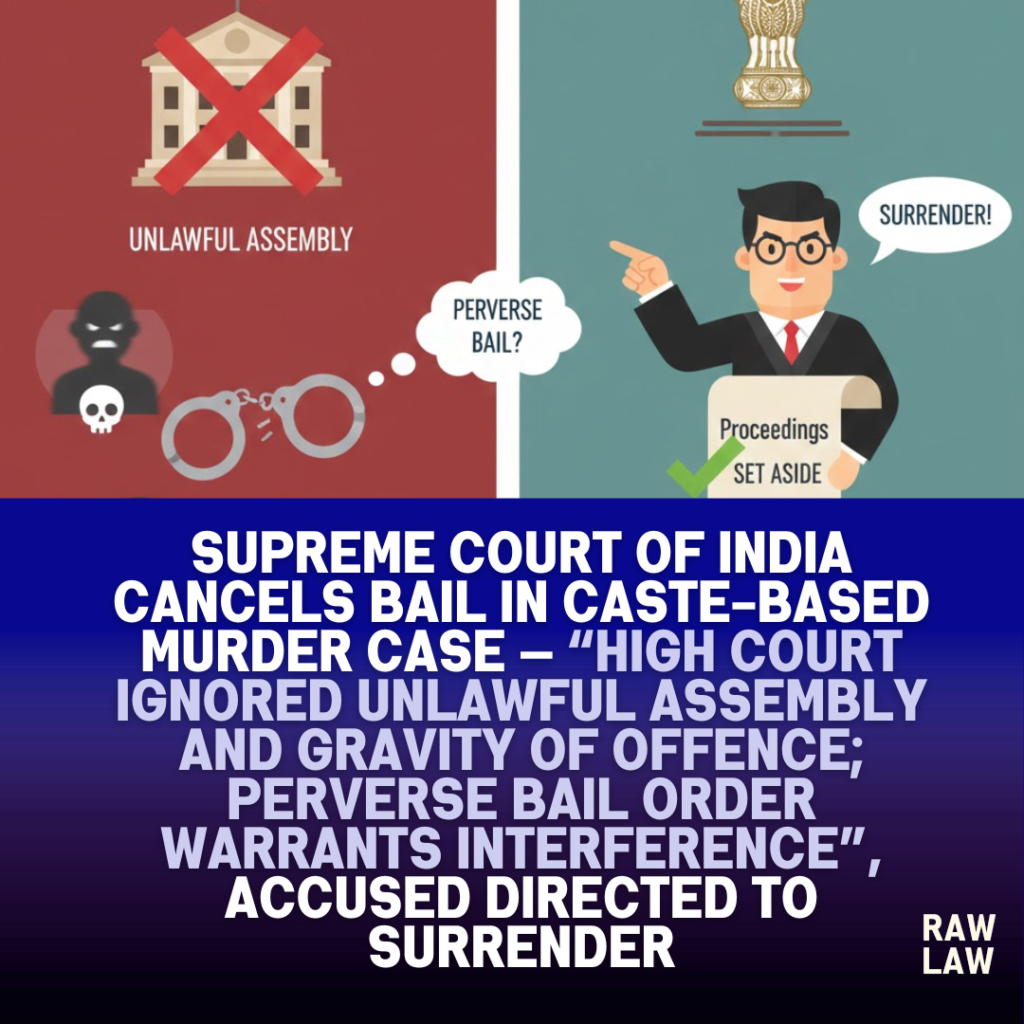
The Court held that the High Court adopted an erroneous approach by dissecting medical evidence at the bail stage and by insisting on attribution of specific injuries in a case involving unlawful assembly under Sections 143, 147, 148 and 149 IPC. The bail order was termed unsustainable and perverse. The accused were directed to surrender within four weeks.
Facts
The incident arose out of a long-standing civil dispute regarding a right of way over agricultural land. On 19 August 2022, the complainant’s husband was allegedly attacked by six persons armed with iron rods and sticks near Shirdi-Lasalgaon Road.
According to the FIR, the accused formed an unlawful assembly, assaulted the deceased with lethal weapons, and hurled caste-based abuses at the complainant. When she attempted to intervene, she too was assaulted.
The victim succumbed to injuries on 24 August 2022 during treatment. Section 302 IPC was subsequently added to the FIR, along with provisions under the SC/ST Act.
Issues
The principal issue before the Supreme Court was whether the High Court was justified in granting bail to the accused in a case involving murder committed by an unlawful assembly and accompanied by caste-based offences.
The Court also examined whether the High Court had ignored settled parameters governing interference with bail orders and whether its reasoning was based on extraneous or legally untenable considerations.
Appellant’s arguments
The complainant argued that there were clear and specific allegations in the FIR attributing active participation to both accused. One was armed with an iron rod and the other with a stick, and both allegedly assaulted the deceased as part of a coordinated attack.
It was contended that the High Court erred in granting bail by questioning which specific injury was caused by which accused, despite invocation of Section 149 IPC. The High Court also wrongly analysed the post-mortem findings as if adjudicating the matter at trial.
The appellant further argued that the gravity of the offence, particularly involving a Scheduled Caste victim, was not given due weight.
Respondents’ arguments
The accused contended that bail once granted should not be lightly cancelled and that cancellation requires proof of misuse of liberty. They argued that there was a delay between the assault and death, creating doubt about causation.
It was submitted that only eight injuries were noted despite six alleged assailants, and that no witness specifically attributed the fatal head injury to the accused.
The defence also relied upon the existence of prior civil disputes to suggest possible false implication.
Analysis of the law
The Supreme Court reiterated the distinction between cancellation of bail under Section 439(2) CrPC and reversal of a bail order by a superior court. It clarified that even absent misuse of liberty, a perverse or legally flawed bail order can be set aside if relevant material has been ignored.
Relying on precedents including Ajwar v. Waseem and Mahipal v. Rajesh Kumar, the Court emphasised that bail in serious offences requires careful evaluation of gravity, societal impact, and role attributed.
The Court also relied on Victim ‘X’ v. State of Bihar to underscore that courts are empowered to cancel bail in grave offences under the SC/ST Act where the order undermines public confidence.
Precedent analysis
The Court referred to its earlier decisions highlighting that an unreasoned or perverse bail order can be interfered with by a superior court.
It reiterated that in cases involving unlawful assembly under Section 149 IPC, individual attribution of specific injury is not a prerequisite at the stage of bail. Once common object is prima facie established, each member is equally liable.
The Court emphasised that bail jurisprudence in grave crimes must not dilute deterrence or public faith in justice delivery.
Court’s reasoning
The Court found that the High Court committed a manifest error by holding that the prosecution failed to specify which weapon caused the fatal head injury. In a case invoking Sections 143, 147, 148 and 149 IPC, such microscopic scrutiny was misplaced.
The post-mortem report disclosed multiple contusions, fractures and blunt trauma to the head resulting in cerebral damage. The High Court’s reasoning that only eight injuries were found despite six assailants was termed irrelevant.
The Supreme Court observed that prior civil litigation could equally constitute motive for the assault, and could not be treated as a ground for bail.
Given the seriousness of the offence, the caste-based allegations, and the prima facie evidence, the bail order was held unsustainable.
Conclusion
The Supreme Court set aside the High Court’s order and cancelled the bail granted to the accused. The respondents were directed to surrender before the trial court within four weeks, failing which coercive steps were to be taken.
The Court directed expeditious trial within one year and clarified that its observations were limited to bail adjudication and would not prejudice the merits of the trial.
Implications
This ruling reinforces the principle that superior courts can overturn bail orders where relevant material has been ignored or gravity of offence underestimated.
It strengthens the jurisprudence relating to unlawful assembly and vicarious liability under Section 149 IPC, particularly in cases involving caste-based violence under the SC/ST Act.
The decision also signals judicial vigilance against superficial grant of bail in serious offences impacting societal confidence in the justice system.
Case Law References
- Ajwar v. Waseem (2024) 10 SCC 768 – Courts must consider gravity, role, and societal impact when granting bail.
- Mahipal v. Rajesh Kumar (2020) 2 SCC 118 – Superior courts may interfere with perverse bail orders.
- Victim ‘X’ v. State of Bihar (2025 INSC 877) – Bail can be cancelled in grave SC/ST Act cases to uphold justice.
- Shabeen Ahmad v. State of Uttar Pradesh (2025) 4 SCC 172 – Bail parameters in serious crimes require strict scrutiny.
The Supreme Court applied these principles to cancel bail in the present case.
FAQs
1. Can a superior court cancel bail even if the accused has not misused liberty?
Yes. If the bail order is perverse, ignores relevant material, or is based on extraneous considerations, a superior court may set it aside.
2. Is individual attribution of injury necessary in unlawful assembly cases at the bail stage?
No. Under Section 149 IPC, each member of an unlawful assembly is vicariously liable for acts done in furtherance of the common object.
3. Does prior civil litigation weaken the prosecution case at the bail stage?
Not necessarily. Such disputes may constitute motive for the offence and cannot automatically justify bail.


