

1. Court’s decision
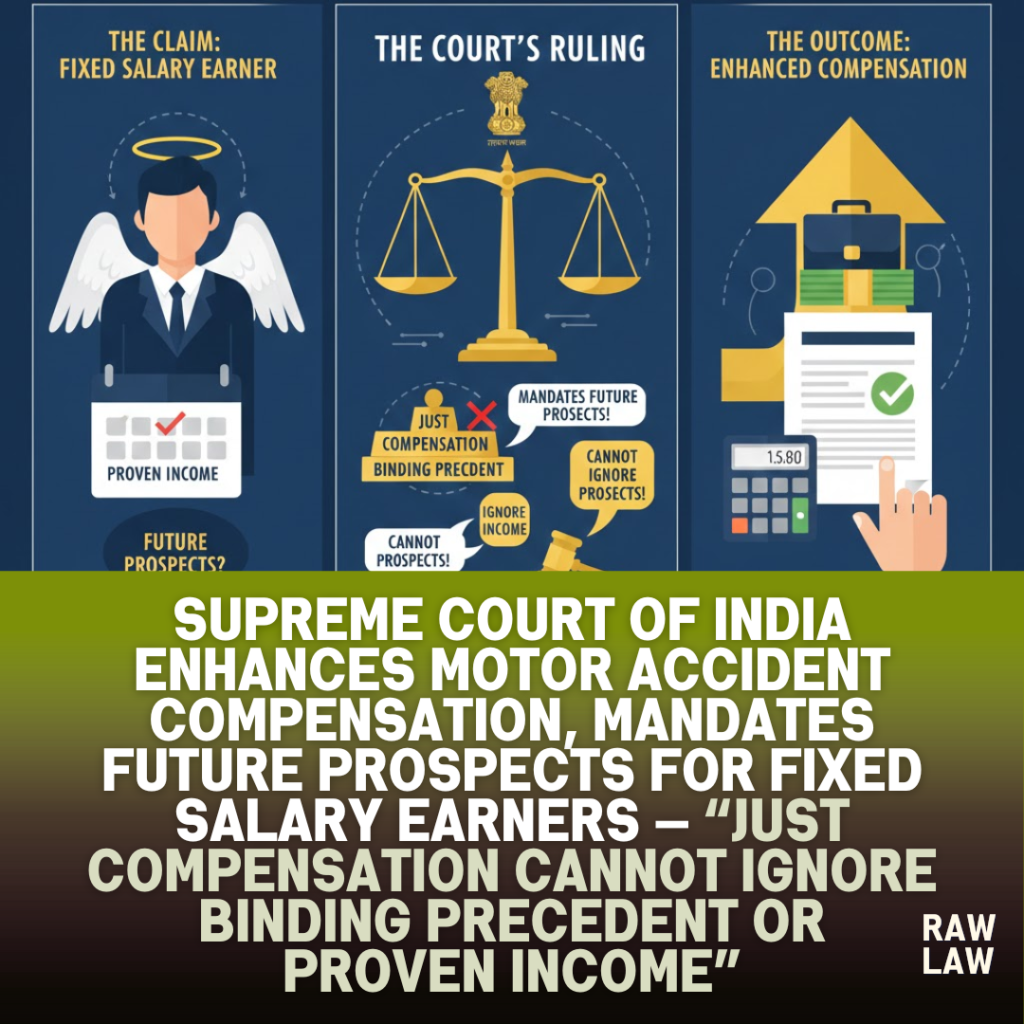
The Supreme Court of India allowed a civil appeal filed by the dependants of a deceased accident victim and substantially enhanced compensation from ₹10.51 lakh to ₹20.80 lakh. The Court held that where reliable documentary evidence of income exists, tribunals and courts cannot resort to guesswork, and that grant of future prospects is mandatory under binding Constitution Bench precedent. It further clarified that “loss of love and affection” cannot be awarded as a separate head, being subsumed within consortium.
2. Facts
The case arose from a fatal road accident dated 9 June 2011, in which a 37-year-old two-wheeler rider died after being hit by a tanker lorry insured with the respondent insurance company. The claimants—his widow, two minor children, and parents—filed a claim under Section 166 of the Motor Vehicles Act, 1988, seeking compensation of ₹20 lakh. They asserted that the deceased was employed as a driver earning ₹10,000 per month. The Motor Accidents Claims Tribunal accepted negligence but assessed income at ₹6,000 per month for want of documentary proof and awarded ₹9.37 lakh. The High Court marginally enhanced compensation to ₹10.51 lakh by taking income at ₹7,000 per month but denied future prospects.
3. Issues
The Supreme Court was required to determine whether the High Court erred in (i) ignoring documentary proof of the deceased’s income, (ii) denying future prospects despite settled law, and (iii) awarding compensation under the head “loss of love and affection” contrary to Constitution Bench authority.
4. Petitioners’ arguments
The claimants argued that the High Court disregarded clear documentary evidence in the form of a salary certificate and employer testimony establishing a fixed monthly income of ₹10,000. They contended that denial of future prospects was contrary to the Constitution Bench ruling in Pranay Sethi, which mandates addition even for fixed-salary earners below 40 years of age. It was further argued that the compensation awarded was neither fair nor “just” under Section 168 of the Act.
5. Respondent’s arguments
The insurer defended the High Court’s refusal to accept the claimed income, citing lack of corroboration. While it did not seriously contest the omission of future prospects, it objected to the High Court’s award under “loss of love and affection”, relying on Pranay Sethi which disapproved that head of compensation and overruled earlier contrary authority.
6. Analysis of the law
The Court reiterated that determination of “just compensation” is guided by structured principles and not unguided discretion. Where income is proved by cogent evidence, courts cannot reduce it on conjecture. The Court emphasised that the concept of future prospects is now an integral component of compensation, having crystallised through binding precedent, and must be applied uniformly to avoid arbitrariness.
7. Precedent analysis
The Court relied extensively on the Constitution Bench judgment in National Insurance Co. Ltd. v. Pranay Sethi, which standardised future prospects and confined non-pecuniary compensation to three conventional heads: loss of estate, loss of consortium, and funeral expenses. It also analysed Magma General Insurance Co. Ltd. v. Nanu Ram and United India Insurance Co. Ltd. v. Satinder Kaur to clarify that parental and filial consortium are included within consortium, and that “loss of love and affection” cannot survive as an independent head.
8. Court’s reasoning
On facts, the Court found that the salary certificate and employer affidavit conclusively proved a monthly income of ₹10,000, which was never discredited by the insurer. Given the deceased’s age of 37 and fixed salary, a mandatory addition of 40% towards future prospects was required. After deducting one-fourth towards personal expenses and applying the correct multiplier of 15, the loss of dependency was recalculated at ₹18.90 lakh. The Court removed the separate award for loss of love and affection but enhanced consortium by recognising spousal, parental, and filial consortium in line with binding precedent.
9. Conclusion
The Supreme Court enhanced the total compensation to ₹20.80 lakh and directed the insurer to pay the balance amount within twelve weeks, along with interest at 9% per annum from the date of filing of the claim petition. The appeal was disposed of accordingly.
10. Implications
This judgment reinforces strict adherence to Pranay Sethi in motor accident compensation cases. It sends a clear signal that future prospects are not discretionary, that proven income cannot be diluted without reasons, and that tribunals must avoid resurrecting disapproved heads of compensation. The ruling strengthens uniformity and predictability in accident compensation jurisprudence.
Case Law References
- National Insurance Co. Ltd. v. Pranay Sethi – Mandated future prospects and limited conventional heads of compensation; applied as binding authority.
- Magma General Insurance Co. Ltd. v. Nanu Ram – Expanded consortium to include parental and filial consortium; relied upon.
- United India Insurance Co. Ltd. v. Satinder Kaur – Clarified that loss of love and affection is subsumed within consortium; followed.
- Reshma Kumari v. Madan Mohan – Reiterated principles governing “just compensation”.
FAQs
Q1. Is future prospects mandatory in motor accident compensation cases?
Yes. Under Pranay Sethi, future prospects must be added even for self-employed or fixed-salary earners, depending on age.
Q2. Can courts award compensation for loss of love and affection separately?
No. The Supreme Court has held that loss of love and affection is included within consortium and cannot be a separate head.
Q3. What happens if documentary proof of income is ignored by courts?
The Supreme Court has clarified that ignoring reliable proof and resorting to guesswork amounts to legal error warranting correction.


