

1. Court’s decision
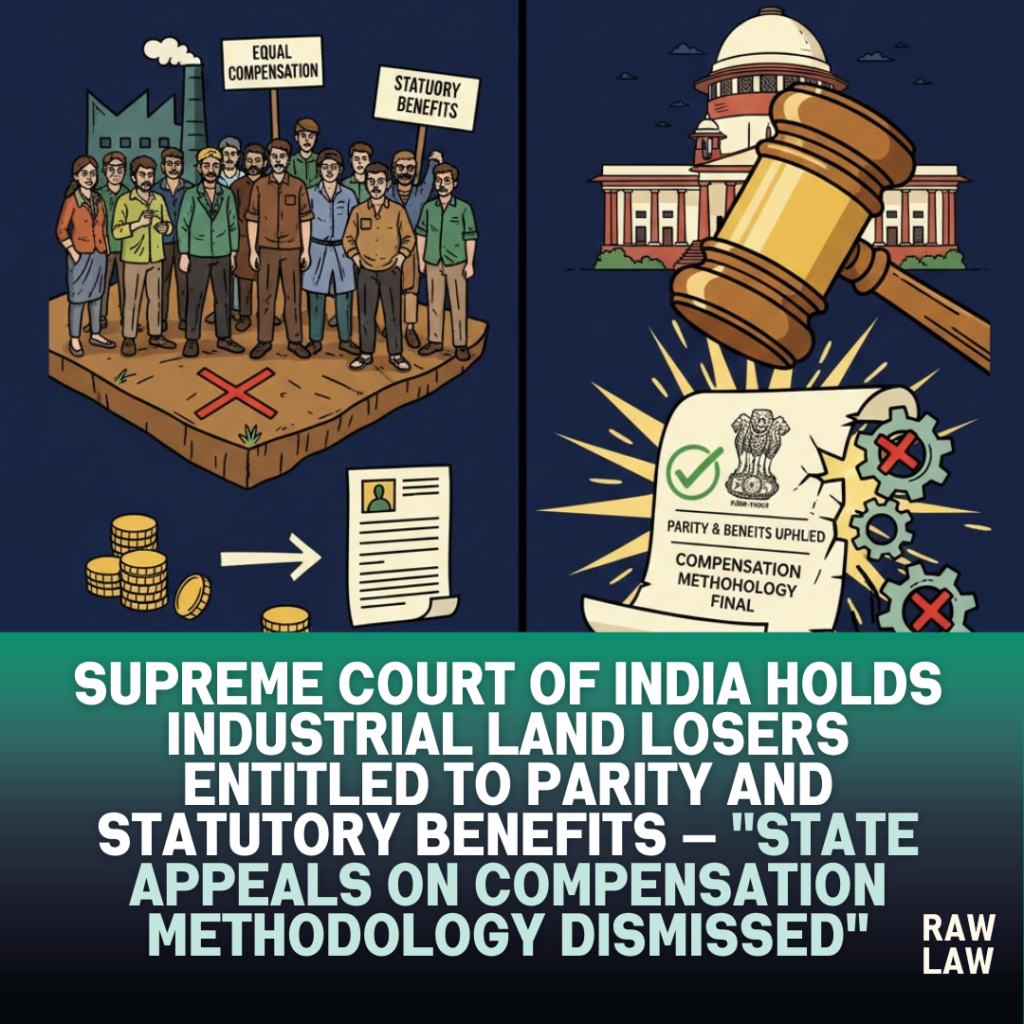
The Supreme Court of India dismissed a large batch of civil appeals filed by the State authorities challenging enhancement of compensation awarded to an industrial land owner whose property was acquired for a public purpose. The Court upheld the approach adopted by the Reference Court and the High Court in determining market value, statutory additions, and parity with similarly situated landowners, holding that the State failed to demonstrate any perversity or legal infirmity in the impugned awards.
2. Facts
The appeals arose out of land acquisition proceedings initiated by the State for an industrial and infrastructure-related public purpose. The respondent, an industrial undertaking, owned land that was notified and acquired under the Land Acquisition Act. Dissatisfied with the compensation awarded by the Land Acquisition Officer, the respondent sought reference, contending that the market value had been grossly undervalued and that comparable acquisitions in the same locality had resulted in substantially higher compensation. The Reference Court enhanced the compensation and granted statutory benefits, which was affirmed by the High Court. The State carried the matter to the Supreme Court through multiple connected appeals.
3. Issues
The principal issues before the Court were whether the Reference Court and the High Court had erred in determining market value, whether parity with compensation awarded in other acquisitions was justified, and whether the statutory components such as solatium, additional amount, and interest were correctly applied in favour of the landowner.
4. Appellant’s arguments
The State authorities argued that the courts below had mechanically relied on previous awards without independently assessing the nature, location, and potential of the acquired land. It was contended that the respondent’s land could not be equated with lands covered by other awards relied upon for parity. The appellants further submitted that the escalation applied to determine market value was excessive and that grant of statutory benefits had resulted in an unjust financial burden on the public exchequer.
5. Respondent’s arguments
The respondent contended that the land formed part of a contiguous industrial belt and possessed similar advantages as lands covered by earlier judicially accepted awards. It was argued that the principle of parity required similarly situated landowners to receive similar compensation. The respondent emphasized that the Reference Court had relied on legally admissible evidence and binding precedents, and that the statutory benefits granted were mandatory under the Land Acquisition Act and could not be curtailed by executive discretion.
6. Analysis of the law
The Court revisited settled principles governing determination of compensation under the Land Acquisition Act. It reiterated that market value must reflect what a willing purchaser would pay to a willing seller on the date of notification, taking into account location, potentiality, and comparable transactions or awards. The Court also emphasized that statutory additions such as solatium and interest are not discretionary but flow directly from the statute once acquisition is upheld.
7. Precedent analysis
The Court relied upon its consistent jurisprudence holding that parity in compensation is a valid consideration when lands are similarly situated and acquired under the same notification or for the same project. It reaffirmed that once a particular method of valuation has been judicially accepted for comparable lands, departure from that method requires cogent reasons. The Court also reiterated earlier rulings that escalation and reliance on prior awards are permissible when direct sale exemplars are unavailable or unreliable.
8. Court’s reasoning
Applying these principles, the Court found that the Reference Court and the High Court had carefully examined the evidence and recorded reasons for adopting the valuation methodology. The lands relied upon for parity were found to be comparable in terms of location and potential. The State’s objections were held to be largely repetitive and already considered by the courts below. The Supreme Court observed that mere dissatisfaction with the quantum of compensation cannot justify interference in appeals under Article 136, absent demonstrable perversity or misapplication of law.
9. Conclusion
The Supreme Court concluded that the enhanced compensation awarded to the respondent was legally sustainable. The appeals filed by the State authorities were dismissed, and the compensation, along with statutory benefits as awarded by the courts below, was upheld.
10. Implications
This judgment reinforces the principles of parity and consistency in land acquisition compensation. It underscores that once courts have determined market value based on sound methodology and comparable cases, the State cannot repeatedly challenge such determinations without fresh or compelling grounds. The ruling provides clarity and certainty to industrial landowners and strengthens judicial scrutiny over executive valuation in compulsory acquisitions.
Case Law References
- Land acquisition parity jurisprudence – The Court reaffirmed that similarly situated landowners must receive similar compensation unless a legally sustainable distinction is shown.
- Statutory benefits under the Land Acquisition Act – Reiterated as mandatory and inseparable from compensation once acquisition is upheld.
FAQs
Q1. Can the State challenge enhanced land acquisition compensation before the Supreme Court?
Yes, but interference is limited. The Supreme Court will not disturb concurrent findings on market value unless there is clear perversity or legal error.
Q2. Is parity with other land acquisition awards a valid ground for enhancement?
Yes. Courts may rely on parity when lands are similarly situated and acquired for the same project or under comparable conditions.
Q3. Are solatium and interest discretionary in land acquisition cases?
No. Statutory benefits such as solatium, additional amount, and interest are mandatory under the Land Acquisition Act.


