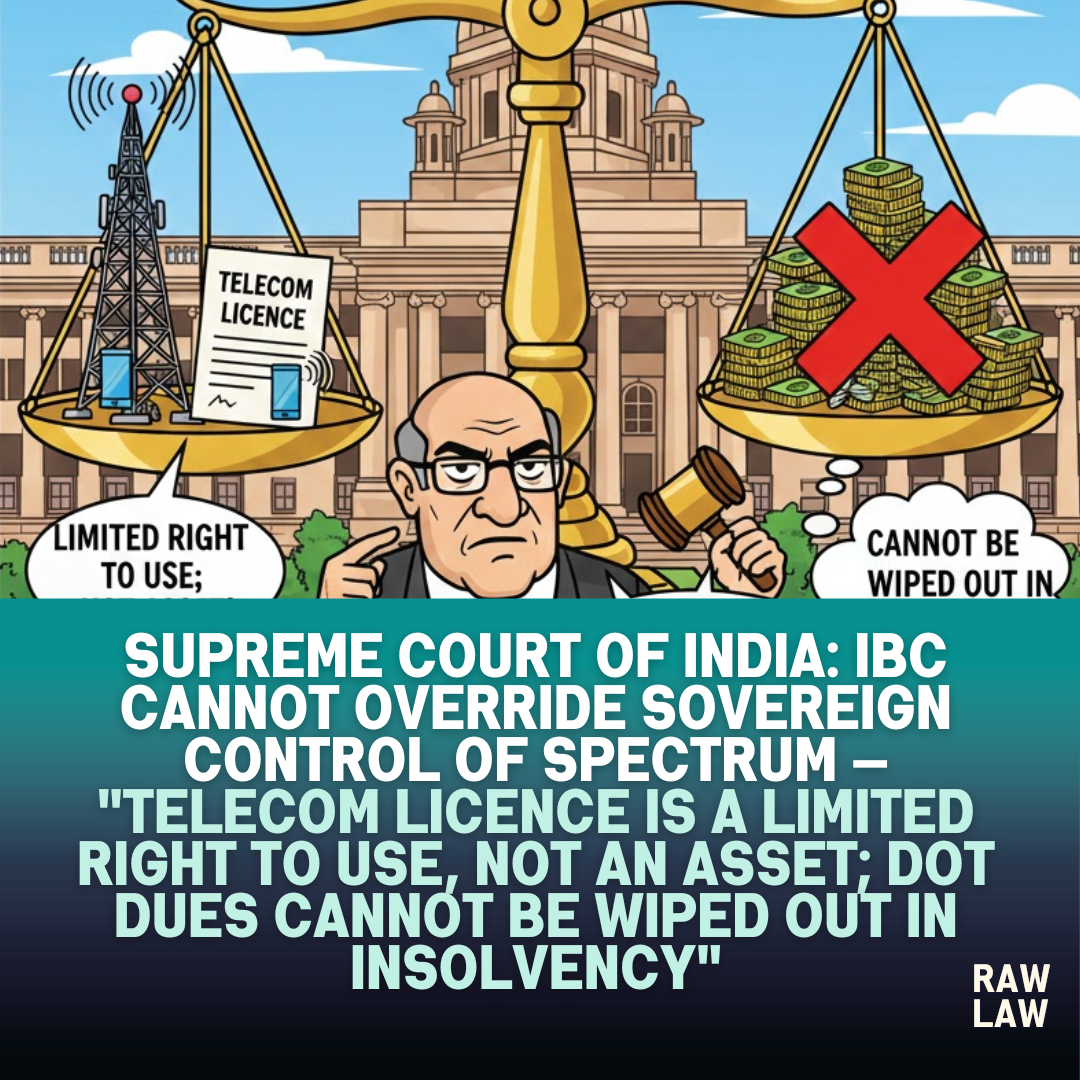
Supreme Court of India: IBC cannot override sovereign control of spectrum — “Telecom licence is a limited right to use, not an asset; DoT dues cannot be wiped out in insolvency”

Court’s decision
The Supreme Court of India held that spectrum is a scarce natural resource held by the Union of India in public trust and cannot be treated as an asset of a telecom service provider under the Insolvency and Bankruptcy Code, 2016. The Court ruled that a telecom licence confers only a limited, conditional and revocable right to use spectrum and does not vest any proprietary or ownership interest in the licensee. Consequently, spectrum usage rights cannot be transferred under a resolution plan without compliance with the Telegraph Act, licence conditions, and Spectrum Trading Guidelines. The Court set aside the contrary conclusions of the NCLAT.
Facts
The appeals arose from insolvency proceedings initiated by Aircel group entities after default in payment of licence fees and spectrum usage charges to the Department of Telecommunications. The corporate debtors invoked Section 10 of the IBC and obtained moratorium protection while substantial Adjusted Gross Revenue dues remained unpaid.
The DoT filed claims before the Resolution Professional asserting dues exceeding ₹9,800 crores. A resolution plan was approved by the Committee of Creditors and sanctioned by the NCLT. The DoT challenged the approval before the NCLAT.
The Supreme Court had earlier, in AGR proceedings, expressed concern over telecom companies invoking insolvency while massive public dues remained unpaid. Specific questions regarding ownership, transferability and treatment of spectrum under IBC were referred to the NCLAT for determination.
Issues
The core issues before the Court were whether spectrum is a natural resource held in public trust and whether telecom service providers possess ownership or merely a right to use spectrum.
The Court also examined whether spectrum usage rights can be treated as “assets” of the corporate debtor under Sections 18 and 36 of the IBC, and whether DoT dues qualify as operational debt capable of being compromised under a resolution plan.
Another central question was whether approval of a resolution plan under IBC can override statutory requirements under the Telegraph Act and Spectrum Trading Guidelines mandating clearance of dues before transfer.
Appellants’ arguments
The financial creditors and resolution professionals contended that spectrum usage rights constitute valuable intangible assets of the corporate debtor. Once insolvency is triggered, such assets fall within the control of the resolution professional and their treatment is governed by the commercial wisdom of the Committee of Creditors.
They argued that DoT dues are operational debt and must be addressed within the statutory waterfall under Section 53 of the IBC. Section 238, it was submitted, gives the IBC overriding effect over inconsistent contractual or statutory instruments.
It was further contended that preventing transfer of spectrum under a resolution plan would frustrate value maximisation and defeat the objective of insolvency resolution.
Respondent’s arguments
The Union of India argued that spectrum is a finite natural resource owned by the people of India, with the Government holding it as trustee. A telecom licence does not create proprietary rights but merely grants a conditional and revocable privilege under Section 4 of the Telegraph Act.
It was submitted that treating spectrum as an asset of the corporate debtor contradicts constitutional principles laid down in Centre for Public Interest Litigation and Natural Resources Allocation.
The DoT maintained that licence fees and spectrum usage charges arise from sovereign privilege and cannot be reduced to ordinary operational debt. It further contended that Spectrum Trading Guidelines mandating clearance of dues prior to transfer cannot be overridden by a resolution plan.
Analysis of the law
The Court undertook an extensive examination of the constitutional framework governing natural resources. It reaffirmed that spectrum is a material resource of the community and must be distributed so as to subserve the common good.
Referring to Section 4 of the Telegraph Act, the Court held that the Central Government enjoys exclusive privilege in respect of telecommunication activities and may grant licences on such conditions and consideration as it thinks fit. Such licences are contractual in form but rooted in sovereign authority.
The Court clarified that ownership of spectrum remains with the State. The licence grants only a limited right to use, subject to compliance with regulatory conditions, including payment of dues.
It emphasized that Explanation to Section 18 and Section 36(4)(a)(iv) of the IBC exclude assets not owned by the corporate debtor and contractual rights of use from the insolvency estate.
Precedent analysis
The Court relied on Centre for Public Interest Litigation v. Union of India to reiterate that spectrum is a scarce natural resource and that the State acts as trustee.
It also referred to Natural Resources Allocation, In re, which held that alienation of natural resources must serve public purpose and withstand scrutiny under Article 14.
In AUSPI (I) and AUSPI (II), the Court had earlier recognised the Government’s exclusive privilege under Section 4 of the Telegraph Act and its duty to obtain fair value for spectrum.
Drawing from Bharti Airtel Ltd. v. Union of India, the Court emphasized that while telecom licences are contractual, constitutional and statutory mandates prevail over purely commercial considerations.
Court’s reasoning
The Court rejected the NCLAT’s finding that spectrum can be treated as an intangible asset of the corporate debtor capable of being subjected to insolvency proceedings.
It held that ownership and control of spectrum remain with the Government. The licensee’s interest is conditional, defeasible, and subject to revocation for breach or non-payment.
The Court further held that Spectrum Trading Guidelines requiring clearance of dues before transfer are binding and cannot be bypassed through IBC proceedings. Section 238 of the IBC does not permit overriding of telecommunication statutes governing natural resources.
Allowing spectrum transfer under insolvency without clearing dues would undermine public trust doctrine and enable private parties to “wriggle out” of sovereign obligations.
Conclusion
The Supreme Court concluded that IBC cannot be used as a mechanism to restructure ownership or control of spectrum. Telecom licences confer only a regulated right to use and do not create proprietary interest.
DoT dues arising from licence conditions cannot be extinguished or subordinated in a resolution plan in derogation of statutory mandates. The appeals were decided accordingly, reaffirming sovereign control over spectrum and limiting the reach of insolvency proceedings in respect of natural resources.
Implications
This judgment has far-reaching consequences for telecom insolvency cases. It establishes that natural resources governed by statutory regimes cannot be treated as ordinary commercial assets under IBC.
Resolution plans involving telecom companies must comply with the Telegraph Act and Spectrum Trading Guidelines. Public dues tied to sovereign privilege cannot be compromised contrary to statutory conditions.
The ruling strengthens the public trust doctrine and delineates the boundary between insolvency law and sector-specific regulatory frameworks.
Case law references
- Centre for Public Interest Litigation v. Union of India (2012) 3 SCC 1 – Recognised spectrum as a scarce natural resource held in public trust.
- Natural Resources Allocation, In re, Special Reference No.1 of 2012 (2012) 10 SCC 1 – Allocation of natural resources must subserve common good.
- Union of India v. Association of Unified Telecom Service Providers of India (2011) 10 SCC 543; (2020) 3 SCC 525 – Affirmed exclusive privilege under Section 4 and AGR interpretation.
- Bharti Airtel Ltd. v. Union of India (2015) 12 SCC 1 – Telecom licence contractual in form but subject to constitutional constraints.
FAQs
1. Can spectrum be treated as an asset under the Insolvency and Bankruptcy Code?
No. The Supreme Court has clarified that spectrum remains a sovereign natural resource and is not an asset owned by the telecom company.
2. Can telecom dues to DoT be wiped out under a resolution plan?
No. Licence fees and spectrum usage charges arise from statutory conditions and cannot be extinguished contrary to telecom laws.
3. Does Section 238 of the IBC override telecom regulations?
No. The IBC cannot override sector-specific statutes governing natural resources like spectrum.