Supreme Court of India: Income Tax Department cannot deny regularization to similarly placed casual workers — “Misapplication of Umadevi corrected; services ordered regularized from 01 July 2006”

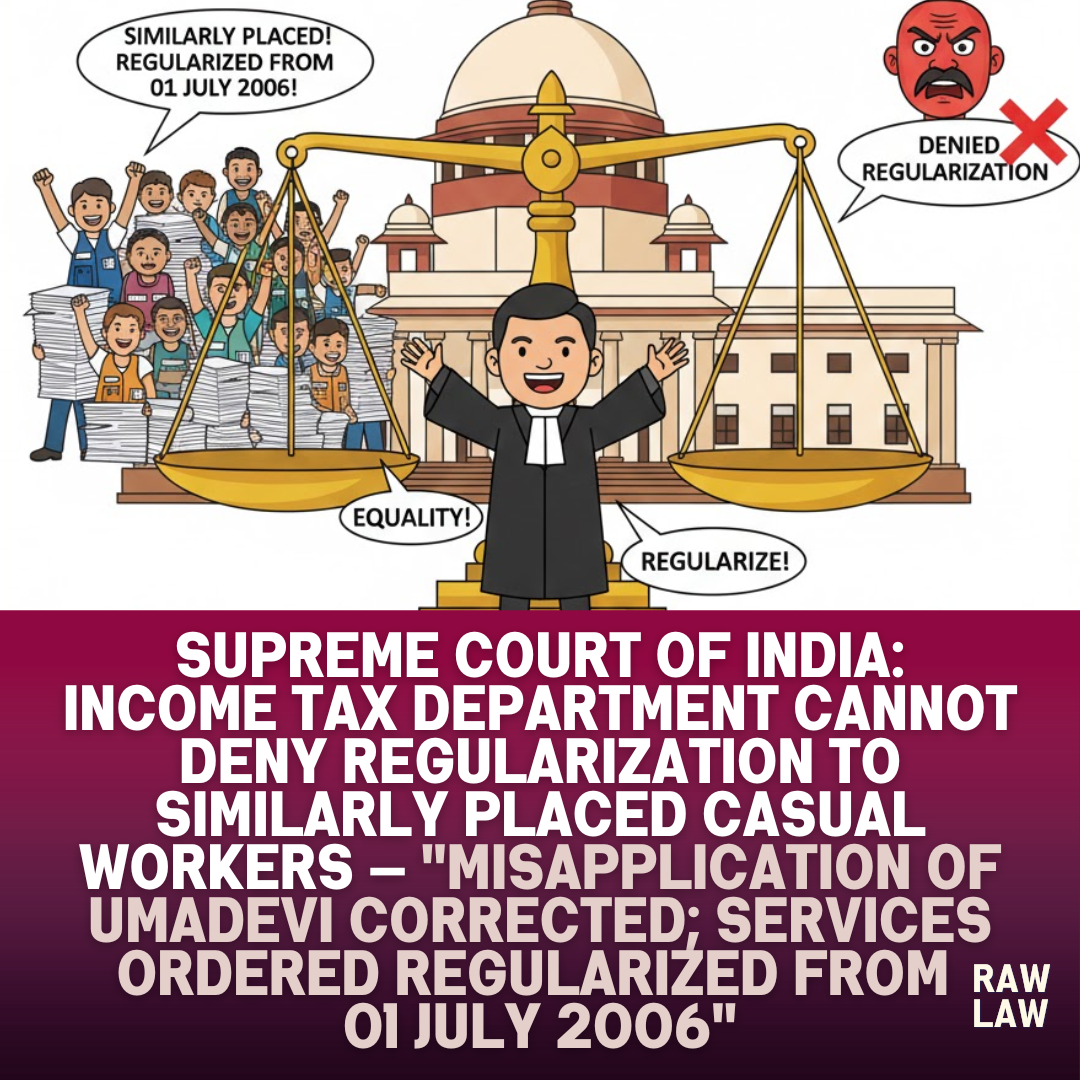
Court’s decision
The Supreme Court of India allowed a civil appeal filed by long-serving casual workers of the Income Tax Department, directing regularization of their services with effect from 01 July 2006. The Court held that the appellants were similarly situated to other daily-wage workers whose services had already been regularized pursuant to earlier Supreme Court judgments. It ruled that denial of regularization amounted to discriminatory treatment and that reliance on Umadevi to reject their claim was misplaced. The High Court’s judgment affirming the Tribunal’s refusal was set aside, and consequential benefits were directed to be released within three months.
Facts
The appellants had registered themselves with the Employment Exchange and were engaged as casual workers in the Office of the Commissioner of Income Tax, Gwalior, during the 1990s. They worked as Sweepers and Cook on daily wages from 1993 to 1998. Their appointments followed sponsorship through Employment Exchange and interviews.
Despite rendering long years of service, they were not granted temporary status or regularization. Subsequently, circulars in 2011 and 2012 indicated outsourcing of the work they had been performing. The appellants made repeated representations seeking regularization but were denied relief.
They approached the Central Administrative Tribunal, which rejected their claim on the ground that they did not meet the ten-year continuous service requirement as on 10 April 2006 under Secretary, State of Karnataka v. Umadevi (3). The High Court affirmed this decision. The matter reached the Supreme Court.
Issues
The principal issue was whether the appellants, long-serving casual workers of the Income Tax Department, were entitled to regularization despite not fulfilling the ten-year cut-off condition strictly applied under Umadevi (3).
A related issue was whether similarly situated employees having already been regularized pursuant to Supreme Court directions, denial of similar relief to the appellants amounted to discrimination.
The Court also examined whether the nature of their appointment was “irregular” or “illegal” and whether outsourcing of work indicated the perennial character of duties performed.
Petitioners’ arguments
The appellants contended that they were identically placed with employees in Ravi Verma v. Union of India, whose services had been regularized from 01 July 2006. They produced a list of daily-wage workers (as on 31 October 2005) showing that both they and the employees in Ravi Verma were part of the same cadre.
They argued that their appointments were not illegal but merely irregular, having been made through Employment Exchange sponsorship and interviews. Relying on Jaggo v. Union of India, they contended that Umadevi does not prohibit regularization of long-serving employees engaged against sanctioned and perennial work.
It was further urged that outsourcing of their work demonstrated its continued necessity and perennial nature, and that denial of regularization was arbitrary and discriminatory.
Respondents’ arguments
The Income Tax Department contended that the appellants did not satisfy the ten-year continuous service requirement as on 10 April 2006 laid down in Umadevi (3). It argued that no sanctioned posts were available and that the engagements were purely casual.
The Department maintained that subsequent outsourcing was a policy decision and that neither the Tribunal nor the High Court had erred in applying binding precedent to deny regularization.
Analysis of the law
The Supreme Court examined the principles laid down in Umadevi (3), which sought to curb backdoor appointments but permitted one-time regularization for employees in irregular (not illegal) appointments who had served for more than ten years in sanctioned posts.
The Court emphasized that Umadevi should not be misapplied to deny legitimate claims of long-serving employees performing perennial and essential duties. The distinction between “irregular” and “illegal” appointments remains crucial.
Further, the Court relied on its prior decisions where regularization had been directed for similarly placed Income Tax Department employees, reinforcing the constitutional principle of equality under Article 14.
Precedent analysis
The Court placed significant reliance on:
Ravi Verma v. Union of India (2018) – Directed regularization of similarly situated daily-wage workers in the Income Tax Department from 01 July 2006 on grounds of parity and non-discrimination.
Raman Kumar v. Union of India (2023) – Reiterated that similarly situated employees could not be discriminated against in matters of regularization.
Jaggo v. Union of India (2024) – Clarified that Umadevi distinguishes between illegal and irregular appointments and does not bar regularization of long-serving employees performing perennial functions.
The Court observed that the names of the present appellants appeared in the same official list of daily-wage workers as those regularized in Ravi Verma. Denying them similar treatment would violate equality principles.
Court’s reasoning
The Court found that five daily-wage workers from the same list had already been regularized pursuant to Supreme Court orders. The present appellants’ names appeared in the identical list dated 31 October 2005, as well as subsequent lists.
Thus, they were similarly situated and entitled to parity. Discriminatory treatment in public employment could not be sustained.
The Court further noted that outsourcing of their work demonstrated its perennial nature, supporting the argument that their engagement was not for temporary or sporadic purposes.
The Tribunal’s mechanical reliance on Umadevi was held erroneous, and the High Court’s affirmation of that approach was also set aside.
Conclusion
The Supreme Court set aside the High Court’s judgment and directed that the appellants’ services be regularized from 01 July 2006 on the same terms as granted in Ravi Verma and Raman Kumar. Consequential benefits were ordered to be released within three months.
The civil appeal was allowed without costs.
Implications
This ruling reinforces that Umadevi cannot be invoked mechanically to deny regularization where employees have rendered long, continuous service in perennial functions and similarly situated employees have already been regularized.
The judgment strengthens the doctrine of parity in public employment and reiterates that government departments cannot selectively apply Supreme Court rulings.
For casual and daily-wage workers across departments, the decision affirms that long-standing service combined with non-discriminatory treatment remains a powerful basis for regularization claims.
Case law references
- Secretary, State of Karnataka v. Umadevi (3) (2006)
Limited regularization but distinguished between illegal and irregular appointments. - Ravi Verma v. Union of India (2018)
Directed regularization of Income Tax daily-wage workers from 01 July 2006. - Raman Kumar v. Union of India (2023)
Extended parity principle in regularization cases. - Jaggo v. Union of India (2024)
Clarified misuse of Umadevi and protected long-serving irregular appointees.
FAQs
1. Can casual Income Tax workers claim regularization after Umadevi?
Yes, if their appointments are irregular (not illegal), they performed perennial duties, and similarly placed employees have been regularized, courts may grant relief.
2. Does outsourcing defeat a regularization claim?
Not necessarily. If outsourcing replaces the same perennial work, it may strengthen the argument that the duties were regular in nature.
3. What principle guided the Supreme Court’s decision?
The principle of parity and non-discrimination under Article 14, along with correct application of Umadevi distinguishing irregular from illegal appointments.