Supreme Court of India orders regularisation of Income Tax daily-wage workers — “Similarly situated employees cannot be discriminated” and Umadevi cannot be misapplied

Court’s decision
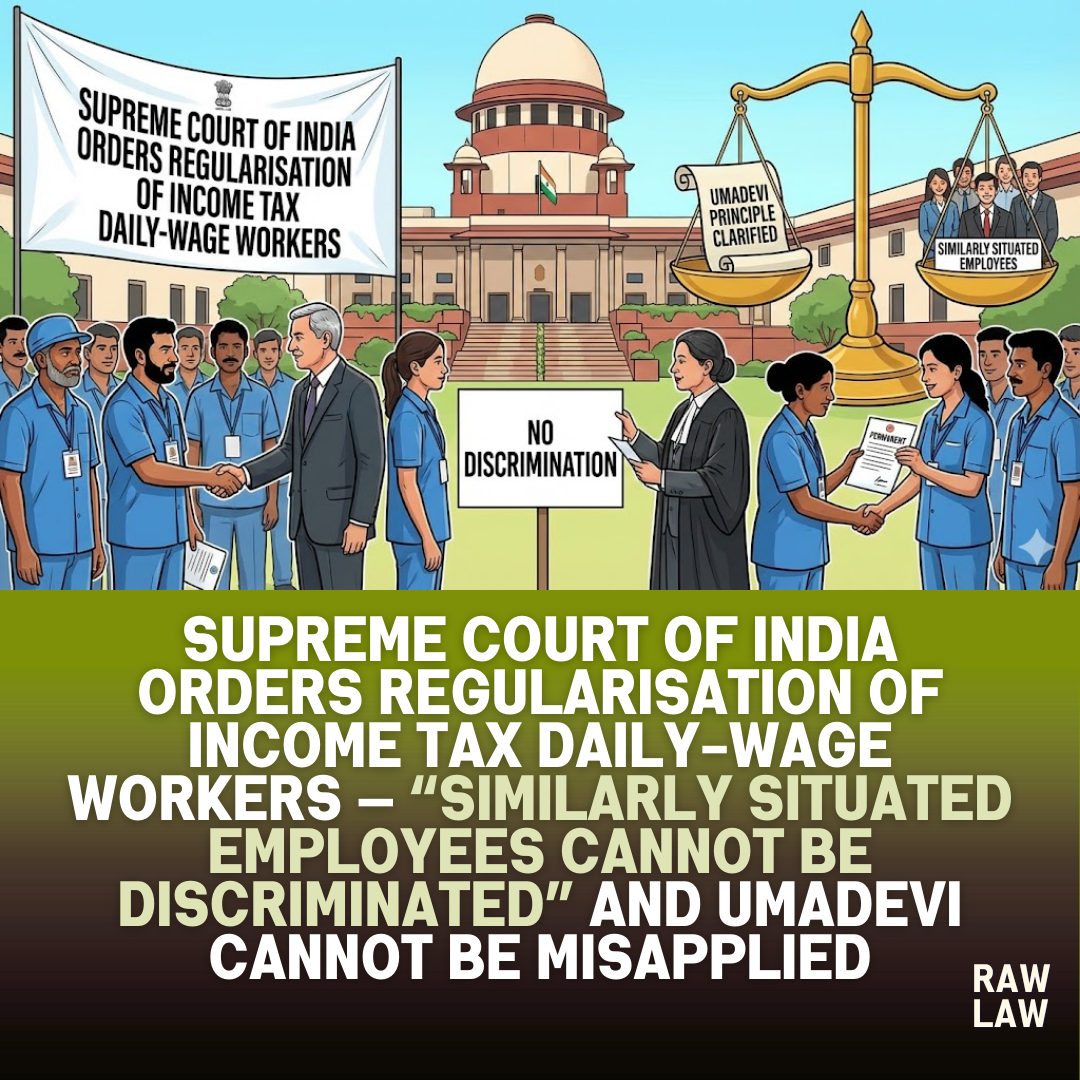
The Supreme Court allowed the civil appeal and directed regularisation of the appellants—casual workers in the Income Tax Department, Gwalior—from 01.07.2006, on the same terms as granted in Ravi Verma and Raman Kumar. The Court held that the appellants were similarly situated to other daily-wage workers whose services had already been regularised pursuant to earlier Supreme Court judgments. It ruled that denial of similar relief amounted to discriminatory treatment and that reliance on Umadevi (3) was misplaced in the facts of the case.
Facts
The appellants had registered with the Employment Exchange and were engaged as casual workers in the Office of the Commissioner of Income Tax, Gwalior. Appellants Nos. 1 to 3 were engaged as Sweepers in October 1997 and May 1998, while Appellant No. 4 was engaged as Cook in December 1993.
They claimed to have worked continuously for several years and expected conferment of temporary status and eventual regularisation. However, their representations were rejected. They approached the Central Administrative Tribunal seeking regularisation, but the Tribunal dismissed their application on 13.05.2015, holding that they did not satisfy the ten-year continuous service requirement as on 10.04.2006 under Secretary, State of Karnataka v. Umadevi (3).
The High Court of Madhya Pradesh affirmed the Tribunal’s decision on 26.08.2019, leading to the present appeal.
Issues
The Supreme Court examined:
- Whether the appellants were entitled to regularisation despite not fulfilling the strict ten-year criterion as on 10.04.2006 under Umadevi (3).
- Whether denial of regularisation amounted to discriminatory treatment when similarly situated daily-wage workers had already been regularised.
- Whether the Tribunal and High Court erred in applying Umadevi (3) without considering subsequent Supreme Court precedents.
Appellants’ arguments
The appellants argued that they were similarly situated to other daily-wage workers in the same Income Tax office whose services were regularised pursuant to the Supreme Court’s decision in Ravi Verma v. Union of India (2018).
They relied on the list of daily-wage workers working in the CIT Charge, Gwalior as on 31.10.2005 (reproduced in the judgment), which included both the appellants and those earlier regularised. They contended that discriminatory treatment violated Article 14.
They also relied on Jaggo v. Union of India (2024), submitting that their appointments were at worst “irregular” and not “illegal,” and that outsourcing of their work demonstrated its perennial nature.
Respondents’ arguments
The Income Tax Department contended that the appellants did not meet the eligibility criteria laid down in Umadevi (3), namely continuous service of ten years as on 10.04.2006.
It argued that no sanctioned posts were available and that the appellants were merely casual workers whose services were later outsourced through contractors. The Department maintained that the Tribunal and High Court had correctly denied relief.
Analysis of the law
The Supreme Court examined its earlier ruling in Ravi Verma (2018), where daily-wage workers in the same Income Tax office were directed to be regularised from 01.07.2006 after finding discriminatory treatment.
The Court noted that the names of the present appellants appeared in the same official list of daily-wage workers as on 31.10.2005, alongside those already regularised. The list, reproduced in the judgment (Page 6), included both the appellants and beneficiaries of earlier Supreme Court directions.
The Court further referred to Raman Kumar v. Union of India (2023), where similar relief was granted to other Income Tax daily-wage workers on parity grounds.
Importantly, the Court relied on Jaggo v. Union of India (2024 INSC 1034), reiterating that Umadevi (3) does not bar regularisation where appointments are “irregular” but not “illegal,” and where long and continuous service has been rendered against perennial posts.
Precedent analysis
In Ravi Verma (2018), the Supreme Court held that denial of regularisation to Gwalior daily-wage workers, when others elsewhere were regularised, amounted to discrimination and directed regularisation from 01.07.2006.
In Raman Kumar (2023), the Court reaffirmed this parity principle.
In Jaggo (2024), the Court clarified that Umadevi should not be weaponised to deny legitimate claims of long-serving employees performing perennial functions, especially where outsourcing replaced them.
The present Bench applied these precedents, holding that selective reliance on Umadevi to deny parity was legally untenable.
Court’s reasoning
The Court observed that the appellants’ names appeared in the official list of daily-wage workers as on 31.10.2005, 11.11.2005, and 31.01.2008, establishing parity with those regularised in Ravi Verma.
It held that similarly situated employees cannot be discriminated against in the matter of regularisation.
The Tribunal and High Court erred in mechanically applying the ten-year cut-off under Umadevi (3) without considering subsequent binding precedents.
The Court further emphasised that outsourcing of the same work demonstrated its perennial nature, supporting the appellants’ claim that their appointments were not illegal.
Accordingly, the Court directed regularisation from 01.07.2006 with consequential benefits to be released within three months.
Conclusion
The Supreme Court set aside the High Court’s judgment dated 26.08.2019 and allowed the civil appeal. The appellants’ services were ordered to be regularised from 01.07.2006 on the same terms as in Ravi Verma and Raman Kumar. Intervenors impleaded in interim applications were also granted similar relief.
Implications
This judgment strengthens the principle of parity in public employment. It clarifies that Umadevi (3) cannot be selectively invoked to deny regularisation where similarly situated employees have already been granted relief.
The ruling reinforces that outsourcing of perennial work cannot defeat legitimate claims of long-serving daily-wage workers.
For government departments, the judgment serves as a caution against discriminatory regularisation policies and misapplication of constitutional bench precedents.
Case law references
- Secretary, State of Karnataka v. Umadevi (3) (2006 INSC 216) — Regularisation principles and distinction between illegal and irregular appointments.
- Ravi Verma v. Union of India (2018) — Directed regularisation of Income Tax daily-wage workers at Gwalior.
- Raman Kumar v. Union of India (2023) — Granted parity-based regularisation to similarly situated workers.
- Jaggo v. Union of India (2024 INSC 1034) — Clarified that Umadevi cannot be misapplied to deny regularisation of long-serving employees.
FAQs
1. Can daily-wage government employees seek regularisation after Umadevi?
Yes, if their appointments are irregular (not illegal), they have rendered long continuous service, and similarly situated employees have been regularised.
2. What does “similarly situated employees cannot be discriminated” mean?
It means that when courts grant regularisation to one group of employees, others in identical factual circumstances must receive equal treatment.
3. Does outsourcing defeat a claim for regularisation?
No. Courts may treat outsourcing of the same work as evidence of perennial nature, supporting regularisation claims.