

Court’s decision
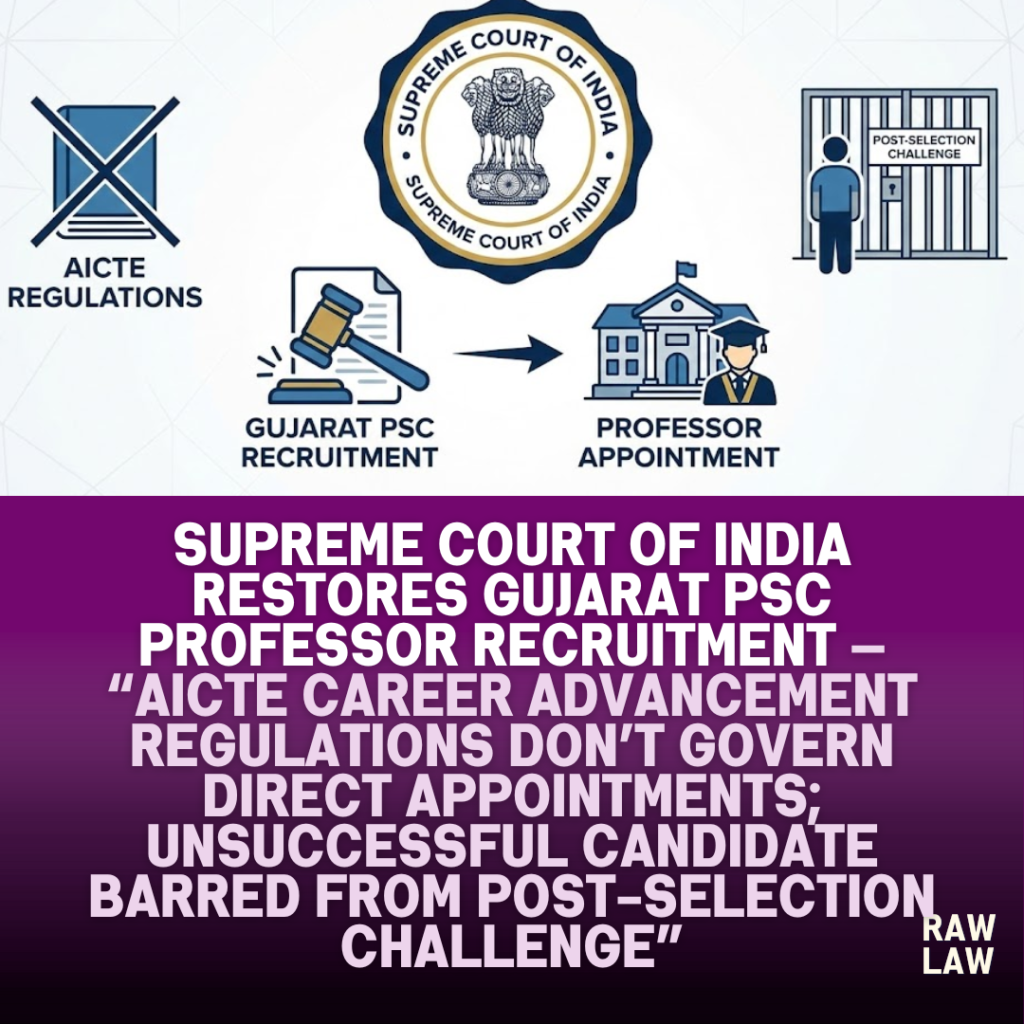
The Supreme Court of India allowed the appeal filed by the Gujarat Public Service Commission and set aside the Gujarat High Court Division Bench’s interference with a 2015 recruitment process for the post of Professor in Government Engineering Colleges. The Court held that the All India Council for Technical Education Career Advancement Scheme Regulations, 2012 apply only to promotion and career progression of incumbent teachers and not to direct recruitment conducted under State recruitment rules. Reaffirming the principle that candidates who participate without protest cannot challenge selection norms after failure, the Court upheld the interview-based recruitment and restored the dismissal of the writ petition.
Court’s decision
A Bench comprising Justices Pamidighantam Sri Narasimha and Alok Aradhe quashed the High Court’s directions requiring a fresh selection under AICTE norms. The Court ruled that insolvency-style judicial overreach was evident in the High Court’s approach, as it effectively replaced State recruitment rules with an inapplicable central regulatory framework. The Supreme Court upheld the recruitment conducted pursuant to the 23 September 2015 advertisement and declared that it could not be reopened a decade later on an erroneous understanding of regulatory hierarchy.
Facts
The Gujarat Public Service Commission issued an advertisement in September 2015 for recruitment to seven posts of Professors in Government Engineering Colleges, including one post in Plastic Engineering. The recruitment was governed by the Government Engineering Colleges Recruitment Rules, 2012, and general guidelines which prescribed assessment through personal interview.
The respondent candidate applied, appeared for interview in December 2015, and secured only 28 marks against the minimum qualifying requirement of 45 marks for her category. She was not recommended for appointment. After being declared unsuccessful, she invoked the AICTE Career Advancement Scheme Regulations, 2012 and challenged the selection process, seeking a direction for appointment as Professor.
Issues
The core issue before the Supreme Court was whether the AICTE Career Advancement Scheme Regulations, 2012 govern direct recruitment to the post of Professor in Government Engineering Colleges conducted by a State Public Service Commission under State recruitment rules. A connected issue was whether a candidate who participated in the selection process without objection could challenge the method of selection after being unsuccessful.
Appellant’s arguments
The Commission argued that the High Court erred in extending AICTE Career Advancement Scheme Regulations to an open competitive recruitment. It contended that the advertisement clearly stipulated interview-based selection and that the candidate accepted these terms by participating without protest. The Commission submitted that the AICTE Regulations were meant for career progression of existing faculty and could not displace State recruitment rules framed for initial appointments. It was urged that the High Court’s directions amounted to rewriting the recruitment framework ex post facto.
Respondent’s arguments
The candidate argued that AICTE Regulations, framed under a parliamentary enactment, prevail over State rules and must govern even direct recruitment to teaching posts. She contended that interview-only selection violated AICTE norms based on academic performance indicators and infringed her right to equality under Article 16. It was also submitted that the principle of estoppel could not be invoked to bar a constitutional challenge to an illegal selection process.
Analysis of the law
The Supreme Court undertook a structural reading of the AICTE Career Advancement Scheme Regulations, 2012. It noted that the Regulations are expressly designed for promotions and career progression of incumbent and newly appointed Assistant Professors, Associate Professors and Professors. The framework of Academic Performance Index, performance-based appraisal, and screening-cum-evaluation committees presupposes an existing service profile within an academic institution.
The Court held that these Regulations are not recruitment rules and cannot logically apply to candidates seeking entry into service through open competition. It clarified that while AICTE has authority to prescribe qualifications and standards, it does not possess power to abolish or override State recruitment rules for initial appointments.
Precedent analysis
The Court relied on settled jurisprudence that a candidate who participates in a selection process without demur cannot challenge the “rules of the game” after being declared unsuccessful. It reaffirmed that estoppel operates to prevent such post-hoc challenges, especially where the selection criteria were clearly disclosed in advance. The Court distinguished cases where AICTE norms override State action on qualifications, noting that the present dispute concerned evaluation methodology, not eligibility standards.
Court’s reasoning
Applying these principles, the Court held that the High Court committed a jurisdictional error in treating AICTE Career Advancement Scheme Regulations as applicable to direct recruitment. The Regulations operate in a different field from State recruitment rules and cannot be converted from a “ladder” for career progression into a “gate” for entry into service.
The Court also found the challenge barred by conduct, as the candidate willingly participated in the interview-based process and invoked AICTE norms only after failure. It observed that courts do not make appointments and a recruitment concluded in 2015 could not be reopened in 2025 on an inapplicable regulatory basis.
Conclusion
The Supreme Court allowed the appeal, set aside the Gujarat High Court’s judgment, and upheld the recruitment conducted by the Gujarat Public Service Commission under the 2015 advertisement. The writ petition stood dismissed, and no costs were awarded. The Court conclusively held that AICTE Career Advancement Scheme Regulations do not govern direct recruitment to professorial posts under State rules.
Implications
This judgment decisively clarifies the boundary between central academic regulations and State recruitment powers. It protects long-concluded recruitment processes from belated regulatory challenges and reinforces the doctrine that candidates cannot approbate and reprobate after participating in selection. For universities and public service commissions, the ruling provides certainty that AICTE career progression norms cannot be weaponised to unsettle direct recruitment conducted under valid State rules.
Case law references
- AICTE Career Advancement Scheme Regulations, 2012: Held to govern promotion and career progression, not direct recruitment. Applied to exclude their applicability to State PSC recruitment.
- Estoppel after participation in selection: A candidate cannot challenge selection criteria after participating without protest. Applied to bar the respondent’s writ challenge.
- Division of regulatory fields: Central academic standards and State recruitment rules operate in distinct domains. Applied to restore State recruitment framework.
FAQs
1. Do AICTE Career Advancement Scheme Regulations apply to direct recruitment of professors?
No. The Supreme Court has clarified that these Regulations apply only to promotion and career progression of existing faculty, not to initial recruitment.
2. Can an unsuccessful candidate challenge the selection process after participating?
Generally no. Courts apply the principle that a candidate who participates without protest cannot challenge the selection norms after being unsuccessful.
3. Can State recruitment rules for professors be overridden by AICTE Regulations?
Only in matters of qualifications and academic standards. AICTE career progression regulations do not override State rules governing direct recruitment.


