Supreme Court Orders Release of Liquor-Seized Commercial Truck; Holds Gujarat Prohibition Act Does Not Absolutely Bar Interim Custody and Imposes ₹15-Lakh Security Pending Trial

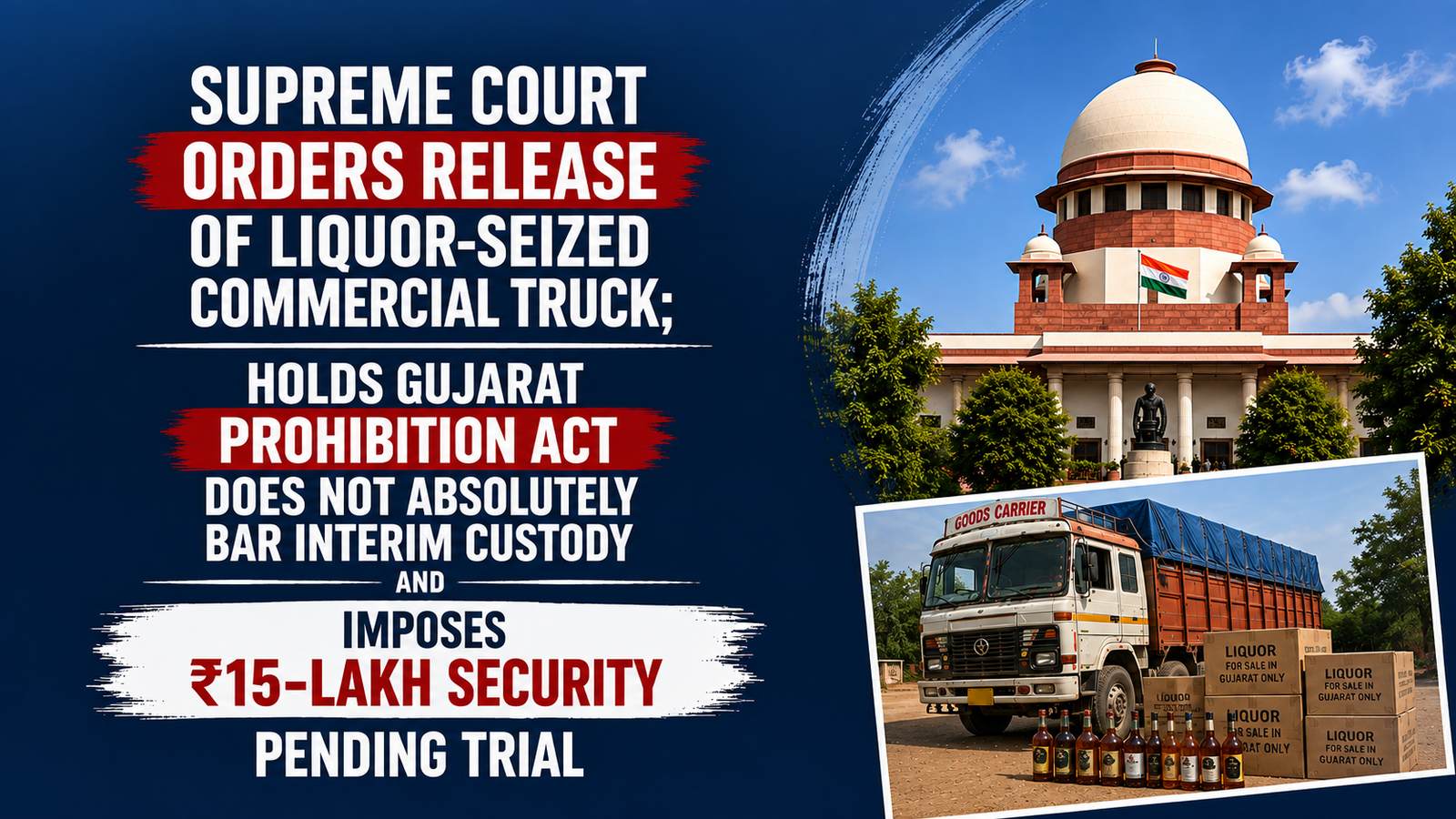
Supreme Court Releases Truck Seized With 22,532 Litres of Liquor; Holds Section 98(2) Gujarat Prohibition Act Is Not Absolute Bar to Interim Custody
Facts
The case concerned an Ashok Leyland commercial truck bearing registration No. RJ-14-GQ-22692, owned by M/s ABC Express. During the intervening night of 4–5 January 2025, the truck was intercepted while travelling from Modasa towards Vadodara via Lunawada. Police alleged that prohibited Indian-Made Foreign Liquor was being transported under the guise of ordinary transport goods.
Upon opening the truck, police discovered 8,064 bottles of IMFL measuring approximately 22,532.253 litres and valued at ₹17,02,656. The truck also contained edible transport goods worth approximately ₹98.66 lakh. The driver was unable to produce a permit for transporting the liquor.
An FIR was registered under Sections 65(a), 65(e), 98(2), 81, 116(b) and 83 of the Gujarat Prohibition Act, 1949. A charge-sheet was subsequently filed on 1 March 2025 against four accused, including the driver.
The owner sought interim custody of the truck under Section 497 of the BNSS. The Chief Judicial Magistrate rejected the application, the Sessions Judge affirmed that decision, and the Gujarat High Court also declined relief.
The owner therefore approached the Supreme Court.
Issues
The central question was:
Whether Section 98(2) of the Gujarat Prohibition Act creates an absolute statutory prohibition against releasing a vehicle on interim custody where liquor exceeding the prescribed quantity was allegedly transported in it.
The Court also considered whether keeping a commercial vehicle at the police station throughout a potentially lengthy criminal trial was justified when its evidentiary value could be preserved through photographs, videography and panchnama.
Appellant’s Arguments
M/s ABC Express contended that it was the owner of a commercial transport vehicle and was not itself implicated in the offence.
The truck had been seized from its driver. The appellant argued that the criminal trial could take four to five years and that keeping the truck parked at the police station would cause deterioration and substantial financial loss.
The appellant was willing to furnish adequate security and comply with conditions imposed by the Trial Court.
Respondent’s Arguments
The State of Gujarat relied principally upon Section 98(2) of the Gujarat Prohibition Act.
According to the State, because the quantity of liquor exceeded the prescribed limit, the statutory provision prevented the truck from being released on bond or surety until final judgment.
The State therefore maintained that the Magistrate, Sessions Court and High Court had correctly refused interim custody.
Analysis of the Law
The Supreme Court rejected the proposition that Section 98(2) constituted an absolute embargo against interim release.
The Court emphasized the practical problem caused by seized vehicles being left indefinitely at police stations and court compounds. Such vehicles deteriorate, lose value and cause substantial financial loss to their owners while often serving no continuing evidentiary purpose.
The Court held that provisions relating to interim custody give criminal courts broad discretion to determine how property produced during an investigation or trial should be preserved.
The purpose of these provisions is not to punish an owner before adjudication by allowing valuable property to waste away.
Section 98(2) Is Not an Absolute Bar
The Court relied heavily upon Khengarbhai Lakhabhai Dambhala v. State of Gujarat, which had examined the same provision.
Section 98 concerns confiscation, whereas the criminal court’s power concerning custody of property produced before it during investigation or trial operates in a different field.
The two statutory schemes must therefore be harmoniously construed rather than treating Section 98(2) as completely eliminating the criminal court’s interim-custody jurisdiction.
The Supreme Court consequently held that the courts below had taken an unduly narrow view of their powers concerning seized property.
Precedent Analysis
Sunderbhai Ambalal Desai v. State of Gujarat
This decision establishes that seized vehicles should ordinarily not remain parked at police stations for prolonged periods.
Magistrates should pass appropriate custody orders because keeping vehicles idle serves little purpose and causes deterioration.
The present Court reiterated that applications for interim custody should be dealt with expeditiously and judiciously.
Khengarbhai Lakhabhai Dambhala v. State of Gujarat
This was the most directly applicable precedent.
The Supreme Court had already considered the supposed embargo contained in Section 98(2) of the Gujarat Prohibition Act and held that confiscation provisions and the criminal court’s interim-custody jurisdiction operate in different fields.
The present judgment followed that approach.
Basavva Kom Dyamangouda Patil v. State of Mysore
The Court reiterated the fundamental principle that property seized by police should not remain in court or police custody longer than absolutely necessary.
Where continued retention is unnecessary, the property may appropriately be restored to its owner during inquiry or trial, particularly where deterioration or other compelling circumstances exist.
General Insurance Council v. State of Andhra Pradesh
The Supreme Court highlighted the practical reality that vehicles kept stationary at police stations rapidly deteriorate because of weather exposure, theft or cannibalisation of valuable parts.
This reinforced the need for courts to avoid mechanically retaining vehicles until completion of trial.
Court’s Reasoning
The Supreme Court found that the cumulative circumstances strongly favoured the appellant.
The truck was a commercial vehicle, and continued seizure resulted in an ongoing loss of livelihood. It occupied police-station space while deteriorating and losing value every day.
More importantly, the charge-sheet had already been filed.
Whatever evidentiary value remained in the truck could adequately be preserved through a detailed panchnama, photography and videography. There was therefore little practical justification for keeping the physical vehicle immobilised throughout the criminal trial.
The possibility of eventual confiscation was also insufficient to deny interim custody.
The Gujarat Prohibition Act contains its own confiscation procedure, including notice and an opportunity of hearing. Possible confiscation at the conclusion of proceedings could be protected through adequate security and conditions imposed upon the owner.
The Supreme Court therefore held that the High Court and subordinate courts had erred by refusing release solely on the basis of Section 98(2) without properly examining the principles governing interim custody and the relevant statutory amendments.
Conclusion
The Supreme Court allowed the appeal and set aside the orders of the Gujarat High Court and the courts below.
It directed that interim custody of the truck be handed over to M/s ABC Express subject to safeguards, principally:
- a personal bond with appropriate security of ₹15 lakh;
- production of the truck whenever required by the Investigating Officer or Trial Court;
- prohibition against alienating or creating third-party rights during trial;
- preparation of detailed panchnama, photographs and videography before release; and
- liberty to proceed against the security or vehicle if confiscation is ultimately ordered.
The Court expressly clarified that its observations concerned only interim custody and would not influence the merits of the criminal trial.
Case Details
Case: M/s ABC Express v. State of Gujarat
Court: Supreme Court of India
Citation: 2026 INSC 940
Case Number: Criminal Appeal No. 4172 of 2026, arising out of SLP (Crl.) No. 10301 of 2026
Bench: Justice Prashant Kumar Mishra and Justice Shree Chandrashekhar
Date: 2 September 2026
Result: Appeal allowed; orders refusing interim custody set aside; commercial truck directed to be released to its owner subject to ₹15-lakh security and other safeguards.