Supreme Court Protects ₹950-Crore UAE Decree From Asset Dissipation; Orders ₹200-Crore Additional Security, Upholds No Contempt and Leaves Corporate Veil Issue Open

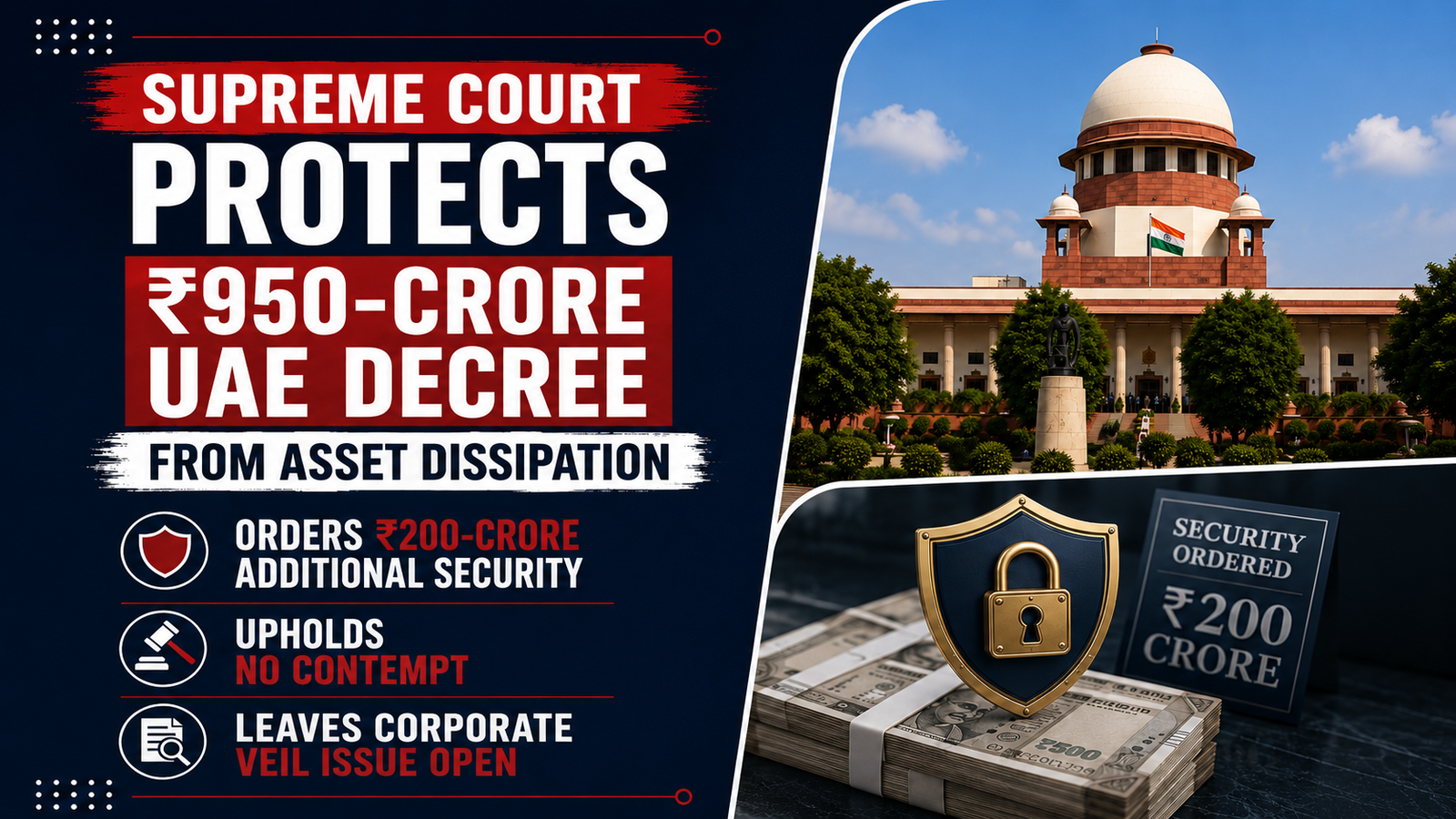
Supreme Court Orders ₹200-Crore Additional Security to Protect UAE Decree; Finds No Contempt but Notes Prima Facie Attempt to Camouflage and Dissipate Assets
Facts
Ras Al Khaimah Investment Authority (“RAKIA”), a public entity affiliated with the Government of Ras Al Khaimah, had entrusted funds to Nimmagadda Prasad (“NP”) for investment in the VANPIC Project, involving development of ports, an industrial corridor and an airport in Andhra Pradesh. RAKIA alleged that these funds were misappropriated.
In civil proceedings in the UAE, the Ras Al Khaimah Court of First Instance found RAKIA to be the victim of a fraudulent scheme and directed NP to pay AED 267,941,374, approximately ₹543.92 crore, with 6% annual interest. The decree was upheld by the superior court in cassation.
RAKIA sought enforcement in India under Section 44A CPC, asserting that the UAE was a reciprocating territory. Execution proceedings were instituted before the Commercial Courts at Hyderabad and Ranga Reddy. RAKIA secured attachment of NP’s assets estimated at approximately ₹212 crore.
The dispute subsequently expanded to IQuest, Matrix Pharmacorp, Tianish Laboratories, Moschip Technologies and members of NP’s family. RAKIA alleged that NP exercised direct or indirect control over a web of entities and that corporate transactions were being used to shield or dissipate assets and frustrate execution.
A significant dispute arose from a statement made by IQuest before the Commercial Court that it had initially been interested in acquiring Viatris but had subsequently decided not to proceed. RAKIA treated this as an undertaking. It alleged that the transaction was subsequently rerouted through Matrix, which acquired Tianish.
RAKIA instituted contempt proceedings before the Telangana High Court. The High Court ultimately dismissed them, holding that IQuest’s statement was merely clarificatory and not a binding undertaking. It also declined to pierce the corporate veil in summary contempt proceedings.
Parallel proceedings concerning the Matrix-Tianish merger were pursued before the NCLT and NCLAT. The NCLT approved the merger but initially protected RAKIA by restricting alienation and creation of charges over post-merger assets. The NCLAT subsequently removed those protections.
These interconnected contempt, execution and company-law proceedings ultimately reached the Supreme Court and were heard together.
Issues
The principal issues before the Supreme Court were:
- Whether IQuest’s statement before the Commercial Court constituted a clear and binding undertaking to the Court, breach of which could amount to contempt.
- Whether Matrix, Tianish, Viatris, Moschip or other entities could be proceeded against for contempt based upon IQuest’s statement.
- Whether RAKIA’s UAE decree was entitled to protection pending its execution in India under Section 44A CPC.
- Whether the transactions involving NP, his family and related corporate entities created a genuine apprehension of asset dissipation or shielding to defeat execution.
- Whether the existing status quo orders should continue or could be replaced with adequate financial security.
- Whether NP’s family-controlled entities could be treated as a unified structure or alter egos whose assets could be reached by lifting the corporate veil.
- Whether the NCLAT was justified in removing the protective conditions imposed by the NCLT while approving the Matrix-Tianish merger.
Appellant’s Arguments
RAKIA argued that its UAE decree was valid, binding and substantially unsatisfied and that NP and his family had used a series of corporate arrangements to shield or dissipate assets.
It alleged pervasive familial control over several corporate entities and argued that separate corporate personality could not be used as a device to frustrate execution. RAKIA therefore sought application of the alter ego doctrine and lifting of the corporate veil.
RAKIA further contended that the statement made by IQuest before the Commercial Court amounted to an enforceable undertaking and that subsequent transactions violated it.
It emphasised the importance of comity of courts and reciprocal enforcement of foreign judgments, arguing that a decree from a notified reciprocating territory could not be allowed to become meaningless because of asset transfers.
According to RAKIA, the present value of the foreign decree as on 23 July 2026 was approximately ₹949.96 crore, and around 75% remained unsecured. It sought continuation of restraints, additional security and a forensic examination of the assets held by NP, his family and affiliated entities.
Respondents’ Arguments
NP and the other respondents contended that substantial security had already been provided. They pointed to approximately ₹225 crore deposited in cash and title deeds of Medchal land which they valued at over ₹400 crore.
They argued that RAKIA’s numerous applications were effectively paralysing or “strangulating” legitimate publicly listed and bank-financed businesses.
On contempt, the respondents argued that IQuest’s statement was not a binding undertaking. They relied on the Telangana High Court’s finding that no contempt had occurred.
They further invoked Section 60 CPC, contending that only property belonging to the judgment debtor could ordinarily be attached and that entities which were strangers to the UAE decree could not automatically be compelled to furnish security.
Matrix and Tianish relied upon the doctrine of separate corporate personality, arguing that the corporate veil could be pierced only on clear and cogent evidence after proper adjudication. They maintained that NP had never held shares in Matrix or exercised legal, managerial or beneficial control over it.
Analysis of the Law
The Supreme Court separated two distinct legal questions: contempt liability and protection of the foreign decree pending execution.
On contempt, the Court held that an undertaking must be sufficiently clear, express and binding. Courts cannot manufacture an implied undertaking from an ambiguous or merely explanatory statement.
However, the absence of contempt did not prevent the Court from examining whether interim protective measures were necessary to preserve the effectiveness of execution.
The Court recognised that the RAK decree was a decree of a superior court in a reciprocating territory and was therefore prima facie executable in India. The principle of comity required Indian courts to give appropriate weight to such a decree. Without effective interim protection, reciprocal enforcement could be undermined and the decree rendered incapable of execution.
At the same time, the Supreme Court consciously declined to finally determine whether the separate corporate personalities of NP’s family-controlled entities could be disregarded. That question required adjudication on evidence in the pending execution proceedings.
Precedent Analysis
The Supreme Court principally considered Babu Ram Gupta v. Sudhir Bhasin & Anr., (1980) 3 SCC 47, which establishes that the nature and extent of an alleged undertaking must be carefully construed. A court cannot assume an implied undertaking where none appears from the record, and contempt jurisdiction must be exercised cautiously.
The Court also relied upon Patanjali Ayurved Ltd., In re v. Union of India, (2024) 19 SCC 193. That decision recognised that an undertaking may be given through an affidavit, application, express oral statement or even through counsel, and breach of a genuine undertaking may amount to contempt. Whether a statement amounts to an undertaking depends upon its actual language and surrounding circumstances.
Applying these precedents, the Supreme Court agreed with the Telangana High Court that IQuest’s statement did not demonstrate the firm and unequivocal commitment necessary to constitute an undertaking.
Court’s Reasoning
The Supreme Court agreed that IQuest’s statement that it had decided not to proceed with the Viatris acquisition was merely clarificatory. It did not constitute an unconditional or enforceable undertaking capable of supporting contempt proceedings. Consequently, no contempt could be sustained against IQuest or the other corporate respondents.
However, the Court did not accept that this ended the matter.
It found that RAKIA’s apprehension regarding dissipation of NP’s assets was “not without basis.” The series of changes involving NP, his family holdings and related corporate entities demonstrated sufficient familial involvement to warrant protection of the decree.
More significantly, the Supreme Court recorded a prima facie finding that NP appeared to be attempting to camouflage and dissipate assets with a view to defeating execution of the foreign decree. Vacating protection without adequate security could therefore obstruct justice.
The Court noted that NP and his immediate family members appeared to exercise pervasive control over several business entities and that the timing of corporate restructuring and formation of new companies created a genuine apprehension that RAKIA could ultimately be left with nothing more than a “paper decree.”
The Court consequently held that the protective conditions originally imposed by the NCLT ought not to have been disturbed by the NCLAT.
Considering the decree’s present value of approximately ₹949.96 crore, existing securities and disputed valuation of the Medchal land, the Court directed additional security of ₹200 crore to be furnished with the Supreme Court Registry within two weeks.
Crucially, however, the Supreme Court did not finally pierce the corporate veil. Whether NP’s family-controlled entities formed a unified structure whose assets could be reached for execution was expressly left open for determination by the Commercial Courts.
Conclusion
The Supreme Court adopted a balanced approach: it upheld the dismissal of contempt proceedings, but simultaneously strengthened protection for RAKIA’s foreign decree.
It held that IQuest’s statement was not an unconditional undertaking and therefore did not attract contempt. At the same time, NP and the respondent entities were jointly and severally directed to furnish additional security of ₹200 crore within two weeks, over and above security already furnished.
The Court left open the question whether NP’s family-controlled entities constituted a unified corporate structure whose assets could be reached to satisfy the decree. That issue, including lifting of the corporate veil, must be determined independently by the Commercial Courts.
Finally, the Supreme Court directed the Commercial Courts at Hyderabad and Ranga Reddy to decide the main execution petitions and all pending applications expeditiously and, in any event, within four months.
Case Details
Case: Ras Al Khaimah Investment Authority v. Matrix Pharmacorp Private Limited & Anr. and connected appeals
Court: Supreme Court of India, Civil Appellate Jurisdiction
Case Numbers: Civil Appeal Nos. 12993–12994 of 2025; Civil Appeal Nos. 12561–12566 of 2025; connected Civil Appeals arising from SLP (C) Nos. 27277–27279 of 2025 and SLP (C) No. 35892 of 2025
Bench: Chief Justice Surya Kant, Justice Joymalya Bagchi and Justice V. Mohana
Judgment authored by: Justice V. Mohana
Date: 1 September 2026
Result: Contempt finding declined/upheld in respondents’ favour; NP and respondent entities jointly and severally directed to furnish ₹200 crore additional security within two weeks; corporate veil/unified-entity question left open for execution proceedings; Commercial Courts directed to decide execution within four months; all appeals disposed of