Supreme Court Protects Pension of Retired Engineer Despite Invalid Tokre Koli Certificate; Upholds Caste Invalidation but Invokes Article 142 After Three Decades’ Service

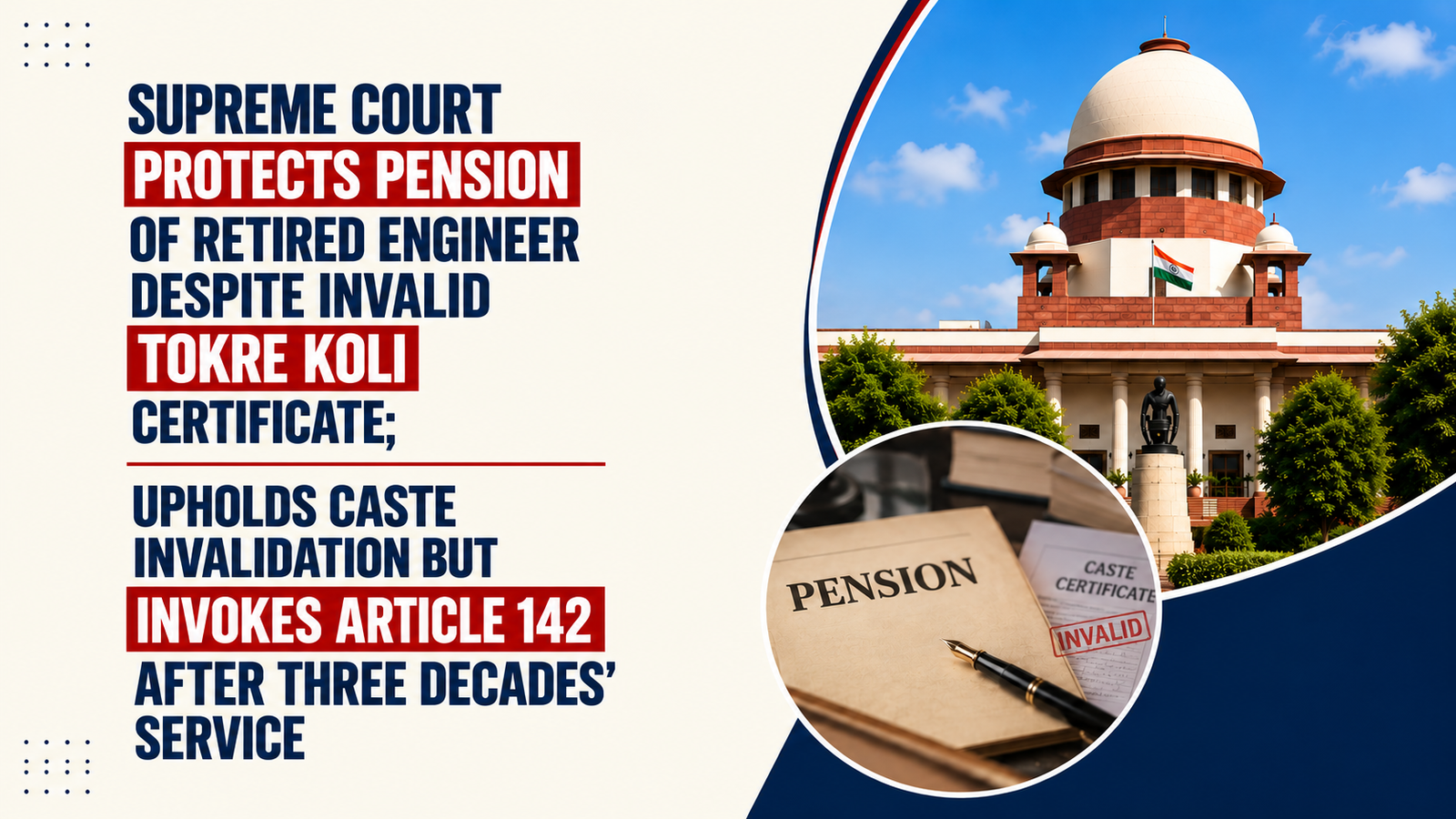
Supreme Court Upholds Cancellation of Tokre Koli Certificate but Protects Pension; Says Exceptional Equities After Three Decades’ Service Warrant Complete Justice Under Article 142
Facts
Shirish Pandharinath Patil was issued a caste certificate in 1984, certifying him as belonging to the “Tokre Koli” Scheduled Tribe. Relying on that certificate, he secured appointment as a Junior Engineer (Civil) with the Municipal Corporation of Greater Mumbai on 21 October 1994 and was promoted in 1999.
After losing the original certificate, he obtained a fresh certificate dated 21 October 2000 from the Sub-Divisional Magistrate, Bhusawal Division, certifying him as belonging to the “Tokare Koli” Scheduled Tribe.
In 2008, his employer referred the caste claim for verification. The Police Vigilance Cell examined old family records in which the caste of his paternal ancestors was recorded as “Koli,” “Hindu Koli” and “Hindu Suryawanshi Koli.”
After prolonged proceedings, the Scheduled Tribe Certificate Scrutiny Committee, by order dated 27 July 2020, invalidated his caste certificate and ordered its cancellation and confiscation.
The Bombay High Court dismissed his writ petition on 15 September 2020, holding that sufficient opportunity had been granted and that the pre-Constitution family records recording the caste as “Koli” had high probative value. It also accepted the Scrutiny Committee’s finding that the caste validity certificate issued to the appellant’s cousin had been obtained by misrepresentation.
The appellant thereafter approached the Supreme Court.
Issues
The principal issues were:
- Whether the Scrutiny Committee and Bombay High Court erred in rejecting the appellant’s claim of belonging to the “Tokre Koli” Scheduled Tribe.
- Whether rejection of his adjournment request before the Scrutiny Committee violated natural justice.
- Whether the old family records describing his ancestors as “Koli,” “Hindu Koli” or “Hindu Suryawanshi Koli” could sustain invalidation of his Scheduled Tribe claim.
- Whether, despite upholding caste invalidation, the Supreme Court could protect his retiral and pensionary benefits under Article 142 after more than three decades of service.
Appellant’s Arguments
The appellant argued that the Scrutiny Committee violated principles of natural justice when it rejected his adjournment request on 2 January 2020, which had been sought because his advocate and elderly family members were unavailable.
He also contended that relevant documents supporting his claim had not been properly considered, including:
- a 7/12 extract concerning family agricultural land recording it as “tribal land”; and
- a caste validity certificate granted to his cousin, Vinod G. Sonavane.
He further argued that historical references to “Koli” and “Suryavanshi Koli” in family records did not necessarily negate his claim to “Tokre Koli” Scheduled Tribe status.
Before the Supreme Court, he alternatively sought protection of his retirement and pension benefits because he had already retired on 30 June 2025.
He filed an affidavit stating that he had no children and no family member had obtained any benefit from the impugned caste certificate. He relied particularly upon Surekha Baljorsingh Thakur v. Caste Scrutiny Committee.
Respondents’ Case
The respondents defended the Scrutiny Committee’s decision and the Bombay High Court judgment on merits.
Their case was supported by the old family records showing the appellant’s paternal ancestors as “Koli,” “Hindu Koli” and “Hindu Suryawanshi Koli,” rather than “Tokre Koli.”
The High Court had also found that the appellant had been afforded sufficient opportunity throughout the lengthy scrutiny proceedings and that rejection of one adjournment application caused no prejudice or violation of natural justice.
Analysis of the Law
1. Supreme Court Upheld Caste Invalidation
The Supreme Court examined the Scrutiny Committee’s order, the Bombay High Court judgment and the material on record.
It expressly held:
“We find no error in the conclusion reached by the Scrutiny Committee and affirmed by the High Court…”
Thus, the Court did not overturn the finding that the appellant failed to establish his Tokre Koli Scheduled Tribe status.
This distinction is critical: the appellant succeeded only in obtaining protection of his retirement benefits, not restoration of his caste status.
2. Long Service and Retirement Created Exceptional Equities
The appellant had entered MCGM service in 1994 and continued until retirement on 30 June 2025, completing more than three decades of service.
During pendency of the Supreme Court proceedings, he had remained in employment because of the Court’s interim order dated 18 November 2021 and ultimately retired on attaining superannuation.
The Court considered these circumstances sufficient to examine whether complete justice required limited protection.
3. Invalid Caste Certificate Normally Carries Legal Consequences
The Supreme Court was careful not to dilute the ordinary consequences of an invalid caste claim.
It expressly recognised that:
“Generally, invalidation of a caste or tribe claim upon verification would have consequences in law.”
However, it held that exceptional circumstances and equitable considerations may justify exercise of Article 142 to do complete justice.
Accordingly, the judgment does not create a general rule that long service automatically protects employment or pension whenever a caste certificate is invalidated.
4. Article 142 Used Only to Protect Pension and Retiral Benefits
The Supreme Court invoked Article 142 to protect the appellant’s service from 21 October 1994 to 30 June 2025, but only for the limited purpose of computing and releasing his retirement and pensionary benefits.
Those benefits must be calculated according to the applicable service rules.
This is therefore a limited equitable protection, not validation of the appointment or caste claim.
5. No Future Reservation Benefit Permitted
The Court expressly clarified that the protection:
- does not validate or recognise the appellant as belonging to the Tokre Koli Scheduled Tribe;
- does not restore the invalidated caste certificate; and
- cannot be used by the appellant or any family member to claim any future benefit.
This limitation is central to understanding the scope of the ruling.
Precedent Analysis
Chairman and Managing Director, Food Corporation of India v. Jagdish Balaram Bahira, (2017) 8 SCC 670
The three-Judge Bench had held that ordinarily an appointment secured on the strength of an invalid caste or tribe certificate cannot survive.
However, it also recognised the Supreme Court’s constitutional power under Article 142 to mould relief in an appropriate exceptional case to achieve complete justice.
The present judgment applies that exceptional-equity principle.
R. Sundaram v. Tamil Nadu State Level Scrutiny Committee, 2023 SCC OnLine SC 287
The Court referred to R. Sundaram as an instance where relief relating to post-retirement benefits was granted notwithstanding annulment of the caste certificate.
Surekha Baljorsingh Thakur v. Caste Scrutiny Committee & Anr., Civil Appeal No. 4586 of 2024
This was particularly relied upon by the appellant.
In that case, the Supreme Court had protected post-retirement benefits despite caste certificate annulment through Article 142.
The Court treated the present appellant’s circumstances as sufficiently exceptional to grant similar limited relief.
Court’s Reasoning
The Supreme Court essentially separated the case into two distinct questions.
On caste status, the appellant failed. The Scrutiny Committee’s conclusion and Bombay High Court judgment were upheld.
On equitable consequences, however, the appellant succeeded.
Several factors influenced the Court:
- he had served MCGM from 1994 until 2025;
- his service exceeded three decades;
- he had already attained superannuation;
- he continued in service during the appeal pursuant to a Supreme Court interim order;
- he had no children; and
- no family member had obtained benefits from the impugned caste certificate.
The Court therefore considered it inequitable to deprive him of pension and retirement benefits accumulated over an entire working career.
Article 142 was used to protect the consequences of past service without legitimising the invalid Scheduled Tribe claim.
Conclusion
The Supreme Court partly allowed the appeal only to the extent of protecting the appellant’s retirement benefits.
It refused to interfere with:
- the Scrutiny Committee’s order dated 27 July 2020 invalidating the Tokre Koli Scheduled Tribe claim; and
- the Bombay High Court judgment dated 15 September 2020 affirming that decision.
However, the appellant’s service from 21 October 1994 until 30 June 2025 was protected for calculation and release of pension and retiral benefits.
The authorities were directed to process and release those benefits within six months.
The caste certificate remains invalid, and neither the appellant nor his family can claim any future benefit on its basis.
Case Details
Case: Shirish Pandharinath Patil v. State of Maharashtra & Ors.
Citation: 2026 INSC 949
Court: Supreme Court of India
Case Number: Civil Appeal No. ___ of 2026 arising out of SLP (C) No. 12938 of 2020
Bench: Justice Aravind Kumar and Justice Vipul M. Pancholi
Judgment by: Justice Vipul M. Pancholi
Date: 3 September 2026
Impugned Judgment: Bombay High Court judgment dated 15 September 2020 in Writ Petition (St.) No. 92659 of 2020.
Result: Appeal partly allowed; Tokre Koli Scheduled Tribe claim remains invalid, but service from 1994 to retirement in 2025 protected under Article 142 solely for pension and retiral benefits, payable within six months.