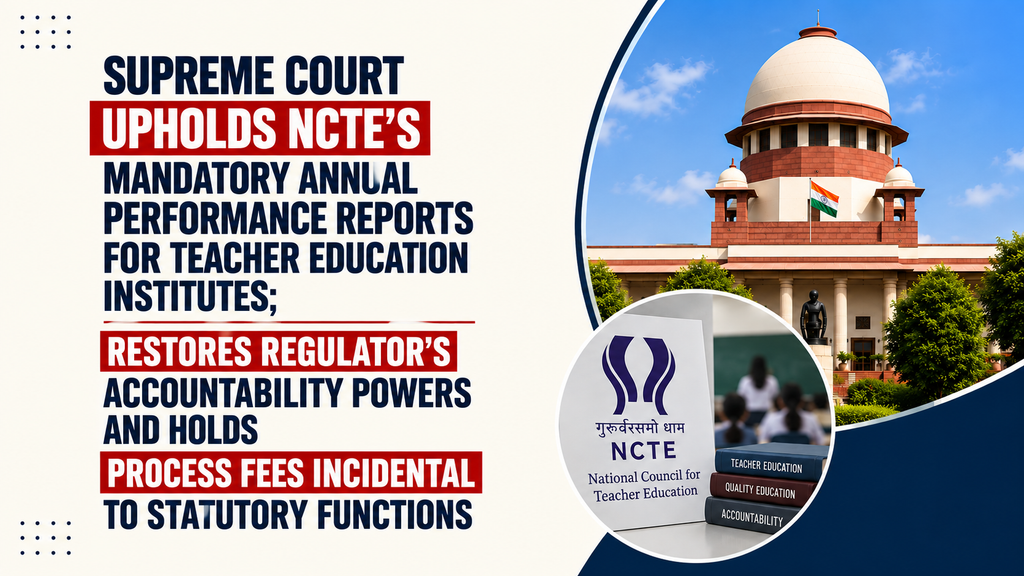
Supreme Court Upholds NCTE’s Mandatory Annual Performance Reports for Teacher Education Institutes; Restores Regulator’s Accountability Powers and Holds Process Fees Incidental to Statutory Functions

Supreme Court Restores NCTE’s Power to Demand Annual Performance Reports From Teacher Education Colleges; Sets Aside Delhi High Court Ruling Striking Down 2019 Notice
Facts
The appeal concerned the regulatory authority of the National Council for Teacher Education (NCTE) over Teacher Education Institutions (TEIs). The Supreme Court specifically examined whether NCTE could require recognised institutions to submit an annual Performance Appraisal Report (PAR).
NCTE had issued a Public Notice dated 22 September 2019, requiring all recognised TEIs to submit an online PAR for academic year 2018–19. The PAR included an annual statement of accounts audited by a Chartered Accountant.
The notice prescribed fees of:
- ₹5,000 for Central and State Government institutions; and
- ₹15,000 for all other institutions,
irrespective of the number of courses conducted. Non-submission could invite action under Section 17(1) of the NCTE Act.
Teacher Education Institutions challenged the notice, principally arguing that the Council itself, rather than the Member Secretary or Executive Committee, was required to evolve and approve the PAR system.
The Single Judge dismissed their writ petition. However, the Division Bench of the Delhi High Court allowed the appeal, holding that there was no material showing that the PAR proforma attached to the notice had been evolved or approved by NCTE or that the Council’s Section 12(k) function had been validly delegated. It therefore quashed the notice.
NCTE challenged that decision before the Supreme Court.
Issues
The principal issues were:
- Whether NCTE possessed statutory power to require recognised Teacher Education Institutions to submit annual Performance Appraisal Reports.
- Whether the Executive Committee and its Member Secretary could implement the Council’s decision regarding PARs.
- Whether a separate formal delegation under Section 27 was necessary.
- Whether performance appraisal is an incidental and ancillary regulatory power even apart from express statutory authorization.
- Whether NCTE could charge ₹5,000/₹15,000 while processing the annual PAR.
- What approach Constitutional Courts should adopt while judicially reviewing measures taken by specialised statutory regulators.
Teacher Education Institutions’ Case
The TEIs argued that the statutory power under Section 12(k) to evolve a suitable performance appraisal system belonged specifically to the Council.
According to them, there was no evidence that the actual PAR proforma accompanying the September 2019 notice had ever been placed before or approved by the Council.
They further contended that there was no material demonstrating that the Council had delegated its Section 12(k) function to the Member Secretary under Section 27.
This reasoning was accepted by the Delhi High Court Division Bench, which found the annual PAR requirement unsustainable.
NCTE’s Case
NCTE’s position was essentially that the Council had already taken the policy decision to implement the PAR system and had authorised NCTE to proceed through a proforma to be developed for that purpose.
The Executive Committee, as the statutory executive arm of the Council, was therefore merely implementing an already approved policy rather than independently exercising the Council’s legislative or regulatory function.
The Supreme Court ultimately accepted this construction.
Analysis of the Law
1. NCTE Has a Broad Statutory Mandate Over Teacher Education
The Court examined the NCTE Act in the context of Article 21A and the Right to Education Act, 2009.
Section 23 of the RTE Act requires minimum qualifications for teachers to be prescribed by an academic authority, and NCTE is that designated academic authority.
Under Section 12 of the NCTE Act, the Council has the primary responsibility to ensure planned and coordinated development of teacher education and maintenance of appropriate standards.
Its functions expressly include monitoring teacher education and, crucially, under Section 12(k), evolving suitable performance appraisal systems, norms and mechanisms for enforcing accountability upon recognised institutions.
2. Teacher Education Institutions Are Constitutional “Duty Bearers”
The judgment gives teacher education a broader constitutional dimension.
Referring to Dinesh Biwaji Ashtikar v. State of Maharashtra, the Court recalled five existing duty bearers responsible for effective implementation of the fundamental right to elementary education.
The Court then expressly added two more:
Sixth duty bearer: Teacher Education Institutions.
Seventh duty bearer: National Council for Teacher Education.
TEIs must properly educate and train teachers, while NCTE must ensure coordinated development, efficiency, integrity and standards throughout the teacher education system.
The Court described NCTE’s regulatory duties as perhaps the highest amongst these duty bearers.
3. Executive Committee Can Implement Council’s Decisions
Section 19 creates the Executive Committee to discharge functions assigned by the Council or determined by regulations.
The Court described it as the body that “actually discharges the functions of the Council” and bears responsibility for implementing the statutory objective of coordinated teacher education development.
The crucial factual finding came from the Council’s 48th General Body Meeting dated 5 February 2019.
The Council considered annual renewal of recognition impractical because of widespread litigation and instead decided to implement the PAR system as a Management Information System.
The recorded decision expressly stated:
“The agenda item was approved as proposed authorising NCTE to proceed…”
Therefore, the Supreme Court found that the Council had already made and approved the substantive policy decision.
The Executive Committee and Member Secretary were simply carrying it into effect.
4. Section 12(k) Expressly Authorises Performance Appraisal
The Court found “ample empowerment” for both the Council and Executive Committee to call for annual PARs.
Section 12(k) itself authorises NCTE to evolve:
- performance appraisal systems;
- norms; and
- mechanisms for enforcing accountability.
The Council had deliberated upon the issue, adopted the PAR mechanism and authorised its implementation.
Accordingly, the Member Secretary acted within statutory authority when issuing the 22 September 2019 notice.
5. PAR Requirement Is Valid Even as an Incidental Regulatory Power
The Court went beyond Section 12(k).
It held that even without specific statutory empowerment, requiring performance reports would constitute an incidental and ancillary power inherent in NCTE’s regulatory responsibilities.
A regulator responsible for maintaining educational standards must logically possess the ability to obtain information from the institutions it regulates.
The Court drew an analogy with NCTE itself being subject to performance audit by the Comptroller and Auditor General of India. If the regulator is accountable through audits, it is natural that institutions within its jurisdiction should similarly provide performance information.
6. Accountability Is an Essential Principle of Administrative Law
A significant portion of the judgment concerns regulatory accountability.
The Supreme Court declared:
“Accountability in itself is an essential principle of administrative law.”
It identified three constituent dimensions of accountability:
- Responsibility — identification of duties and performance obligations.
- Answerability — reasoned decision-making.
- Enforceability — corrective action when responsibility and accountability are absent.
This gives the judgment significance beyond teacher education and potentially makes it relevant to judicial review of regulatory bodies generally.
7. Courts Should Not Adopt a Technical or Pedantic View of Regulators’ Powers
The Supreme Court criticised the approach adopted by the Delhi High Court.
When reviewing action of a statutory regulator, the judicial inquiry should principally examine whether:
- a mandatory statutory provision has been violated; or
- the regulator has transgressed the powers vested in it.
The regulator’s action must be assessed against the larger mandate and purpose of the governing legislation.
The Supreme Court consequently held that Constitutional Courts also have a positive duty to ensure that regulators exercise their statutory powers effectively, efficiently and accountably.
Courts therefore “cannot adopt a technical or a pedantic view” of legitimate regulatory action.
8. ₹5,000–₹15,000 Charges Are Valid Processing Fees
The Public Notice also required payment along with submission of the PAR.
The Supreme Court characterised this payment as a “process fee”, rather than treating it as an impermissible tax.
It held that the power to impose such a processing charge is itself incidental and ancillary to NCTE’s regulatory functions.
Thus, the Court validated both the reporting obligation and the accompanying processing fee.
Precedent Analysis
Dinesh Biwaji Ashtikar v. State of Maharashtra & Ors., 2026 SCC OnLine SC 56
The Court relied significantly on this recent decision concerning the constitutional right to elementary education.
That judgment identified five duty bearers responsible for implementing the right to education. The present judgment expanded that framework by recognising TEIs as the sixth and NCTE as the seventh duty bearer.
Vijay Rajmohan v. CBI, (2023) 1 SCC 329
Cited in the context of the administrative-law principle of accountability, particularly its relationship with responsibility, answerability and enforceability.
Court’s Reasoning
The Supreme Court found the Delhi High Court’s approach excessively technical.
The fundamental error was treating the Member Secretary’s notice as though it represented an independent policy decision.
In reality:
- Section 12(k) expressly authorised NCTE to create performance appraisal mechanisms;
- the Council considered PAR at its 48th General Body Meeting;
- the Council approved the proposal;
- the Council authorised NCTE to proceed through a proforma;
- the Executive Committee was statutorily responsible for implementation; and
- the Member Secretary merely issued the operational notice implementing that mandate.
The Court therefore found no unlawful delegation.
More broadly, the Court held that a regulator entrusted with maintaining standards cannot effectively discharge that obligation if it lacks the power to demand information, conduct assessments and enforce institutional accountability.
Performance appraisal was consequently not an extraneous exercise but an integral component of NCTE’s statutory regulatory function.
Conclusion
The Supreme Court allowed NCTE’s appeal and set aside the Delhi High Court Division Bench judgment dated 13 March 2023 in LPA No. 190 of 2021.
It expressly declared that:
- the Public Notice dated 22 September 2019 is legal and valid;
- NCTE is empowered to require Teacher Education Institutions to upload annual Performance Appraisal Reports;
- the Executive Committee is competent to implement the Council’s decision;
- performance appraisal is independently sustainable as an incidental and ancillary regulatory power; and
- the accompanying payment is a permissible processing fee.
There was no order as to costs.
Case Details
Case: The National Council for Teacher Education v. Association of NCTE Approved Colleges Trust & Ors.
Citation: 2026 INSC 953
Court: Supreme Court of India
Case Number: Civil Appeal No. ___ of 2026 arising out of SLP (C) No. 11756 of 2023
Bench: Justice Pamidighantam Sri Narasimha and Justice Alok Aradhe
Date: 3 September 2026
Impugned Judgment: Delhi High Court, LPA No. 190 of 2021, dated 13 March 2023
Result: Appeal allowed; Delhi High Court judgment set aside; NCTE’s 22 September 2019 Public Notice requiring annual Performance Appraisal Reports upheld as legal and valid; no costs.