Supreme Court Rejects ₹22 Crore Cotton Fire Insurance Claim; Holds Additional Premium Paid After Loss Cannot Retrospectively Extend Exhausted Turnover-Based Policy Coverage

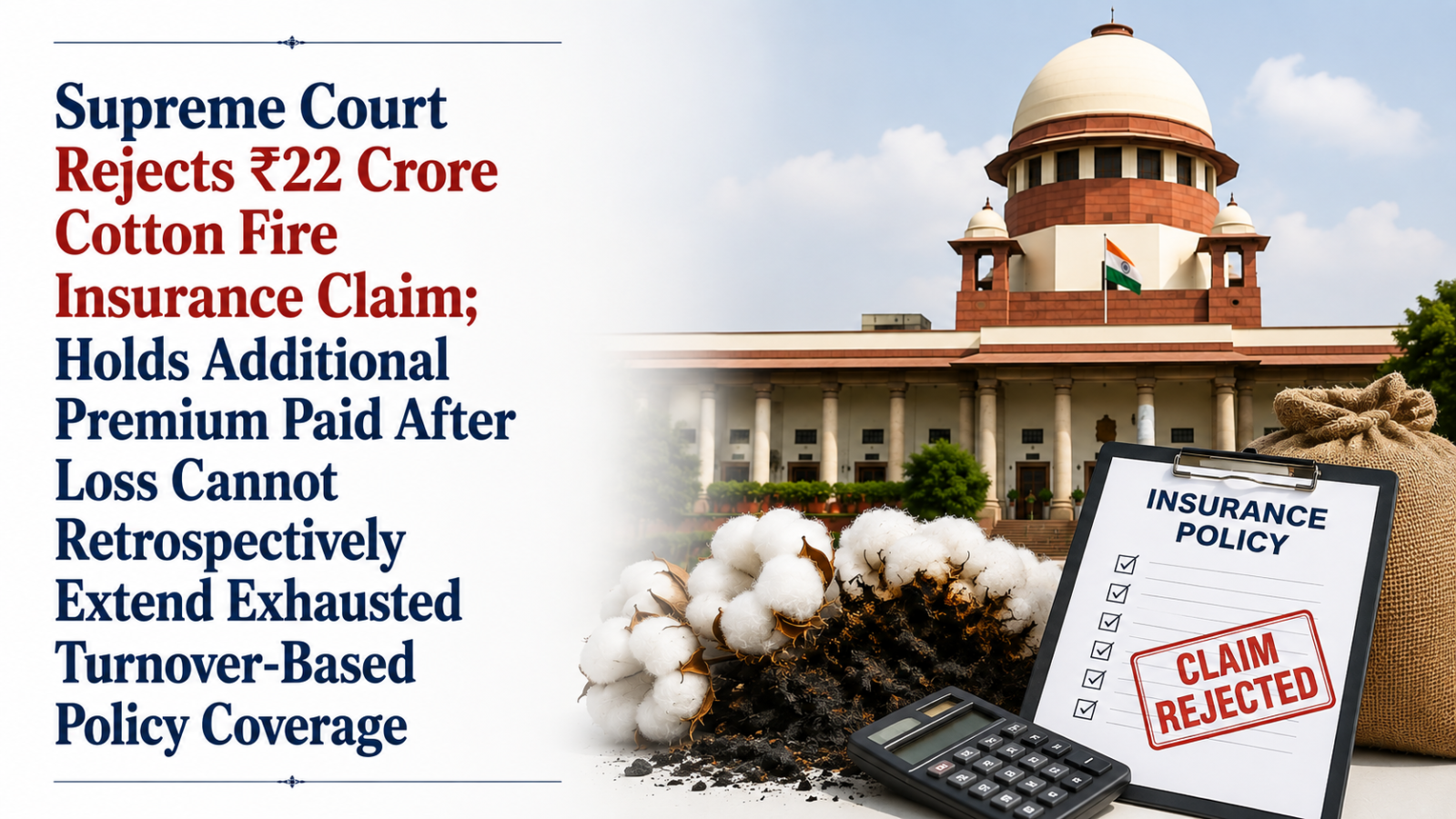
Supreme Court Allows Insurer’s Appeal in ₹22 Crore Cotton Fire Claim; Holds Statutory Premium Requirement Overrides Assurances by Company Officers
Facts
The respondent, Louis Dreyfus Commodities India Pvt. Ltd., obtained a Marine Cargo Annual Turnover Policy from New India Assurance covering an annual turnover of ₹1,200 crore for the period 1 January 2010 to 31 December 2010. The premium was payable in two equal instalments.
On 7 November 2010, a fire broke out at a Container Freight Station where 41,481 cotton bales belonging to the respondent were stored. The insurer was informed the same day.
The first surveyor appointed by the insurer assessed the loss at approximately ₹22.01 crore.
The dispute arose because the insured’s actual turnover had substantially exceeded the policy limit. According to the insurer, the total ₹1,200 crore turnover cover had already been exhausted by July 2010, and on the date of the fire the turnover had risen to ₹1,724.12 crore.
The respondent relied on an email dated 17 May 2010 from the insurer’s Divisional Manager stating that, after payment of the second instalment, all transits would remain covered until expiry of the policy even if turnover exceeded ₹1,200 crore.
After the fire, the insurer demanded an additional premium of approximately ₹86.86 lakh, which the respondent paid on 17 December 2010. An endorsement was then issued enhancing the coverage, expressly effective from that date.
The insurer subsequently repudiated the claim on 27 July 2012.
The NCDRC allowed the consumer complaints and directed payment of the amount assessed by the surveyor, relying particularly on the May 2010 email assurance.
New India Assurance challenged that decision before the Supreme Court.
Issues
The principal issues before the Supreme Court were:
- Whether Section 64VB of the Insurance Act, 1938 barred the insurer from being held liable for additional risk before the corresponding premium was paid or guaranteed.
- Whether the May 2010 email from the insurer’s Divisional Manager could bind the insurer to cover turnover beyond ₹1,200 crore.
- Whether acceptance of additional premium after the fire retrospectively regularised the insurance cover.
- Whether the insurer was estopped from repudiating the claim after demanding and accepting additional premium.
- Whether the Divisional Manager possessed actual, implied or ostensible authority to enlarge the insurer’s risk beyond the policy limits.
Petitioner’s Arguments
New India Assurance argued that the policy was turnover-based and that the coverage had already been exhausted well before the fire.
It contended that Section 64VB of the Insurance Act prohibits an insurer from assuming risk unless premium has first been received or payment has been guaranteed in the prescribed manner.
According to the insurer, when the fire occurred on 7 November 2010, no additional premium had been paid for the turnover exceeding ₹1,200 crore. The subsequent premium paid on 17 December 2010 could not retrospectively cover an already occurred loss.
The insurer further argued that the Divisional Manager who sent the May 2010 email had no authority to override Section 64VB or the company’s internal guidelines, which permitted premium adjustment only downwards.
It also submitted that the subsequent endorsement expressly became effective only from 17 December 2010, thereby confirming that enhanced risk attached prospectively and not retrospectively.
Respondent’s Arguments
Louis Dreyfus argued that the policy itself contemplated adjustment of premium according to actual annual turnover.
Special Condition 4 stated that premium was subject to annual turnover and would be charged according to actual turnover during the policy period.
The respondent relied heavily on the Divisional Manager’s 17 May 2010 email, which expressly assured that, after payment of the second premium instalment, all transits would remain covered until expiry of the policy even if turnover exceeded ₹1,200 crore.
It contended that, having given this representation and later demanded and accepted additional premium, the insurer could not subsequently deny coverage.
The respondent also invoked principles of agency and estoppel, arguing that the Divisional Manager acted on behalf of the insurer and his representation bound the company.
Analysis of the Law
The Supreme Court placed decisive reliance on Section 64VB of the Insurance Act, 1938.
The provision creates a statutory embargo against an insurer assuming risk unless premium has already been received or its payment has been guaranteed in accordance with law.
The Court held that the section squarely applied because turnover was central to determining the extent of risk under the Marine Cargo Annual Turnover Policy.
The ₹1,200 crore insured turnover had already been exceeded by 10 July 2010, well before the November fire. Consequently, if the respondent wished to obtain additional coverage, it was required either to pay the corresponding premium or guarantee payment within the legally prescribed framework.
The additional coverage purchased on 17 December 2010 could therefore operate only from that date.
The statute did not permit post-facto regularisation of risk that had already materialised.
Precedent Analysis
Deokar Exports (P) Ltd. v. New India Assurance Co. Ltd.
The Court relied on Deokar Exports (P) Ltd. v. New India Assurance Co. Ltd., (2008) 14 SCC 598 for the principle that, where premium can be ascertained in advance, risk cannot ordinarily be assumed before premium is paid.
This reinforced the statutory construction of Section 64VB.
Harshad J. Shah v. LIC of India
On agency, the Court referred to Harshad J. Shah v. LIC of India, (1997) 5 SCC 64.
Actual authority may be express or implied, whereas apparent authority depends upon the principal’s representation to the third party.
However, statutory restrictions on an agent’s authority cannot be overcome simply by the agent’s own conduct.
Justice N. Kotiswar Singh’s supplementary opinion emphasised that an officer may ordinarily possess authority to explain or administer a policy, but that does not mean the officer can create a new risk, enlarge the sum insured or dispense with a statutory requirement governing attachment of risk.
Delhi Electric Supply Undertaking v. Basanti Devi
The concurring judgment also considered Delhi Electric Supply Undertaking v. Basanti Devi, (1999) 8 SCC 229 on implied and ostensible authority.
The Court distinguished that case because the principal itself had created the business arrangement that caused the insured to believe the agent could collect premium.
In the present case, no comparable representation established that the Divisional Manager had authority to enlarge the insurer’s turnover-based risk or override Section 64VB.
State of Orissa v. United India Insurance Co. Ltd.
The Court also relied on State of Orissa v. United India Insurance Co. Ltd., (1997) 5 SCC 512, where a Branch Manager had exceeded his authority by incorporating an undertaking outside the permissible insurance coverage.
A managerial designation alone does not confer authority to add liabilities outside the policy framework.
Court’s Reasoning
The Supreme Court disagreed with the NCDRC’s reliance on the May 2010 email.
It held that the Divisional Manager could ordinarily correspond with the insured and explain the existing policy, but his authority did not extend to overriding the company’s binding directions or the statutory prohibition under Section 64VB.
The company’s 2006 guidelines specifically provided that turnover premium adjustment could only be made downwards in view of Section 64VB.
Therefore, there was no lawful authority for the Divisional Manager to promise automatic continuation of cover beyond the insured turnover without additional premium.
The Court also rejected the respondent’s plea of estoppel.
Estoppel cannot operate contrary to a statute. Even if an insurer’s employee made a representation inconsistent with Section 64VB, such representation could not compel the insurer to assume a risk that the statute prevented it from assuming.
The additional endorsement issued after payment of premium expressly stated that it became effective from 17 December 2010. This was incompatible with the argument that coverage had retrospectively existed on 7 November 2010.
Justice N. Kotiswar Singh’s supplementary opinion clarified the agency point further.
The Divisional Manager had authority to correspond regarding the policy, but authority to administer or explain a policy is not authority to rewrite it.
An agent cannot obtain implied authority to undertake something that the principal itself is statutorily barred from doing.
Likewise, subsequent acceptance of premium could not amount to retrospective ratification because the endorsement itself expressly operated prospectively from 17 December 2010.
Ratification can cure lack of authority in an agent, but cannot cure breach of a mandatory statutory requirement.
Conclusion
The Supreme Court held that Section 64VB of the Insurance Act applied squarely to the dispute.
Since the insured turnover had already exceeded the policy limit before the November 2010 fire and no additional premium had been paid or guaranteed at that time, the insurer had not assumed the additional risk.
The premium paid on 17 December 2010 and the corresponding endorsement could operate only prospectively from that date.
The Divisional Manager’s earlier email could not override the statutory prohibition or create unlimited insurance cover.
Similarly, neither estoppel nor subsequent ratification could be invoked to impose liability contrary to Section 64VB.
Accordingly, the Supreme Court allowed both appeals and set aside the NCDRC’s decision granting the insurance claim.
Case Details
Case: The New India Assurance Company Limited & Ors. v. M/s Louis Dreyfus Commodities India Pvt. Ltd.
Court: Supreme Court of India
Case Number: Civil Appeal Nos. 7687–7688 of 2025; 2026 INSC 876
Judge: Justice Sanjay Karol and Justice Nongmeikapam Kotiswar Singh; principal judgment authored by Justice Sanjay Karol, with supplementary concurring observations by Justice N. Kotiswar Singh.
Date: 18 August 2026
Result: Appeals allowed; NCDRC award set aside. Insurer held not liable because additional premium was paid only after the fire and could not retrospectively extend coverage.