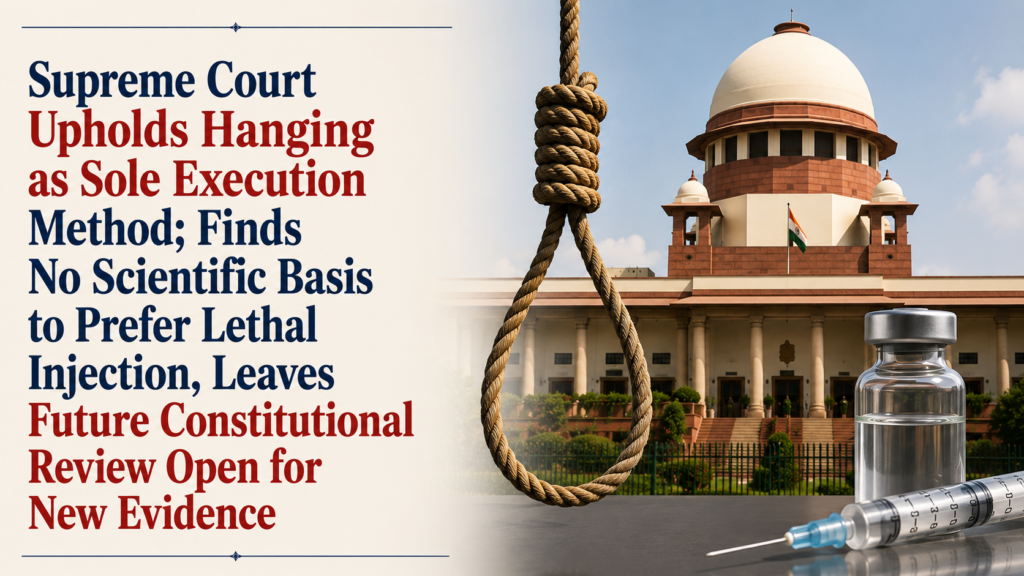
Supreme Court Upholds Hanging as Sole Execution Method; Finds No Scientific Basis to Prefer Lethal Injection, Leaves Future Constitutional Review Open for New Evidence

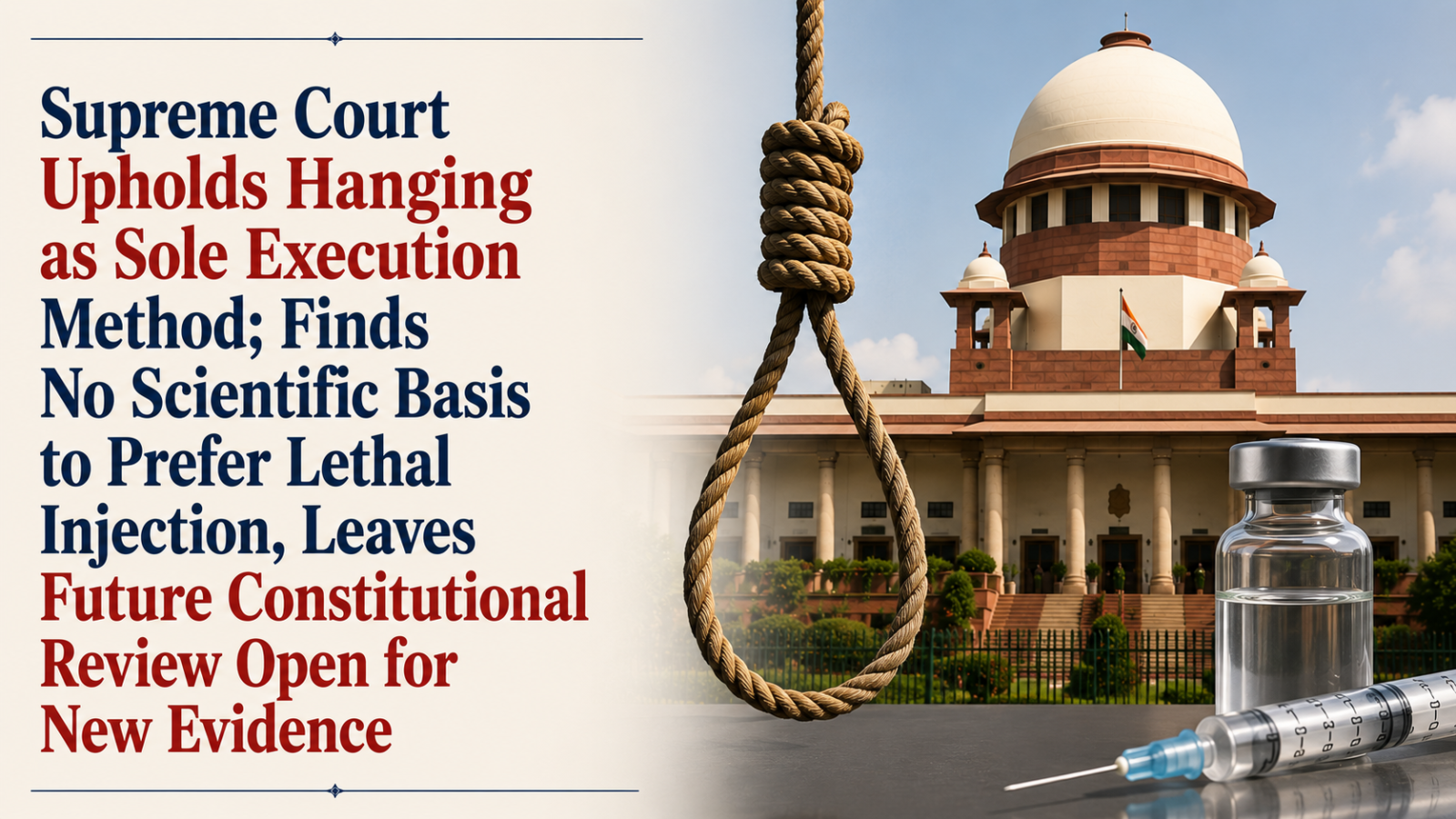
Supreme Court Dismisses PIL Against Hanging but Keeps Future Review Open if Advances in Science Establish a Less Painful Execution Method
Facts
The petition was instituted as a public interest litigation under Article 32 of the Constitution by Rishi Malhotra challenging the constitutional validity of Section 354(5) of the Code of Criminal Procedure, 1973, corresponding to Section 393(5) of the Bharatiya Nagarik Suraksha Sanhita, 2023, insofar as the provisions prescribe hanging by the neck as the sole mode of execution of a death sentence.
The petitioner sought a declaration that hanging violated Articles 14 and 21 and also sought recognition of a fundamental right to die through a dignified procedure.
The Court clarified that the constitutionality of the death penalty itself was not under reconsideration. That question had already been settled through decisions such as Jagmohan Singh v. State of U.P. and Bachan Singh v. State of Punjab. The narrower issue was whether the method used to execute a lawful death sentence satisfied the requirements of fairness, reasonableness and human dignity under Article 21.
The statutory prescription of hanging has existed since colonial criminal procedure and was retained not only in the CrPC, 1973 but also in the recently enacted BNSS, 2023.
The petitioner contended that developments in medical science, constitutional jurisprudence and international human-rights standards since the Supreme Court’s 1983 ruling in Deena v. Union of India justified reconsideration of hanging as the exclusive mode of execution.
Issues
The principal issues before the Supreme Court were:
- Whether hanging as the sole mode of execution under Section 354(5) CrPC/Section 393(5) BNSS violates Article 21, particularly the constitutional requirement of dignity and minimum unnecessary suffering.
- Whether prescribing hanging for civilian convicts while permitting shooting under military statutes creates unconstitutional discrimination under Article 14.
- Whether subsequent scientific, medical and empirical material warranted reconsideration of Deena v. Union of India, which had upheld hanging as constitutionally valid.
- Whether lethal injection, shooting or any other alternative had been demonstrated to be sufficiently more humane, certain and painless than hanging.
- Whether a two-Judge Bench could refer Deena, a three-Judge Bench judgment subsequently approved by a Constitution Bench, for reconsideration.
Petitioner’s Arguments
The petitioner argued that execution by hanging is barbaric, cruel and inhumane and violates the right to dignity guaranteed by Article 21.
He relied extensively on the 187th Report of the Law Commission of India, which discussed the physical consequences of hanging and recorded that hanging could involve considerable physical pain and suffering.
The petitioner argued that successful execution depends upon accurate calculation of the prisoner’s weight, height and length of drop. If the drop is insufficient, death may occur through prolonged strangulation; if excessive, it may cause severe bodily injury or even decapitation.
Accordingly, the uncertainty inherent in the procedure made it incompatible with a dignified death.
He also invoked international standards, particularly the ECOSOC safeguards requiring capital punishment, where retained, to be carried out so as to inflict the minimum possible suffering.
On Article 14, the petitioner pointed out that the Army Act, Air Force Act and Navy Act permit death sentences to be executed either by hanging or shooting. He argued that providing an alternative to military offenders while denying one to civilians was arbitrary.
He therefore sought either striking down of the provisions or reading them down to permit alternative modes such as lethal injection or shooting.
Respondent’s Arguments
The Union of India opposed the petition and argued that the constitutional validity of hanging was already settled by Deena v. Union of India, where a three-Judge Bench had specifically upheld Section 354(5) CrPC under Article 21.
The Attorney General emphasised that Deena had found hanging, when properly administered, to result in almost instantaneous unconsciousness without lingering death, torture or degradation.
It was further argued that Parliament had consciously retained hanging while enacting Section 393(5) BNSS in 2023, thereby reaffirming the legislative choice despite longstanding debate regarding alternative methods.
The Union maintained that Article 21 does not require the State to employ the theoretically “best” method of execution. The constitutional requirement is that the procedure must not be cruel, torturous or degrading and must operate within a just and fair legal framework.
It was also argued that a condemned prisoner has no constitutional right to choose his mode of execution.
On shooting under military statutes, the Union contended that those enactments operate in a specialised field concerning military personnel and military necessity. Their different framework therefore did not amount to hostile discrimination against civilians.
The Attorney General further emphasised the documented problems associated with lethal injection, including difficulty in venous access, drug shortages, untested protocols and botched executions.
Analysis of the Law
The Supreme Court began with the doctrine of stare decisis.
It noted that the constitutionality of hanging under Section 354(5) CrPC had already been exhaustively examined by a three-Judge Bench in Deena v. Union of India, (1983) 4 SCC 645.
A two-Judge Bench could not depart from that ruling merely because a different view might now appear preferable. Departure from a larger Bench precedent would require compelling justification such as a significant constitutional development, legislative change or cogent new scientific and empirical material undermining the foundation of the earlier judgment.
The Court considered this constraint even stronger because Deena had subsequently been considered and approved by a Constitution Bench in Shashi Nayar v. Union of India.
Therefore, the question was not simply whether some material existed criticising hanging, but whether the material was sufficiently compelling to establish that the constitutional and scientific basis of Deena had become untenable.
The Court concluded that this threshold had not been met.
Precedent Analysis
Deena v. Union of India
This was the controlling authority.
In Deena, the Supreme Court had directly examined whether hanging violated Article 21 and compared hanging with other methods, including electrocution, lethal gas, shooting and lethal injection.
After analysing available scientific and expert material, Deena held that none of the alternatives possessed a distinct and demonstrable advantage over hanging.
The present Bench held that no sufficiently compelling evidence had been produced to displace that conclusion.
Shashi Nayar v. Union of India
The Court regarded Shashi Nayar (Smt) v. Union of India, (1992) 1 SCC 96 as particularly significant because a Constitution Bench had approved Deena.
Consequently, a two-Judge Bench had an even narrower basis for reopening the issue.
Gian Kaur v. State of Punjab
The judgment recognised the constitutional importance of dignity flowing from Gian Kaur v. State of Punjab and acknowledged that the protection of human dignity does not simply disappear because a person has been sentenced to death.
The method adopted by the State must therefore continue to satisfy constitutional standards relating to dignity and unnecessary suffering.
However, this principle did not itself establish that hanging was unconstitutional or that lethal injection was constitutionally required.
Bachan Singh v. State of Punjab
The Court noted that Bachan Singh had affirmed the constitutionality of capital punishment while restricting its application to the “rarest of rare” cases.
The present proceedings did not reopen the constitutionality of the death penalty itself; they concerned only its method of execution.
Shabnam v. Union of India
Project 39A relied upon Shabnam v. Union of India, (2015) 6 SCC 702, particularly the requirement that execution should lead to immediate unconsciousness followed quickly by death without unnecessary mutilation.
However, the Court did not consider the material placed before it sufficient to establish that hanging could no longer satisfy the constitutional standard identified in the earlier authorities.
Court’s Reasoning
The Court accepted that constitutional interpretation is capable of evolving and that scientific developments may justify reconsideration of an earlier constitutional ruling.
However, evolution alone does not permit a smaller Bench to disregard binding precedent.
The petitioner was therefore required to place credible and unimpeachable scientific or empirical material demonstrating that the factual assumptions underlying Deena had materially changed.
The Court found that this had not been done.
Importantly, even the material placed on record by Project 39A, while questioning hanging, also identified serious uncertainties surrounding lethal injection.
The Court therefore found no concrete scientific material demonstrating that lethal injection was demonstrably more humane or reliable than hanging.
It also rejected the comparison with execution by shooting under the military statutes. Military enactments govern a distinct category of persons and operate within a specialised statutory regime. Their provision for shooting could not therefore establish that hanging under ordinary civilian criminal law was discriminatory.
Another consideration was the absence of evidence demonstrating even a single documented botched execution in India under the existing statutory framework.
Conversely, the material relating to lethal injection in the United States disclosed numerous failed or botched executions. The Court held that this evidence undermined rather than strengthened the assertion that lethal injection was necessarily a superior alternative.
Accordingly, the Bench was not persuaded either to strike down the statutory provisions or to refer Deena to a larger Bench.
Conclusion
The Supreme Court held that no sufficient case had been made out for referring Deena v. Union of India to a larger Bench for reconsideration.
Accordingly, the constitutional challenge to Section 354(5) CrPC and Section 393(5) BNSS, insofar as they prescribe hanging as the mode of execution, failed.
However, the Court made two significant qualifications.
First, it expressly clarified that dismissal of the petition does not permanently foreclose future constitutional scrutiny. If compelling scientific, medical or empirical evidence emerges demonstrating that the factual basis of Deena has materially changed, the constitutional issue may be reconsidered.
Second, the Court stated that the Union Government remained free to constitute an expert body comprising specialists in law, forensic medicine, neuroscience, penology and allied disciplines to examine whether another method could better minimise unnecessary pain while preserving the dignity of the condemned prisoner.
Such an exercise, however, falls within the policy domain of the Executive and Legislature.
The writ petition was therefore dismissed with these observations.
Case Details
Case: Rishi Malhotra & Anr. v. Union of India
Court: Supreme Court of India
Case Number: Writ Petition (Criminal) No. 145 of 2017; 2026 INSC 873
Judge: Justice Vikram Nath and Justice Sandeep Mehta; judgment authored by Justice Sandeep Mehta
Date: 18 August 2026
Result: Writ petition dismissed. Hanging remains the constitutionally valid statutory method of execution; no larger Bench reference ordered. Future review remains open if compelling new scientific evidence emerges.