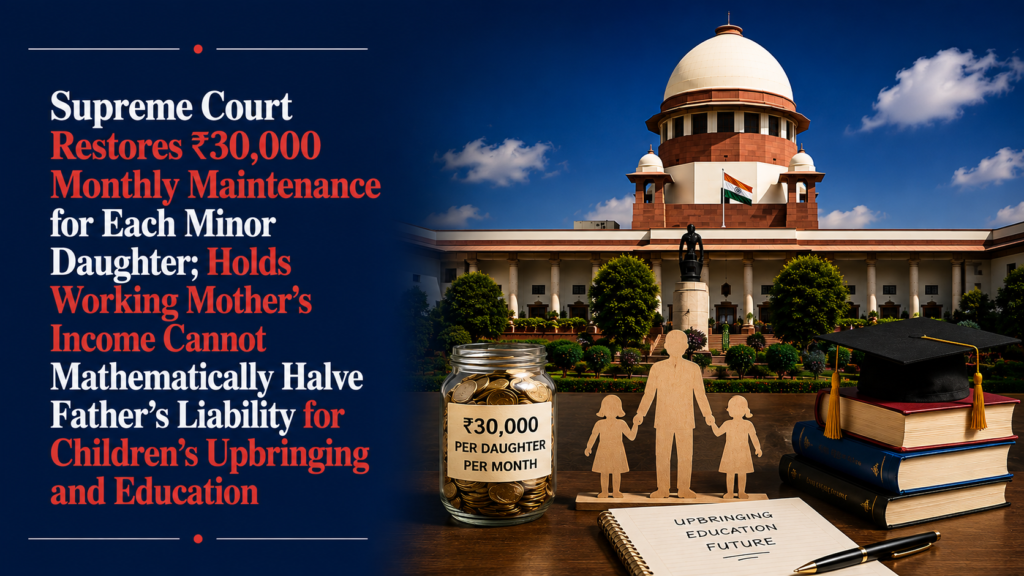
Supreme Court Restores ₹30,000 Monthly Maintenance for Each Minor Daughter; Holds Working Mother’s Income Cannot Mathematically Halve Father’s Liability for Children’s Upbringing and Education

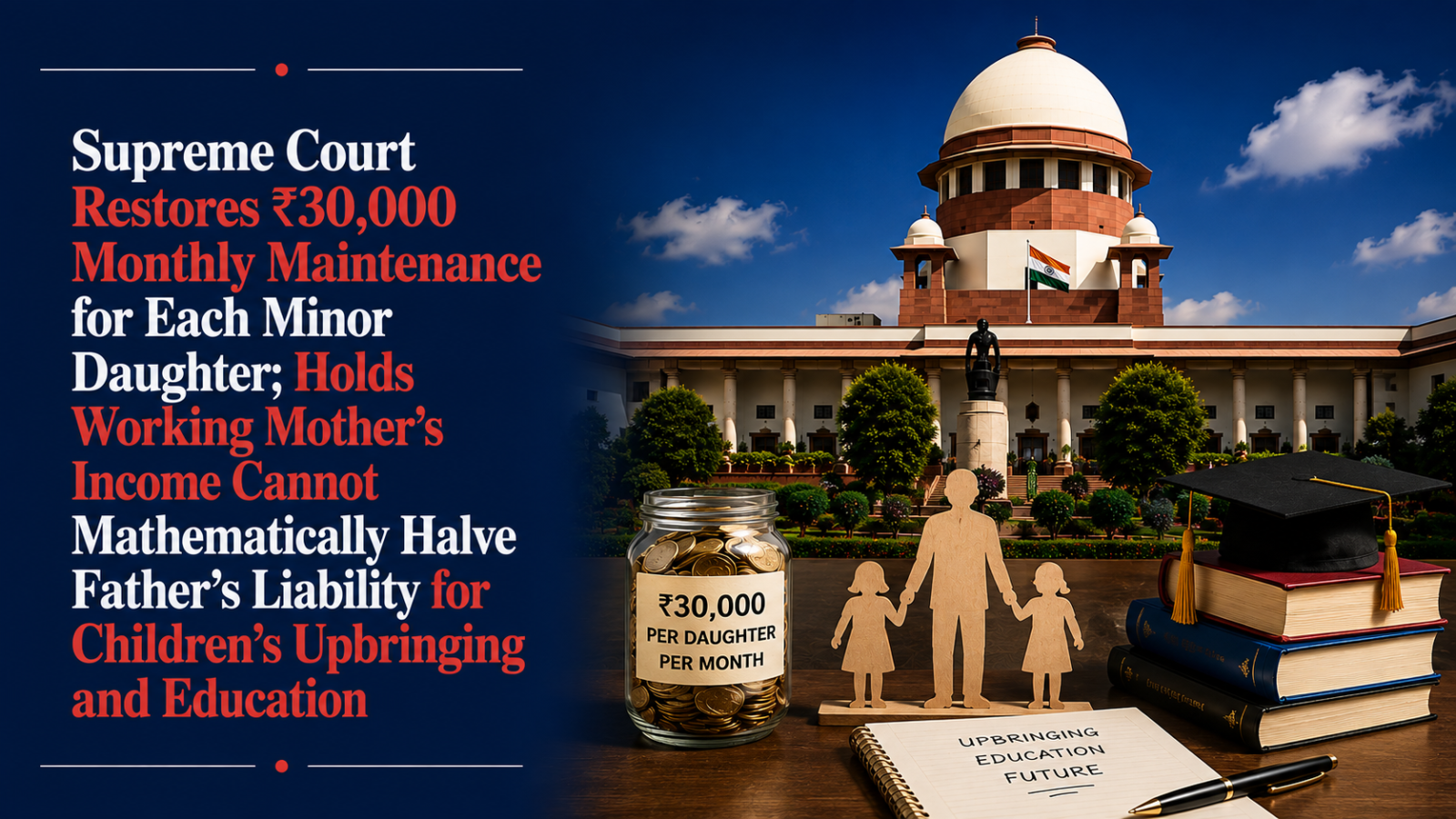
Supreme Court Restores ₹60,000 Monthly Child Maintenance; Holds Custodial Mother’s Care Has Monetary Relevance and Father’s Liability Cannot Be Split by Arithmetic Alone
Facts
The appeal was filed by Sujata Kumari and her two minor daughters, aged approximately nine and eight years, against an Allahabad High Court order dated 9 February 2026 reducing the interim maintenance payable by the respondent-husband/father. The appellant-wife and respondent-husband had married on 18 June 2006 and had two surviving daughters.
Following matrimonial discord, the wife and daughters left the matrimonial home. In 2022, they instituted Case No. 355/2022 under Section 125 CrPC, claiming maintenance of ₹2,50,000 per month from the respondent.
Both spouses were medical professionals. The wife, an MBBS, DGO-qualified gynaecologist, stated that she earned ₹1,50,000 per month at a hospital in Greater Noida. The husband, an MBBS, MD-qualified paediatrician, disclosed income of ₹2,00,000 per month as a consultant, although the wife claimed that he owned his own nursing home.
By order dated 21 October 2024, the Family Court declined interim maintenance to the wife because she was independently earning but awarded ₹30,000 per month to each minor daughter, aggregating to ₹60,000 per month.
The husband challenged the order before the Allahabad High Court. The High Court partly allowed his revision and reduced the maintenance from ₹30,000 to ₹15,000 per month for each daughter, effectively halving the father’s liability.
The wife and daughters therefore approached the Supreme Court.
Issues
The principal issues before the Supreme Court were:
- Whether the High Court was justified in reducing the interim maintenance awarded to each minor daughter from ₹30,000 to ₹15,000 per month merely because their mother was independently earning.
- Whether the financial responsibility of maintaining children must necessarily be divided equally or arithmetically between two earning parents.
- Whether the custodial parent’s daily care, supervision and responsibility for the children’s upbringing constitute a material non-monetary contribution when determining maintenance.
- Whether ₹60,000 per month for two school-going daughters was excessive considering the parents’ professional and financial status.
- Whether the High Court had sufficient grounds in revisional jurisdiction to interfere with the Family Court’s assessment of interim maintenance.
Appellants’ Arguments
The appellants argued that the High Court had erred in reducing the amount despite recognising the tender age of the daughters and their need for proper education, care and upbringing.
They contended that the children’s educational and living expenses were substantial and could not reasonably be met from the mother’s income alone.
The appellants further asserted that the husband actually earned considerably more than the disclosed ₹2,00,000 per month and maintained that the Family Court had correctly assessed the evidence before fixing ₹30,000 per month for each daughter.
Respondent’s Arguments
The respondent-husband supported the High Court’s reduction.
He argued that responsibility for maintaining the daughters rested upon both parents. Since the wife was herself a practising gynaecologist earning ₹1,50,000 per month, she was financially capable of contributing substantially towards their expenses.
According to him, the Family Court’s ₹30,000-per-child award was excessive, and the High Court had appropriately distributed the financial responsibility between the two earning parents.
Analysis of the Law
Shared Parental Responsibility Does Not Mean 50:50 Arithmetic
The Supreme Court accepted the general proposition that the obligation to maintain children is shared by both parents.
However, it rejected the High Court’s assumption that shared responsibility necessarily translates into a mathematically equal division of monetary expenditure.
The Court stated:
“The obligation to maintain the children is shared by both parents, but it cannot be divided by arithmetic alone.”
The daughters lived with their mother, who attended to their daily requirements and upbringing while simultaneously pursuing her profession. Such care, the Court recognised, is a real contribution that cannot simply be quantified in money.
Mother’s Earnings Are Not Automatically a Ground to Reduce Father’s Liability
The Supreme Court categorically held that the fact that the wife earns an income “is not, by itself, a reason to halve the father’s liability.”
Therefore, an earning custodial parent cannot automatically be treated as having already assumed exactly half the child’s financial burden.
The nature and extent of the custodial parent’s daily care must also be factored into the overall allocation of responsibility.
Status, Income and Children’s Needs
The Court also examined the husband’s own financial capacity.
He was a qualified paediatrician who, by his own admission, earned ₹2,00,000 per month. Against that financial position, ₹60,000 per month for two school-going daughters aged eight and nine was not considered excessive.
Their education and upbringing reasonably required expenditure of that magnitude.
Precedent Analysis
The Supreme Court did not rely upon or discuss any previous reported judgment in deciding the appeal.
The decision proceeded directly from the factual circumstances, the respective incomes of the parents, the children’s educational and developmental needs, the custodial responsibilities undertaken by the mother, and the limited justification given by the High Court for interfering with the Family Court’s assessment.
The judgment therefore principally establishes its reasoning through the proposition that shared parental responsibility cannot be reduced to a mechanical 50:50 financial formula, particularly where one parent carries the children’s day-to-day care and upbringing.
Court’s Reasoning
The Supreme Court found the High Court’s reasoning fundamentally inadequate.
The High Court itself had accepted that ₹60,000 per month was sufficient and appropriate for both daughters, considering their parents’ status. It nevertheless reduced the father’s contribution to ₹30,000 merely because the mother was also earning.
Crucially, the High Court did not find the Family Court’s assessment perverse, nor did it conclude that ₹60,000 was excessive. There was therefore no substantive basis for interfering with the Family Court’s determination.
The Supreme Court rejected the High Court’s mathematical approach because the mother was not merely making a financial contribution. The daughters resided with her, and she was responsible for their daily care and upbringing while simultaneously working.
The Court recognised this caregiving as an independent and substantial contribution, observing that it “cannot be measured in money” and is often the greater contribution.
Even disregarding the mother’s earnings altogether, the Supreme Court found ₹60,000 reasonable given the father’s admitted monthly income of ₹2 lakh and the needs of two school-going daughters.
The Family Court had considered the parties’ income affidavits, social status and expenses of the daughters before fixing ₹30,000 per child. The Supreme Court therefore found the amount “just and reasonable” and undeserving of interference in revision.
The Court also emphasised that the substantive Section 125 CrPC proceedings remained pending and that the dispute before it concerned only interim maintenance, providing an additional reason not to disturb the Family Court’s assessment.
Conclusion
The Supreme Court allowed the appeal and set aside the Allahabad High Court’s order dated 9 February 2026.
It restored the Family Court’s order directing the father to pay ₹30,000 per month to each minor daughter, aggregating to ₹60,000 per month.
The Court held that the mother’s independent earnings could not, by themselves, justify mechanically halving the father’s maintenance liability. The mother’s responsibility for the daughters’ daily care, education and upbringing constituted a real and substantial contribution that had to be recognised while allocating parental responsibility.
Any arrears were directed to be paid by the respondent-husband within three months. The pending Section 125 CrPC maintenance proceeding was directed to be decided independently on its own merits, uninfluenced by the interim findings.
Case Details
Case: Sujata Kumari & Others v. Rahul Kumar & Another
Court: Supreme Court of India, Criminal Appellate Jurisdiction
Citation: 2026 INSC 896
Case Number: Criminal Appeal of 2026 arising out of SLP (Criminal) No. 9661 of 2026
Judges: Justice Vikram Nath and Justice Sandeep Mehta
Date: 20 August 2026
Result: Appeal allowed; High Court order reducing maintenance set aside; Family Court’s award of ₹30,000 per month to each daughter restored; arrears payable within three months.