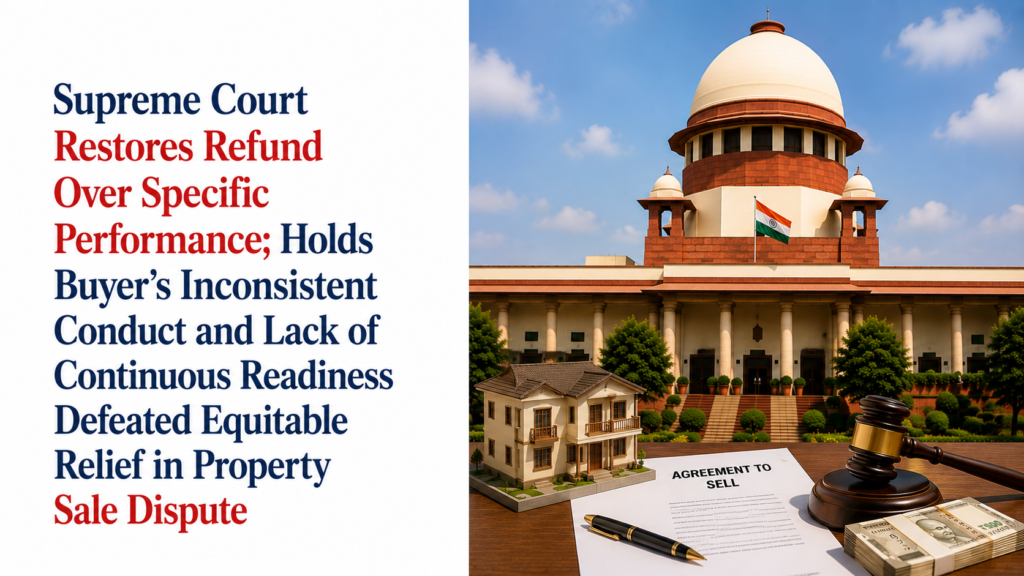
Supreme Court Restores Refund Over Specific Performance; Holds Buyer’s Inconsistent Conduct and Lack of Continuous Readiness Defeated Equitable Relief in Property Sale Dispute

Supreme Court Refuses Specific Performance; Holds Buyer’s Inconsistent Conduct Defeated Equitable Relief in Property Sale Dispute
Facts
The dispute arose from an Agreement to Sell dated 1 April 2004, under which the appellant, V.N.A.S. Chandran, agreed to sell his property at Udhagamandalam to the first respondent, S. Venila, for a consideration of ₹2.25 crore. A General Power of Attorney was simultaneously executed in favour of the purchaser’s husband, who handled the transaction, and substantial advance payments were made. The agreement provided that the sale would be completed within sixty days after an ex parte preliminary decree in a pending partition suit was set aside.
Subsequently, disputes arose regarding payment of the balance consideration, readiness to complete the sale, revocation of the power of attorney, and termination of the agreement. The purchasers instituted a suit seeking specific performance or, alternatively, refund of the advance amount. The Trial Court refused specific performance but directed refund of ₹85 lakh with interest. The Madras High Court reversed that finding and granted specific performance. The seller challenged the High Court’s decision before the Supreme Court.
Issues
- Whether the purchasers had continuously proved their readiness and willingness to perform their obligations under the agreement.
- Whether their conduct disentitled them from the equitable relief of specific performance.
- Whether the High Court was justified in reversing the Trial Court’s refusal to grant specific performance.
- Whether refund of the advance amount constituted the appropriate relief.
Appellant’s Arguments
The appellant argued that the purchasers failed to establish continuous financial readiness to pay the balance sale consideration. Dishonoured cheques, absence of sufficient funds, and the inability to demonstrate financial capacity at the relevant time showed lack of readiness and willingness.
It was further submitted that the purchasers adopted inconsistent positions by filing criminal complaints seeking recovery of the advance amount while simultaneously pursuing specific performance. They had also taken contradictory stands regarding assignment of contractual rights to a third party and had attempted to create third-party rights under the agreement. These circumstances, according to the appellant, disentitled them from obtaining the equitable relief of specific performance.
Respondents’ Arguments
The respondents contended that they had always remained ready and willing to perform their contractual obligations. They relied upon the sale of their own properties, a Memorandum of Understanding entered into for raising funds, and the production of a demand draft before the High Court to establish financial capacity.
They further argued that the seller wrongfully terminated the agreement before expiry of the contractual period and that the criminal complaint was merely a counterblast to proceedings initiated by the seller. According to them, these circumstances did not amount to abandonment of their right to seek specific performance.
Analysis of the Law
The Supreme Court examined the law governing specific performance under the unamended Specific Relief Act, 1963.
The Court reiterated that although a valid contract may exist, specific performance is an equitable and discretionary remedy, not one that follows automatically. A plaintiff must establish continuous readiness and willingness to perform contractual obligations from the date of the agreement until the passing of the decree.
The Court also emphasised that a litigant seeking equitable relief must approach the court with clean hands. Inconsistent pleadings, contradictory legal positions, suppression of material facts, or conduct lacking bona fides may justify refusal of specific performance even where the agreement itself is otherwise valid.
Precedent Analysis
The Supreme Court relied upon several leading authorities, including:
- Annamalai v. Vasanthi (2025)—holding that a purchaser may seek specific performance without seeking a declaration where unilateral termination merely amounts to repudiation of the contract.
- N.P. Thirugnanam v. Dr. R. Jagan Mohan Rao (1995)—holding that continuous readiness and willingness is a mandatory condition for specific performance.
- Kamal Kumar v. Premlata Joshi (2019)—reiterating that specific performance is discretionary and depends upon equitable considerations.
- Major Gen. Darshan Singh v. Brij Bhushan Chaudhary (2024)—holding that the conduct of the plaintiff is a crucial factor while granting equitable relief.
- Muddam Raju Yadav v. B. Raja Shanker (2026)—holding that suppression of material facts and lack of bona fides justify refusal of specific performance.
- Saradamani Kandappan v. S. Rajalakshmi (2011) and Nanjappan v. Ramasamy (2015)—recognising that long passage of time may also weigh against granting specific performance.
Court’s Reasoning
The Supreme Court found that the High Court had erred in concluding that the purchasers had established continuous readiness and willingness.
The Court observed that the purchasers’ financial capacity remained doubtful throughout the transaction. Two cheques issued towards the sale consideration had been dishonoured for insufficiency of funds, and the Memorandum of Understanding relied upon for raising money did not establish actual availability of funds at the relevant time. The subsequent production of a demand draft before the High Court several years later could not cure the absence of continuous readiness from the inception of the dispute.
The Court further held that the purchasers had taken contradictory positions by pursuing criminal proceedings for recovery of the advance amount while simultaneously seeking specific performance, and by adopting inconsistent stands regarding assignment of rights in favour of a third party. Such conduct demonstrated absence of the bona fides required for obtaining an equitable decree.
The Court also considered the passage of more than two decades since execution of the agreement and the advanced age of the seller. In these circumstances, compelling transfer of the property would no longer be equitable.
Conclusion
The Supreme Court allowed the appeals, set aside the judgment of the Madras High Court, and restored the Trial Court’s decree refusing specific performance. It held that the purchasers failed to establish continuous readiness and willingness and that their inconsistent conduct disentitled them to equitable relief. The Court upheld refund of the advance amount with interest and permitted the purchasers to withdraw the amount already deposited before the Trial Court along with accrued interest.
Case Details
Case: V.N.A.S. Chandran v. S. Venila & Others
Court: Supreme Court of India
Case Number: Civil Appeal Nos. 7825–7828 of 2013
Judges: Hon’ble Mr. Justice Prashant Kumar Mishra and Hon’ble Mr. Justice N.V. Anjaria
Date: 31 July 2026
Result: Appeals Allowed. The Supreme Court restored the Trial Court’s decree refusing specific performance, upheld refund of ₹85 lakh with interest, and set aside the Madras High Court’s decree directing execution of the sale deed.