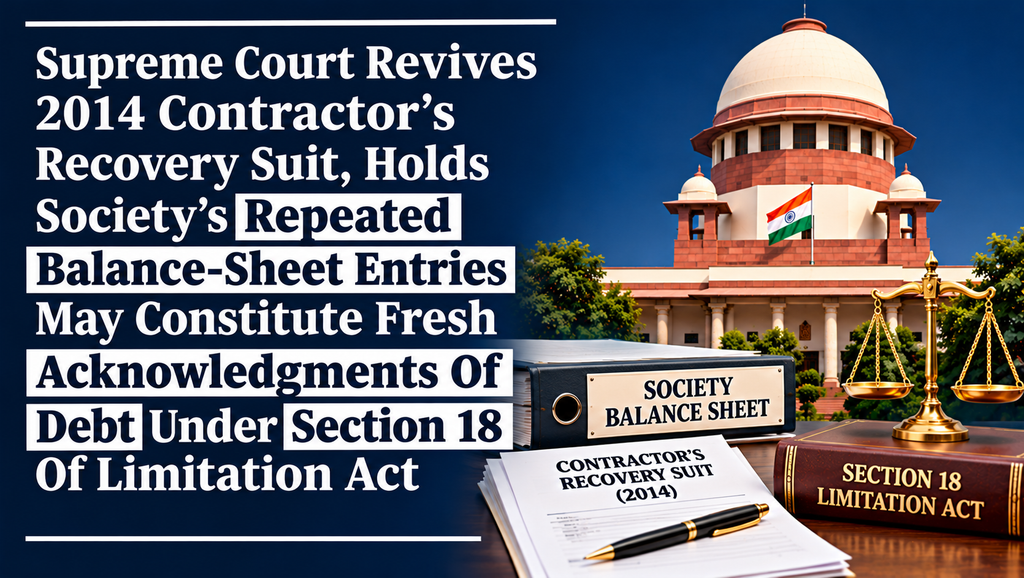
Supreme Court Revives 2014 Contractor’s Recovery Suit, Holds Society’s Repeated Balance-Sheet Entries May Constitute Fresh Acknowledgments Of Debt Under Section 18 Of Limitation Act

Supreme Court Sets Aside Rejection Of 14-Year-Old Contract Claim, Rules Creditor Need Not Be Specifically Named In Balance Sheet And Disputed Liability Must Be Tried, Not Rejected Under Order VII Rule 11 CPC
Facts
Wazir Hussain entered into a civil-works contract dated 10 February 2000 with Vigyapan Loke Delhi Advertising CGHS Ltd. for construction work on a multistorey building in Mayur Vihar, Delhi. He raised running bills between 2000 and 2003 and instituted a summary recovery suit under Order XXXVII CPC in 2014 seeking ₹11,16,000 as principal, ₹11,04,840 as interest calculated at 9% per annum, and further interest. The Society applied for rejection of the plaint under Order VII Rule 11 CPC, arguing limitation, absence of cause of action and alleged embezzlement. On 6 January 2020, the Trial Court refused rejection, taking note of outstanding amounts carried in the Society’s balance sheets for successive years up to 2013 and leaving disputed bills and liability for trial. On 4 November 2024, the Delhi High Court allowed the Society’s civil revision and rejected the plaint as time-barred, finding no sufficiently established acknowledgment of the contractor’s debt. Yusuf, legal heir of the original plaintiff, appealed to the Supreme Court.
Issues
Whether recurring amounts shown in the defendant-Society’s balance sheets up to 2012–13, when read with its earlier bank reconciliation statements and cheques issued to the contractor, could amount to an acknowledgment of a subsisting liability under Section 18 of the Limitation Act, 1963; whether the creditor must be expressly named in the balance-sheet entry; and whether disputed linkage between those entries and the claimed dues could justify rejecting the plaint at the threshold under Order VII Rule 11 CPC.
Appellant’s Arguments
The plaintiff’s legal heir relied upon the Society’s financial statements, which continued to carry forward liabilities described as relating to 2004–05 through the financial year 2012–13. Its 2004–05 bank reconciliation statements expressly referred to three cheques issued in favour of ‘Wazir Hussain Contractor’, connecting the claimant with the underlying transaction and the accounts. The plaintiff argued that the balance-sheet entry as at 31 March 2013, read with these earlier records, acknowledged a subsisting liability and furnished a fresh period of limitation under Section 18. Accordingly, whether the amounts carried forward corresponded to the precise recovery claim involved factual questions requiring evidence, rather than summary rejection of the plaint.
Respondent’s Arguments
The defendant-Society contended that the bills dated back to 2000–03 and that the suit filed in 2014 was hopelessly time-barred. It asserted that the balance sheets did not identify the alleged outstanding sum as payable to Wazir Hussain; an amount carried under sundry creditors or historical balances was insufficient to establish a creditor-specific acknowledgment. The Society also disputed the bills and maintainability of the suit, including by alleging embezzlement. It argued that a stale or time-barred debt could not be indefinitely revived by such entries, particularly without an application for condonation of delay.
Analysis of the Law
Section 18(1) of the Limitation Act permits a fresh limitation period where, before the existing period expires, the party against whom a right is claimed signs a written acknowledgment of a subsisting liability. The statutory test is substantive rather than formulaic: an acknowledgment need not use prescribed language or expressly name the creditor if, on reading the writing alongside relevant surrounding circumstances, it evidences an existing jural relationship. Entries in a debtor’s balance sheets are capable of constituting such acknowledgment, but their import must be examined in the context of the financial statements as a whole, including explanatory notes or qualifications. At the Order VII Rule 11 stage, the inquiry is whether the plaint discloses a prima facie basis for proceeding; disputed identification, quantum and evidentiary linkage of debts are ordinarily matters for trial, not conclusive findings on merits.
Precedent Analysis
In Asset Reconstruction Company (India) Ltd. v. Bishal Jaiswal, 2021 INSC 254, the Supreme Court held that balance-sheet entries may be acknowledgments under Section 18, subject to their proper contextual reading with accompanying qualifications, notes and auditor’s reports. Axis Bank Ltd. v. Naren Sheth, 2023 INSC 820, reaffirmed the applicability of Section 18 to balance sheets acknowledging debt. Applying those authorities, the Court distinguished the existence of material potentially extending limitation from definitive proof that each recorded amount represented the debt sued upon. The latter question remained open to a full evidentiary inquiry.
Court’s Reasoning
The Court found an important evidentiary connection missing from the High Court’s threshold analysis: the 2004–05 bank reconciliation statements identified three cheques issued to ‘Wazir Hussain Contractor’, while amounts concerning the same financial period were repeatedly carried forward in the Society’s own subsequent balance sheets through 2013. Under Section 18, a document need not refer to a particular creditor by name where the surrounding records indicate a continuing debtor–creditor relationship. Read together, the entries supported the plaintiff’s contention of successive acknowledgments capable of renewing limitation. Nevertheless, the Court expressly declined to hold that the entire sum claimed stood proved. Whether the cheques, carried-forward balances and suit amounts actually corresponded, and the extent of any liability, required evidence. The High Court therefore erred by effectively deciding contested factual questions in an application under Order VII Rule 11 CPC. On the Court’s finding of repeated acknowledgments, the absence of an application for condonation of delay did not justify dismissal.
Conclusion
The Supreme Court allowed the appeal, set aside the Delhi High Court’s judgment dated 4 November 2024 and restored the original recovery suit to the Trial Court’s file. It held that the balance-sheet and reconciliation records were sufficient to defeat rejection of the plaint on limitation at the threshold, having regard to Section 18 and the pleaded continued acknowledgments. The decision does not decree the plaintiff’s money claim or conclusively establish the debt: all issues relating to genuineness, identity and quantum of liability remain open for trial. The controlling proposition is that recurring balance-sheet recognition of a subsisting liability, contextualised by contemporaneous financial records, may renew limitation without naming the creditor in a fixed format.
Case: Yusuf v. Vigyapan Loke Delhi Advertising CGHS Ltd. (original plaintiff: Wazir Hussain)
Court: Supreme Court of India, Civil Appellate Jurisdiction
Case Number: 2026 INSC 1207; Civil Appeal arising from SLP(C) No. 30778 of 2024
Bench: Justices Vikram Nath, Augustine George Masih and Sandeep Mehta (judgment by Vikram Nath, J.)
Date: 6 November 2026
Result: Appeal allowed; Delhi High Court’s rejection of plaint set aside; recovery suit restored for trial.