Supreme Court Says Accused Cannot Leave India Without Sessions Court Permission In Pending Criminal Case

Court’s Decision
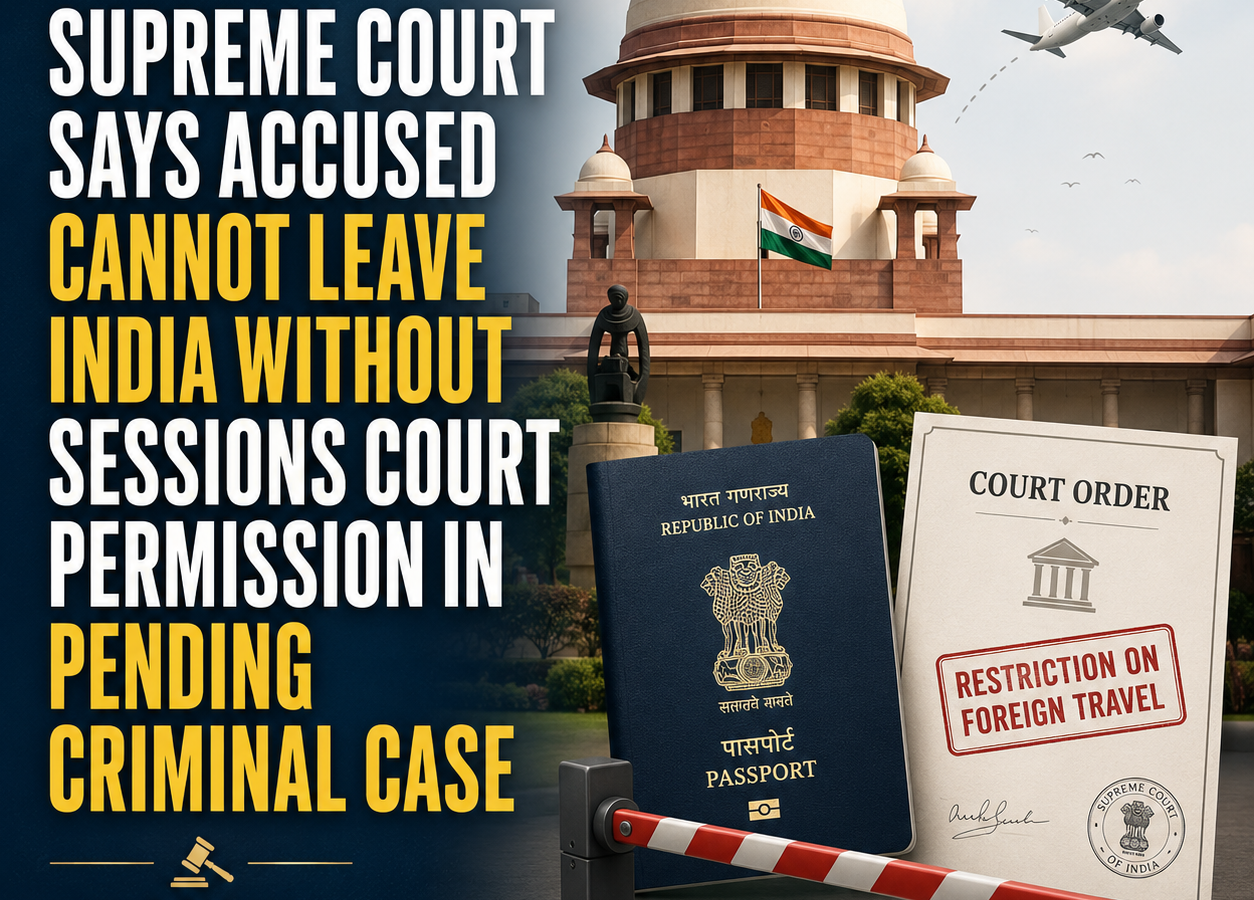
The Supreme Court disposed of the appeal by setting aside the Telangana High Court’s order which had permitted the accused to travel to the United States of America in a pending criminal case. The Court also set aside the Sessions Court’s order directing deposit of the passport.
The Supreme Court held that the accused need not deposit his passport, but he cannot leave India without express permission of the Sessions Court after committal of the case. The Court directed the civil, police and airport administration to coordinate and ensure that the accused does not fly out of the country without such permission.
Facts
The case arose from a complaint lodged in October 2014 regarding the suspicious unnatural death of the complainant’s father. Initially, an unnatural death case was registered under Section 174 CrPC. Later, FIR No. 173 of 2014 was registered for offences under Sections 120-B and 306 read with Section 34 IPC.
The accused was arrayed in the FIR, and a chargesheet was filed against him in February 2016. He had earlier filed proceedings before the High Court seeking quashing of the FIR and criminal proceedings. During the pendency of proceedings, he also sought permission to travel abroad, which was refused.
As he failed to appear before the trial court and did not engage a lawyer, a non-bailable warrant and Look Out Circular were issued against him. Later, the High Court suspended the Look Out Circular, and the accused left India in 2017.
After returning to India in April 2025, he was arrested at Hyderabad Airport. After being released from custody, he sought return of his passport. The Magistrate directed release of the passport but clarified that this did not amount to permission to leave India and that separate permission from the competent court would be necessary.
The Sessions Court reversed that order and directed deposit of the passport. The High Court then allowed the accused’s revision and permitted him to travel to the USA after committal of the case, subject to conditions. The complainant challenged the High Court’s order before the Supreme Court.
Issues
The Supreme Court considered whether the accused should be permitted to travel abroad during the pendency of criminal proceedings.
The Court also examined whether the accused’s right to travel abroad under Article 21 should override the complainant’s right to speedy trial and the larger societal interest in ensuring effective administration of criminal justice.
Appellant’s Arguments
The complainant argued that the accused should not be allowed to travel to the USA until the trial concludes.
It was submitted that the accused had repeatedly filed petitions and applications to delay and obstruct the criminal trial. The complainant also alleged suppression of earlier proceedings and contended that interim protections were obtained and then petitions were withdrawn before final adjudication.
It was further argued that the accused had earlier misused suspension of the Look Out Circular by leaving the country without leave of the court, thereby evading the criminal process. The complainant also disputed the medical ground relied upon by the accused for travelling abroad.
Respondent’s Arguments
The accused argued that requiring him to surrender his passport or restricting foreign travel would unjustifiably curtail his fundamental right to travel abroad under Article 21.
He contended that he had suffered two brain strokes in 2023 and was undergoing medical treatment in the USA. He also argued that he was a citizen of the USA, his family resided there, and he had business and property interests in India.
The accused further submitted that the delay in trial could not be attributed only to him, as other accused persons had also filed quashing petitions and the complainant had sought further investigation after several years.
Analysis Of The Law
The Supreme Court accepted that the right to travel abroad forms part of personal liberty under Article 21. However, it held that this right cannot be viewed in isolation.
The Court emphasised that the right to speedy trial is also an integral part of Article 21. Therefore, a balance must be struck between the accused’s individual liberty and the complainant’s right to speedy trial, along with the larger public interest in ensuring effective criminal justice.
The Court relied on Rajesh Ranjan Yadav v. CBI, where it was held that individual liberty must be balanced with societal interest and that no right is absolute.
Court’s Reasoning
The Supreme Court noted that the FIR was registered in 2014 and the chargesheet was filed in 2016, yet the matter was still at the stage of committal. Nearly ten years had passed since the chargesheet, but the trial had not even commenced.
The Court observed that although delay in criminal proceedings cannot always be attributed to the accused alone, the chronology showed that the accused had actively sought judicial intervention at several stages.
The Court took note of successive petitions, interim protections, and withdrawals of petitions before final adjudication. It observed that such conduct raised serious doubts regarding bona fides.
The Supreme Court also found that the High Court was “indulgent” in permitting travel to the USA on the ground of medical treatment, especially when medical facilities were available in India.
At the same time, the Supreme Court did not accept the Sessions Court’s direction requiring deposit of the passport. It restored the practical effect of the Magistrate’s order: the accused may keep the passport, but cannot leave India without express permission of the Sessions Court.
Conclusion
The Supreme Court set aside both the High Court’s order and the Sessions Court’s order.
The accused is not required to deposit his passport. However, he cannot fly out of India unless he first approaches the Sessions Court after committal and obtains specific permission. If such an application is filed, the Sessions Court must decide it on its own merits and may impose appropriate conditions.
The Court also directed civil, police and airport authorities to coordinate and ensure that the accused does not leave the country without express permission of the Sessions Court. The Supreme Court clarified that its observations will not be treated as findings on the merits of the criminal case.
Key Takeaway
An accused may have a right to travel abroad, but that right is not absolute. Where criminal proceedings are pending for years, and the trial has not even commenced, courts must balance personal liberty with the complainant’s right to speedy trial and the public interest in ensuring that criminal justice is not frustrated.