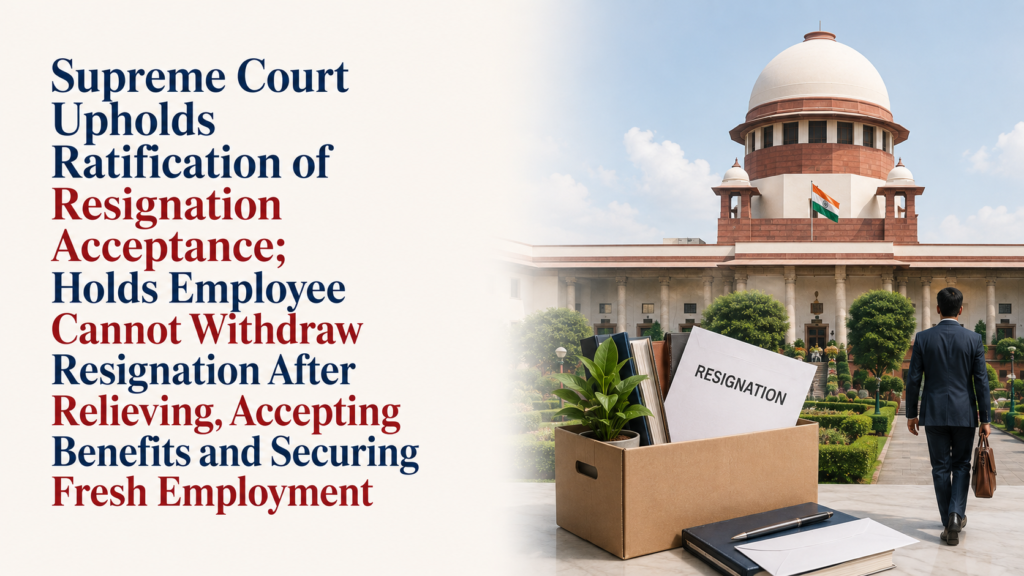
Supreme Court Upholds Ratification of Resignation Acceptance; Holds Employee Cannot Withdraw Resignation After Relieving, Accepting Benefits and Securing Fresh Employment

Employee Who Accepted Relieving and Used Experience Certificate for New Job Cannot Later Seek Reinstatement, Holds Supreme Court
Facts
The respondent, B.S. Rawat, was appointed as Assistant Registrar (Legal) at Delhi Technological University (DTU). On 19 May 2016, he submitted his resignation to take effect from 1 September 2016, but later requested waiver of the notice period and sought immediate acceptance from 31 May 2016.
The Vice-Chancellor holding additional charge accepted the resignation and relieved the respondent. DTU thereafter issued his no-dues certificate, last pay certificate and experience certificate, all of which were accepted by him.
Nearly four months later, the respondent sought to withdraw his resignation, contending that only the Board of Management (BOM) was competent to accept it. Before deciding his request, the BOM ratified the earlier acceptance of resignation. DTU rejected the withdrawal request.
The Delhi High Court ordered reinstatement, while denying back wages. The respondent also challenged similar issues relating to his resignation from the National Institute of Technology, Calicut (NITC), resulting in connected proceedings before the Supreme Court.
Issues
- Whether acceptance of resignation by an officer lacking statutory authority could subsequently be validated through ratification by the competent authority.
- Whether an employee can withdraw resignation after being relieved, accepting all consequential benefits and altering his position.
- Whether the respondent was entitled to reinstatement and back wages in DTU and NIT Calicut.
Petitioner’s Arguments (DTU/NIT)
- The resignation had been voluntarily submitted by the respondent.
- The respondent himself requested waiver of the notice period and immediate relieving.
- Although initially accepted by the Vice-Chancellor holding additional charge, the Board of Management subsequently ratified the acceptance.
- Ratification related back to the original date of acceptance, making the resignation legally valid from inception.
- Having accepted all service benefits and secured another appointment, the respondent was estopped from challenging the resignation.
Respondent’s Arguments
- The respondent contended that only the Board of Management possessed statutory authority to accept his resignation.
- Since the initial acceptance was by an incompetent authority, the resignation never became legally effective.
- Consequently, he retained the right to withdraw it before lawful acceptance.
- In relation to NIT Calicut, he argued that his resignation had not become effective because it had not been properly communicated and that he possessed a right to withdraw it before actual relieving.
Analysis of the Law
The Supreme Court examined:
- the Delhi Technological University Act, 2009;
- the National Institute of Technology First Statutes, 2009;
- the common law Doctrine of Ratification;
- the legal principles governing withdrawal of resignation; and
- the doctrine preventing a party from approbating and reprobating.
The Court explained that ratification validates an act initially performed without authority and, once made by the competent authority, relates back to the date of the original act.
The Court formulated six governing principles of ratification, including:
- ratification validates an otherwise unauthorised act;
- it operates retrospectively;
- only the competent authority can ratify;
- ratification relates back to the original date;
- express approval is sufficient; and
- ratification cannot validate an act prohibited by law or beyond jurisdiction.
Precedent Analysis
The Supreme Court relied upon several important authorities, including:
- Sri Parmeshwari Prasad Gupta v. Union of India — doctrine of ratification.
- High Court of Judicature for Rajasthan v. P.P. Singh.
- Maharashtra State Mining Corporation v. Sunil Pathak.
- National Institute of Technology v. Pannalal Choudhury.
- Municipal Commissioner, Jamnagar Municipal Corporation v. R.M. Doshi.
- Reichel v. Bishop of Oxford (House of Lords) — consummation of resignation.
- Union of India v. Gopal Chandra Misra.
- Raj Kumar v. Union of India — effectiveness of resignation.
- Air India Express Ltd. v. Captain Gurdarshan Kaur Sandhu.
Court’s Reasoning
The Supreme Court held that although the Vice-Chancellor holding additional charge lacked statutory competence to accept the resignation, the Board of Management subsequently ratified that acceptance.
Applying the doctrine of ratification, the Court held that the BOM’s approval related back to the original acceptance, thereby curing the defect of authority.
The Court further found that the respondent himself had:
- voluntarily sought early acceptance of his resignation;
- requested waiver of the notice period;
- accepted relieving, salary and service certificates;
- relied upon the experience certificate to obtain employment at NIT Calicut; and
- challenged the resignation only several months later.
The Court held that the resignation had been fully consummated through the conduct of both parties. The respondent could not simultaneously enjoy the benefits flowing from resignation and later dispute its validity. The Court observed that he could not approbate and reprobate by treating the resignation as valid when joining another institution and invalid when seeking reinstatement.
With respect to the NIT Calicut matter, the Court held that under the applicable Statutes, resignation became effective on acceptance by the competent authority, and the competent authority had validly refused withdrawal after recording reasons.
Conclusion
The Supreme Court allowed DTU’s appeal and set aside the Delhi High Court’s direction of reinstatement. It held that the subsequent ratification by the Board of Management validated the earlier acceptance of resignation and related back to the original date of acceptance, leaving no subsisting resignation capable of withdrawal.
The Court also dismissed the respondent’s appeal regarding back wages and upheld the Kerala High Court’s judgment refusing reinstatement in the NIT Calicut matter, holding that both resignations had become legally effective.
Case Details
Case: Delhi Technological University v. B.S. Rawat
Court: Supreme Court of India
Case Number: Civil Appeal Nos. 9308 & 9309 of 2024; Special Leave Petition (Civil) Nos. 625–626 of 2021
Judges: Justice Pamidighantam Sri Narasimha and Justice Alok Aradhe
Date: 4 August 2026
Result: DTU’s appeal allowed; reinstatement set aside. Employee’s appeal for back wages dismissed. Special Leave Petition relating to NIT Calicut also dismissed.