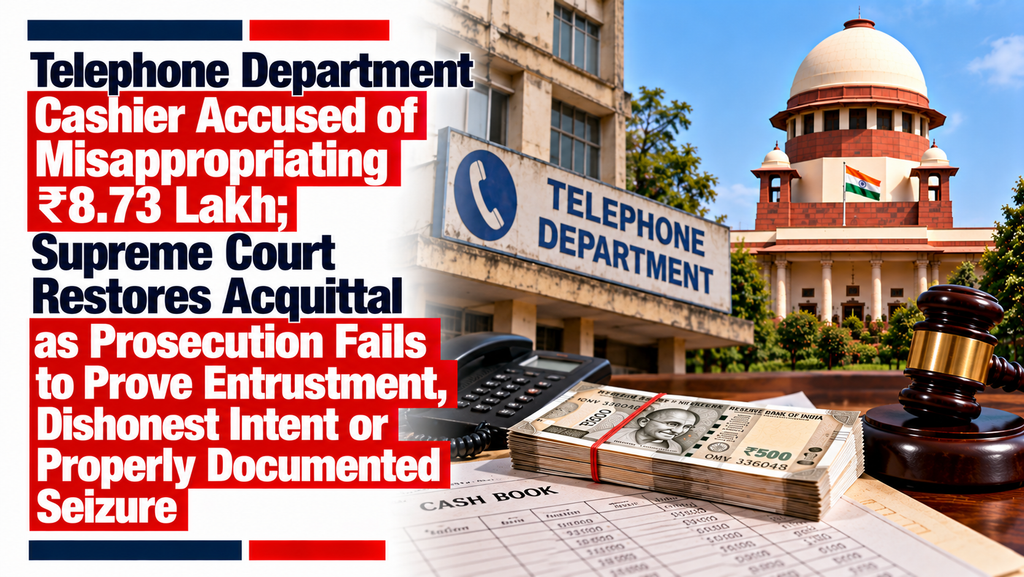
Telephone Department Cashier Accused of Misappropriating ₹8.73 Lakh; Supreme Court Restores Acquittal as Prosecution Fails to Prove Entrustment, Dishonest Intent or Properly Documented Seizure

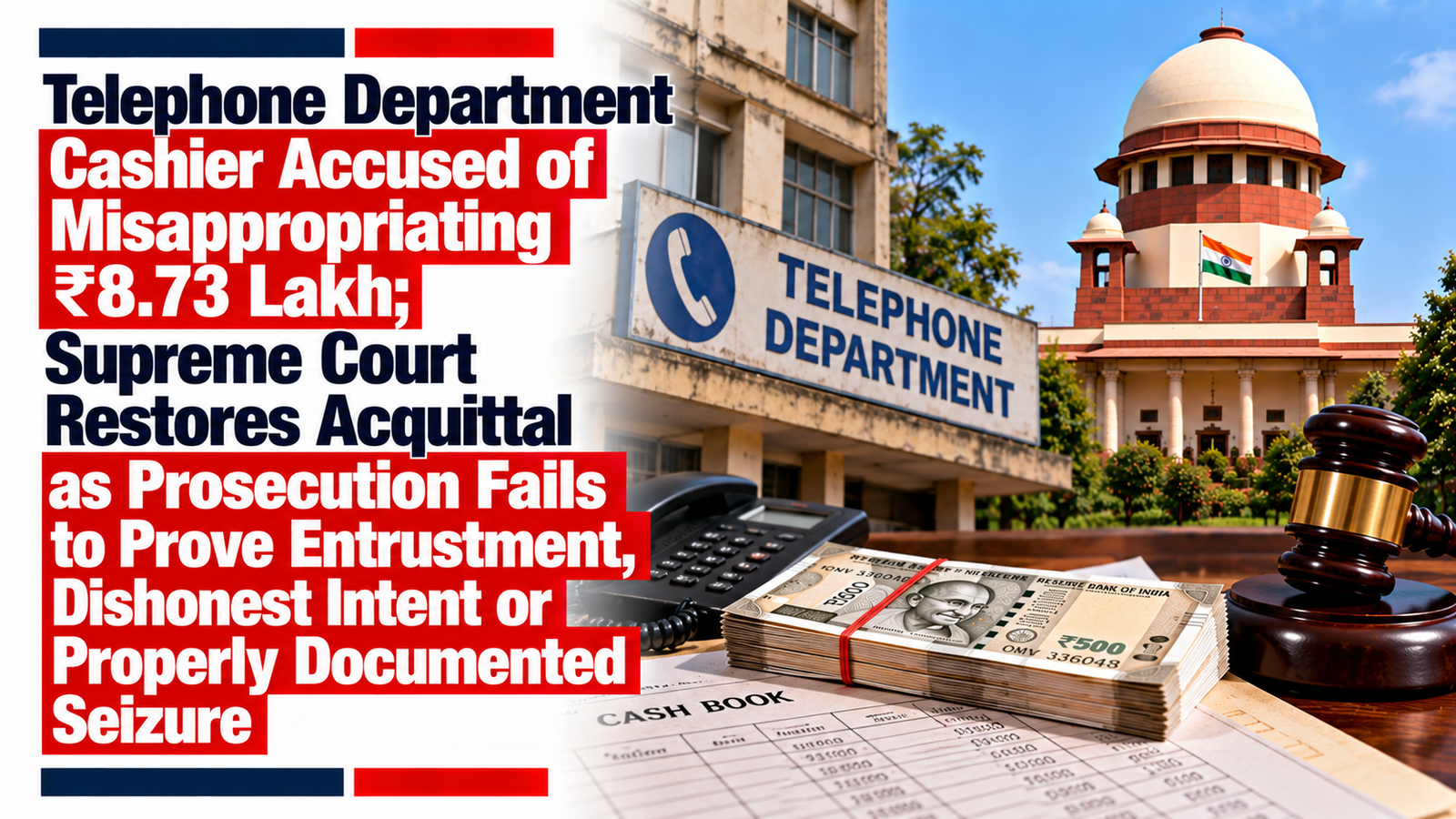
Bombay High Court Convicts Telephone Cashier Over Alleged Missing Collections; Supreme Court Reverses Conviction, Cites Withheld Cash Records and Unproved Alleged Criminal Breach of Trust
Facts
Ramkrushna Prahllad Dongardive worked as a Cashier-cum-Counter Clerk in the Telephone Department at Aurangabad. The prosecution alleged that between 1 July and 9 October 1993 he collected ₹8,73,737 from customers, belatedly deposited ₹3,88,035, and failed to deposit ₹4,75,702. Following a complaint on 11 October 1993, a criminal case was registered and he faced trial under Section 409 of the Indian Penal Code. The Chief Judicial Magistrate, Aurangabad, acquitted him on 20 February 2002, finding the documentary and oral evidence insufficient. On 12 October 2017, the Bombay High Court, Aurangabad Bench, reversed the acquittal and sentenced him to one year’s rigorous imprisonment and a ₹5,000 fine. He challenged that reversal before the Supreme Court.
Issues
Whether the prosecution established entrustment of cash, dishonest misappropriation and dishonest intention necessary for an offence under Section 409 IPC; whether non-production of original cashbooks, registers and audit records justified an adverse inference against the prosecution; whether the purported seizure of 46 documents was proved despite hostile panch witnesses and procedural lapses; whether the High Court properly applied the principles governing reversal of an acquittal; and whether a person convicted for the first time on appeal must be heard separately on sentence.
Petitioner’s Arguments
The appellant argued that the trial court had reasonably acquitted him and that the High Court impermissibly substituted another view of the evidence. The prosecution had not proved receipt of the specific sums, belated deposits, non-deposits or dishonest intent. Despite repeated applications and directions, the Telephone Department did not produce the daily cash handover register or receipt-book stock register; an adverse inference was therefore justified. The High Court also wrongly shifted the burden to the accused to establish innocence. The appellant relied, among other authorities, on Chelloor Mankkal Narayan Ittiravi Nambudiri and R. Venkatakrishnan.
Respondent’s Arguments
The State of Maharashtra maintained that entrustment of ₹8,73,737 had been established through the appellant’s cashier duties and the documents on record. It argued that ₹3,88,035 was deposited late and ₹4,75,702 remained unpaid, and that Exhibits 7–9, the handwriting expert’s opinion and the appellant’s conduct demonstrated dishonest intention. The State supported the High Court’s reversal of acquittal and urged dismissal of the appeal.
Analysis of the Law
Section 405 IPC requires entrustment of property or dominion over it, followed by dishonest misappropriation, conversion, use or disposal in breach of law or obligation. Section 409 applies the aggravated offence to specified persons; mere accounting irregularity or delay, without proof of dishonest intent, is insufficient. Temporary misappropriation may constitute the offence if dishonesty is established. In an appeal against acquittal, the appellate court may review the evidence but must give proper weight to the trial judge’s assessment, the presumption of innocence and reasonable doubt. Withholding material records can support an adverse inference under Section 114 illustration (g) of the Evidence Act. Non-compliance with search-and-seizure requirements does not automatically invalidate proceedings, but affects evidentiary weight, especially where other defects exist. An appellate court convicting an accused for the first time must hear the accused on sentence.
Precedent Analysis
Chelloor Mankkal Narayan Ittiravi Nambudiri v. State of Travancore-Cochin (AIR 1953 SC 478) was applied both for caution in reversing acquittals and the need to prove entrustment and dishonest use. R. Venkatakrishnan v. CBI (2009 INSC 1037) confirmed that dishonest intention is essential to criminal breach of trust, including temporary misappropriation. Sunder Singh v. State of Uttar Pradesh (AIR 1956 SC 411) and State of Punjab v. Balbir Singh (1994 INSC 96) addressed how irregularities in search and seizure affect evidentiary weight rather than automatically vitiating the prosecution. Mukesh Kumar Yadav v. The State (UT of Andaman & Nicobar Islands) (2026 INSC 559), with discussion of Kumar Exports v. Sharma Carpets and Suryamoorthi v. Govindaswamy, supported the requirement of a hearing on sentence after first appellate conviction. Rabindra Kumar Dey v. State of Orissa (1976 INSC 204) reinforced that the prosecution bears the burden of proving guilt beyond reasonable doubt and cannot rely on weakness in the defence.
Court’s Reasoning
The Supreme Court found no original cashbook, daily register, rough cashbook, audit report or reliable receipt-book allocation record establishing the alleged entrustment and missing sums. The investigating officer acknowledged that the Telephone Department failed to provide these materials even when requested. The appellant himself had sought production of crucial registers, and the trial court rightly drew an adverse inference when they were withheld. The printed ten-page Exhibit 9 did not bear the appellant’s signature or handwriting and did not connect him to the figures shown. The purported seizure of 46 items from his home was undermined by both panch witnesses turning hostile, the lack of his signature on the seizure memorandum and non-compliance with Sections 100(4) and 100(7) CrPC. Such defects, assessed cumulatively, rendered the prosecution’s proof unreliable. The High Court erred by relying on unproved seizures, shifting the burden to the accused and disregarding the trial court’s permissible appreciation of evidence. The High Court also imposed sentence after reversing acquittal without first hearing him on punishment, a further procedural infirmity.
Conclusion
The Supreme Court allowed Criminal Appeal No. 1432 of 2019, set aside the Bombay High Court’s judgment dated 12 October 2017 and restored the Chief Judicial Magistrate’s acquittal dated 20 February 2002. The appellant was acquitted of the charge under Section 409 IPC and his bail bonds were cancelled. The ruling emphasizes that entrustment and dishonest intention must be proved by reliable evidence, and that an appellate court cannot reverse a reasoned acquittal by shifting the burden of proof to the accused.
Case Details
Case: Ramkrushna Prahllad Dongardive v. The State of Maharashtra
Court: Supreme Court of India
Case Number: Criminal Appeal No. 1432 of 2019; 2026 INSC 1099
Judges: Justice Ujjal Bhuyan and Justice Atul S. Chandurkar
Date: 8 October 2026
Result: Appeal allowed; Bombay High Court conviction set aside; trial court acquittal under Section 409 IPC restored; bail bonds cancelled