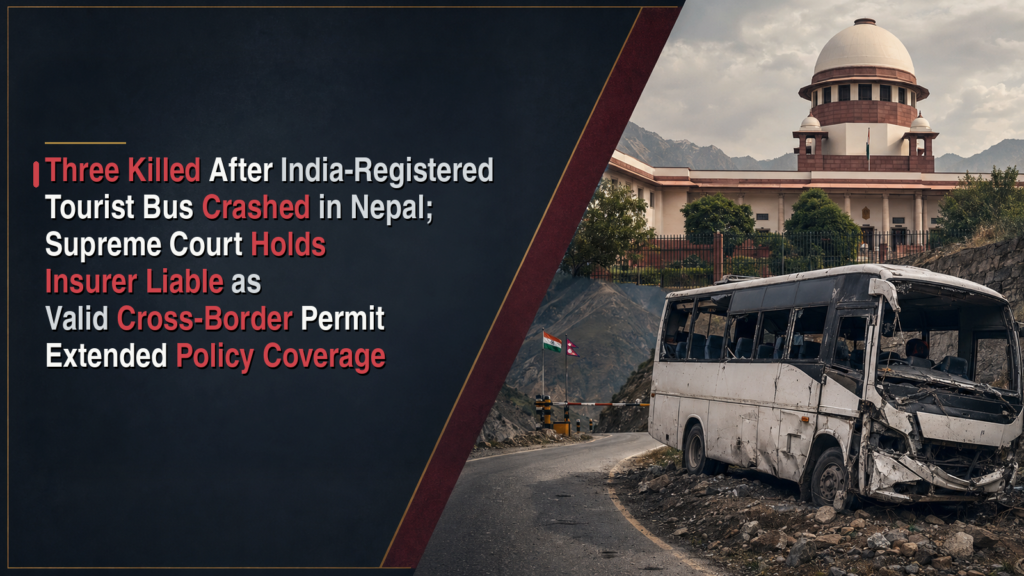
Three Killed After India-Registered Tourist Bus Crashed in Nepal; Supreme Court Holds Insurer Liable as Valid Cross-Border Permit Extended Policy Coverage

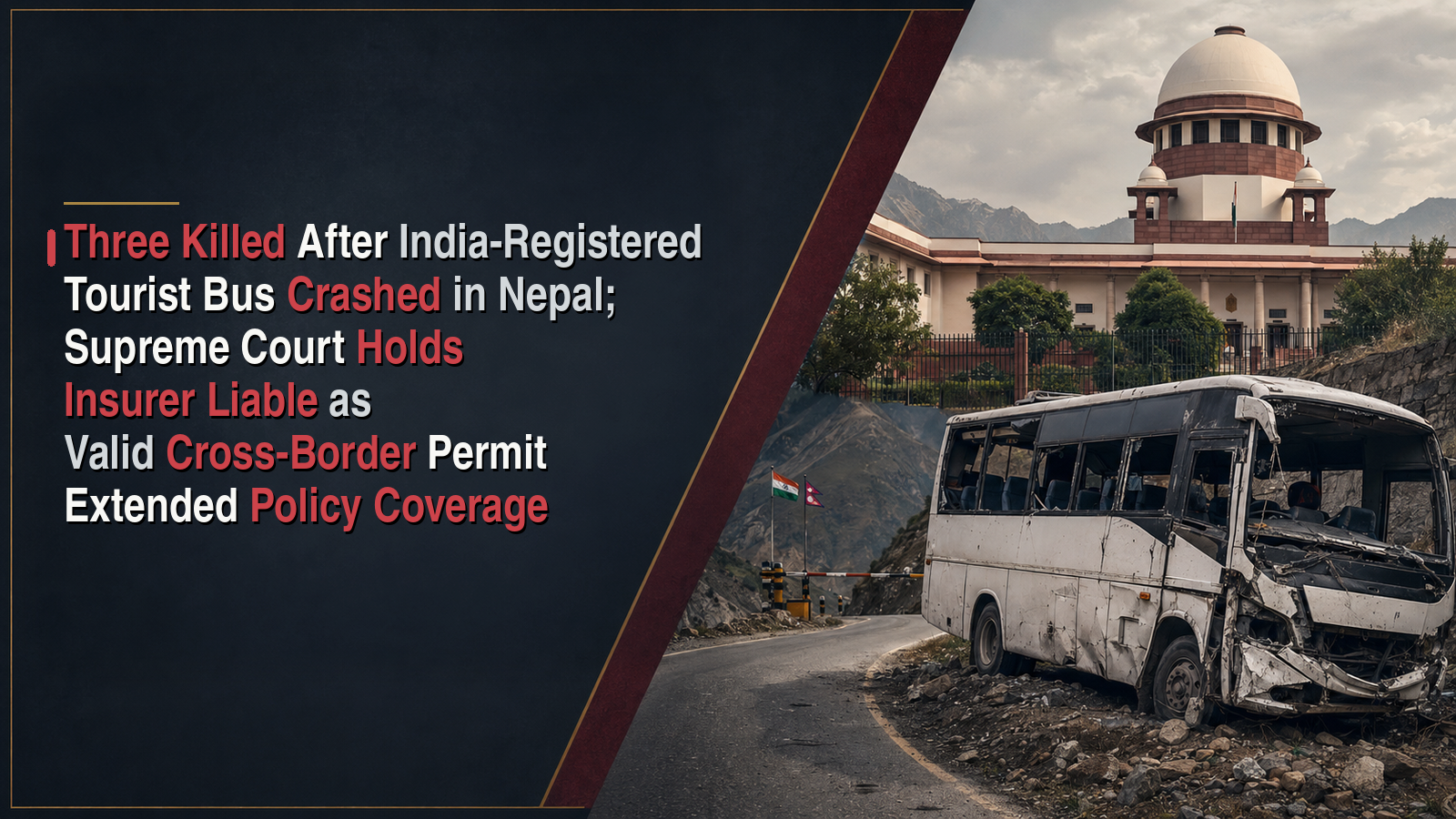
Bus Had Valid Permit to Travel from Durg to Nepal but Insurance Policy Mentioned ‘India’; Supreme Court Extends Coverage and Holds Insurer Liable
Facts
Durg Roadways Private Limited owned a bus registered in India under Registration Number CG-07/LP-0344.
The bus was undertaking a religious tour from Durg in Chhattisgarh to several destinations in Nepal. During the journey, it collided with a hill. Three people died in the accident, including:
- The driver, Riaz Khan;
- Passenger Harish Yadav; and
- One other unidentified victim.
The wife, children and mother of Harish Yadav filed a claim seeking compensation of ₹48,99,776.
On 30 March 2015, the Fourth Additional Motor Accident Claims Tribunal at Durg awarded compensation of ₹32,67,000 with interest at six per cent from 22 October 2011, the date on which the claim petition was instituted.
The Tribunal directed the owner, Durg Roadways Private Limited, to pay the compensation. It did not fasten liability upon Oriental Insurance Company Limited because the accident had occurred outside India.
The owner challenged the award before the Chhattisgarh High Court.
On 4 February 2025, the High Court reversed the Tribunal’s finding on liability and held that Oriental Insurance was required to pay the compensation. The High Court relied upon Anil Kumar v. Roop Kumar Sharma and similar decisions delivered by other High Courts.
Oriental Insurance challenged that judgment before the Supreme Court.
The following facts were undisputed:
- The bus was duly registered in India.
- Before commencing the journey, the owner obtained Special Permit Number 130 of 2010 dated 23 July 2010 from the Additional Regional Transport Authority, Durg.
- The permit was issued under Section 88(8) of the Motor Vehicles Act, 1988 and expressly authorised the bus to travel from Durg to destinations in Nepal.
- The permit was valid from 26 July 2010 to 15 August 2010.
- The driver held a valid driving licence issued by an Indian licensing authority.
- The owner had obtained a motor insurance policy dated 16 May 2010 from Oriental Insurance.
- At the India-Nepal border, the driver’s licence and other relevant documents were verified by the competent authorities.
- Following verification, the Nepalese authorities issued the necessary border documents, including the Indian Tourist Passenger Checking Card and Bhansar Pragna Patra.
- India and Nepal were parties to the Treaty of Peace and Friendship dated 31 July 1950, which recognised reciprocal privileges concerning movement.
The insurance policy contained the following relevant terms:
- Geographical Area: India;
- Area of Extension: Blank or nil; and
- Limitation as to Use: The policy covered use of the vehicle under a permit within the meaning of the Motor Vehicles Act.
Issues
- Whether a motor insurance policy issued in India covered an accident occurring in Nepal when the vehicle possessed a valid special permit authorising cross-border travel.
- Whether non-payment of the additional premium prescribed under General Regulation 4 of the India Motor Tariff, 2002 excluded insurance coverage outside India.
- Whether the “Geographical Area: India” clause prevailed over the separate clause covering use under a valid permit.
- Whether the driver’s Indian driving licence authorised him to drive the vehicle in Nepal.
- Whether Oriental Insurance or the vehicle owner was liable to pay the compensation awarded to the deceased passenger’s family.
Appellant’s Arguments
Oriental Insurance argued that the policy expressly limited its geographical operation to India.
The “Area of Extension” column was left blank, and the owner had not paid the additional premium prescribed by General Regulation 4 of the India Motor Tariff, 2002 for extending the insurance policy to Nepal.
General Regulation 4 permitted geographical extension to countries including Nepal upon payment of:
- ₹500 for a package policy; or
- ₹100 for policies other than package policies.
Such an extension also required an India Motor Tariff-1 endorsement.
Since no additional premium had been paid and no endorsement had been issued, Oriental Insurance contended that the policy did not cover an accident occurring in Nepal.
The insurer further argued that the driver held only an Indian driving licence and was not specifically authorised to drive the bus in Nepal. This allegedly constituted a breach of the insurance policy.
Respondents’ Arguments
The vehicle owner and claimants supported the decision of the Chhattisgarh High Court.
They relied upon the policy clause stating that the vehicle was covered when used under a valid permit within the meaning of the Motor Vehicles Act.
The special permit issued under Section 88(8) expressly authorised the bus to travel from Durg to Nepal. Therefore, the bus was being operated in accordance with the exact use permitted by the policy.
They also relied upon the border verification and documents issued by Nepalese authorities. These documents recorded the driver’s name, driving-licence number and the bus’s registration number.
The respondents maintained that the insurer had failed to expressly exclude cross-border journeys undertaken under a valid permit and could not rely upon ambiguous policy language to deny compensation.
Analysis of the Law
Insurance Policy Must Be Read as a Whole
The Supreme Court reiterated that an insurance policy is a contract between the insurer and the insured.
The contract must be read as a whole, and all its clauses must be interpreted harmoniously. An insurer cannot selectively rely upon one clause while ignoring another clause that extends coverage.
Oriental Insurance relied principally upon the “Geographical Area: India” clause but ignored the “Limitation as to Use” clause.
The latter clause covered use of the vehicle under a permit within the meaning of the Motor Vehicles Act. It did not contain any separate geographical limitation.
Effect of the Special Permit
Section 2(31) of the Motor Vehicles Act defines a permit as one issued by a State Transport Authority, Regional Transport Authority or another prescribed authority authorising the use of a motor vehicle as a transport vehicle.
The special permit in the present case:
- Was issued by the competent Regional Transport Authority;
- Authorised the bus to operate as a transport vehicle; and
- Specifically permitted travel from Durg to Nepal.
The bus was therefore being used under a valid permit as contemplated by the insurance policy.
Once the policy covered use under such a permit, the insurer could not deny coverage merely because the bus was physically operating outside India.
Geographical Clause Was Not Redundant
The Supreme Court clarified that the “Geographical Area: India” clause did not become meaningless.
It would apply where a vehicle travelled outside India without a permit authorising cross-border travel.
If the bus had no valid Nepal permit, Oriental Insurance could have relied upon the geographical restriction. However, because the bus had an express cross-border permit, the “Limitation as to Use” clause covered the journey.
Ambiguous Terms Must Be Construed Against the Insurer
The policy was a standard-form contract drafted by the insurance company.
If Oriental Insurance intended to exclude all accidents outside India, including journeys undertaken under a valid permit, it should have stated so in clear language.
The Court observed that an insurer may decide what risks it wishes to cover or exclude, but those choices must be communicated clearly. Ambiguous or carelessly drafted exclusions cannot be used against an ordinary policyholder.
The rule of contra proferentem requires an ambiguous policy term to be interpreted against the party that drafted it and in favour of the insured.
The Motor Vehicles Act is beneficial legislation intended to compensate victims of road accidents. Where two interpretations are reasonably possible, the interpretation advancing that beneficial object should ordinarily be adopted.
Effect of Non-Payment of Additional Premium
The India Motor Tariff required payment of an additional premium and issuance of an endorsement for geographical extension to Nepal.
The Supreme Court acknowledged that the India Motor Tariff was a binding regulatory instrument issued by the Tariff Advisory Committee under the Insurance Act, 1938.
However, Section 147(5) of the Motor Vehicles Act contains a non-obstante clause. It requires an insurer to indemnify the persons specified in the policy for any liability that the policy itself purports to cover, notwithstanding anything contained in any other law.
Since the policy purported to cover use under a valid permit, Section 147(5) overrode the tariff requirement in the circumstances of this case.
Consequently, failure to pay the additional premium did not invalidate the permit or defeat the insurance coverage promised by the policy.
Extra-Territorial Operation of the Motor Vehicles Act
Article 245(2) of the Constitution of India provides that a Parliamentary law cannot be declared invalid merely because it has extra-territorial operation.
The Motor Vehicles Act was enacted by Parliament and contains provisions contemplating cross-border travel.
Section 139 authorises the Central Government to make rules for:
- Persons temporarily taking vehicles outside India;
- Persons driving outside India; and
- Vehicles operating between India and foreign countries under reciprocal arrangements.
Section 149 also contemplates the liability of Indian insurers in relation to judgments delivered in reciprocating foreign countries.
These provisions demonstrated that the Motor Vehicles Act was intended to operate in appropriate cross-border situations. The Court therefore held that it could apply whether the accident occurred in India or Nepal.
Validity of the Driver’s Licence
The driver held a valid Indian driving licence on the date of the accident.
The Nepalese authorities had verified the licence at the border and issued documents recording his name and licence number. They raised no objection to its validity.
Article 7 of the India-Nepal Treaty of Peace and Friendship recognised reciprocal privileges concerning movement between the two countries.
Oriental Insurance produced no evidence demonstrating that the driver’s licence was invalid in Nepal. The alleged breach of the policy was therefore not established.
Precedent Analysis
Oriental Insurance Company Limited v. Sony Cheriyan
The Supreme Court held that an insurance policy is a contract and the parties are governed by its terms.
The present Court applied that principle by construing all the policy clauses together.
Shivram Chandra Jagarnath Cold Storage v. New India Assurance Company Limited
This decision reaffirmed the contractual nature of insurance policies and the need to ascertain the parties’ obligations from the policy language.
National Insurance Company Limited v. Chief Electoral Officer
The Court held that an insurance contract must be read as a whole and its clauses interpreted harmoniously.
Export Credit Guarantee Corporation of India Limited v. Garg Sons International
This precedent also requires courts to examine the entire insurance contract instead of relying upon isolated clauses.
Syed Mehaboob v. New India Assurance Company Limited
The Supreme Court held that the Motor Vehicles Act is beneficial legislation and should be interpreted liberally to maximise protection for accident victims.
The Court also referred to Ningamma v. United India Insurance Company Limited, K. Ramya v. National Insurance Company Limited and Nidhi Bhargava v. National Insurance Company Limited in support of this principle.
United India Insurance Company Limited v. Pushpalaya Printers
The Court recognised the rule of contra proferentem: where an insurance term is ambiguous or admits two interpretations, the interpretation beneficial to the insured should be adopted.
Sangrur Sales Corporation v. United India Insurance Company Limited
This judgment reaffirmed that ambiguous policy language should ordinarily be construed in favour of coverage.
Mohd. Abdul Samad v. State of Telangana
The judgment explained that a non-obstante clause gives overriding effect to the provision in which it appears over conflicting laws or provisions.
The Supreme Court applied this principle to Section 147(5) of the Motor Vehicles Act.
A.G. Varadarajulu v. State of Tamil Nadu
This decision explained that the scope of a non-obstante clause must be determined from the purpose and language of the provision containing it.
Anil Kumar v. Roop Kumar Sharma
The Chhattisgarh High Court relied upon this Punjab and Haryana High Court judgment while shifting liability from the vehicle owner to the insurer.
The Supreme Court ultimately upheld the High Court’s conclusion that the insurer was liable.
Court’s Reasoning
The Supreme Court held that the bus was covered by the insurance policy at the time of the accident.
The following factors were decisive:
- The bus was registered in India.
- It possessed a valid special permit issued under Section 88(8) of the Motor Vehicles Act.
- The permit specifically authorised travel from Durg to Nepal.
- The policy covered use under a permit and did not geographically restrict that clause.
- Oriental Insurance had not clearly stated that cross-border journeys would remain excluded even when undertaken under a valid permit.
- Ambiguity in a policy drafted by the insurer had to be resolved in favour of the insured and the accident victims.
- Section 147(5) required the insurer to satisfy the liability that its policy purported to cover and overrode the tariff requirement concerning additional premium.
- The Motor Vehicles Act contemplated extra-territorial and cross-border operation.
- The driver held a valid Indian licence that had been verified and accepted by the Nepalese authorities.
- The insurer produced no evidence proving that the licence was invalid in Nepal.
The Court also noted that the India Motor Tariff, 2002 had been entirely de-notified by the Insurance Regulatory and Development Authority of India with effect from 1 April 2024.
The Inter-Country Transport Vehicles Rules, 2021 now require a valid insurance policy for cross-border vehicles but do not clearly explain whether and how a domestic policy extends to the destination country.
To reduce future disputes, the Supreme Court suggested that:
- Cross-border insurance coverage must be stated clearly and unambiguously;
- Any exclusion of foreign travel must be expressly written into the policy;
- Policyholders must be informed when a separate cross-border endorsement is required; and
- The Insurance Regulatory and Development Authority of India should consider issuing a master circular standardising cross-border clauses in motor insurance policies.
The Court also advised Motor Accident Claims Tribunals to provide clear reasoning connecting the evidence, applicable law and final conclusion so that unnecessary appeals and delays can be reduced.
Conclusion
The Supreme Court dismissed Oriental Insurance’s appeal and affirmed the Chhattisgarh High Court’s decision.
It held that the insurer was liable to pay:
- Compensation of ₹32,67,000;
- Interest at six per cent from 22 October 2011; and
- Accrued interest, wherever applicable.
If the amount had not already been deposited, Oriental Insurance was directed to deposit it within four weeks and remit it directly to the claimants.
If the amount was already deposited before the competent forum, it was directed to be released to the claimants along with accrued interest.
A copy of the order was directed to be communicated to the Insurance Regulatory and Development Authority of India for consideration of the Court’s suggestions on standard cross-border insurance clauses.
Case Details
Case: The Oriental Insurance Company Limited v. Durg Roadways Private Limited and Others, 2026 Indian Supreme Court 722
Court: Supreme Court of India
Case Number: Civil Appeal of 2026 arising out of Special Leave Petition (Civil) Number 20645 of 2025; the Civil Appeal number is not specified in the order
Judges: Justice Sanjay Karol and Justice Nongmeikapam Kotiswar Singh
Date: 20 July 2026
Result: Insurance company’s appeal dismissed; Oriental Insurance held liable to pay ₹32.67 lakh with six per cent interest for the fatal bus accident in Nepal.