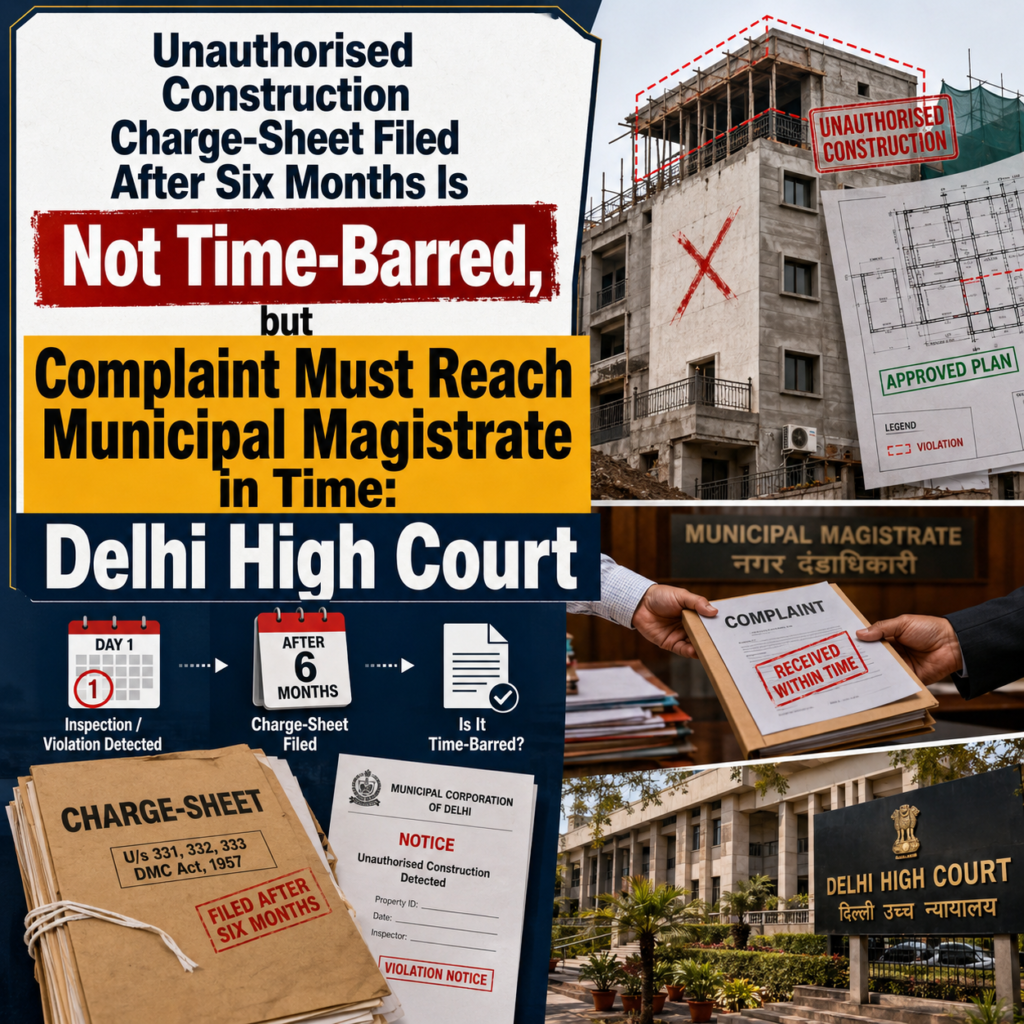
Unauthorised Construction Charge-Sheet Filed After Six Months Is Not Time-Barred, but Complaint Must Reach Municipal Magistrate in Time: Delhi High Court

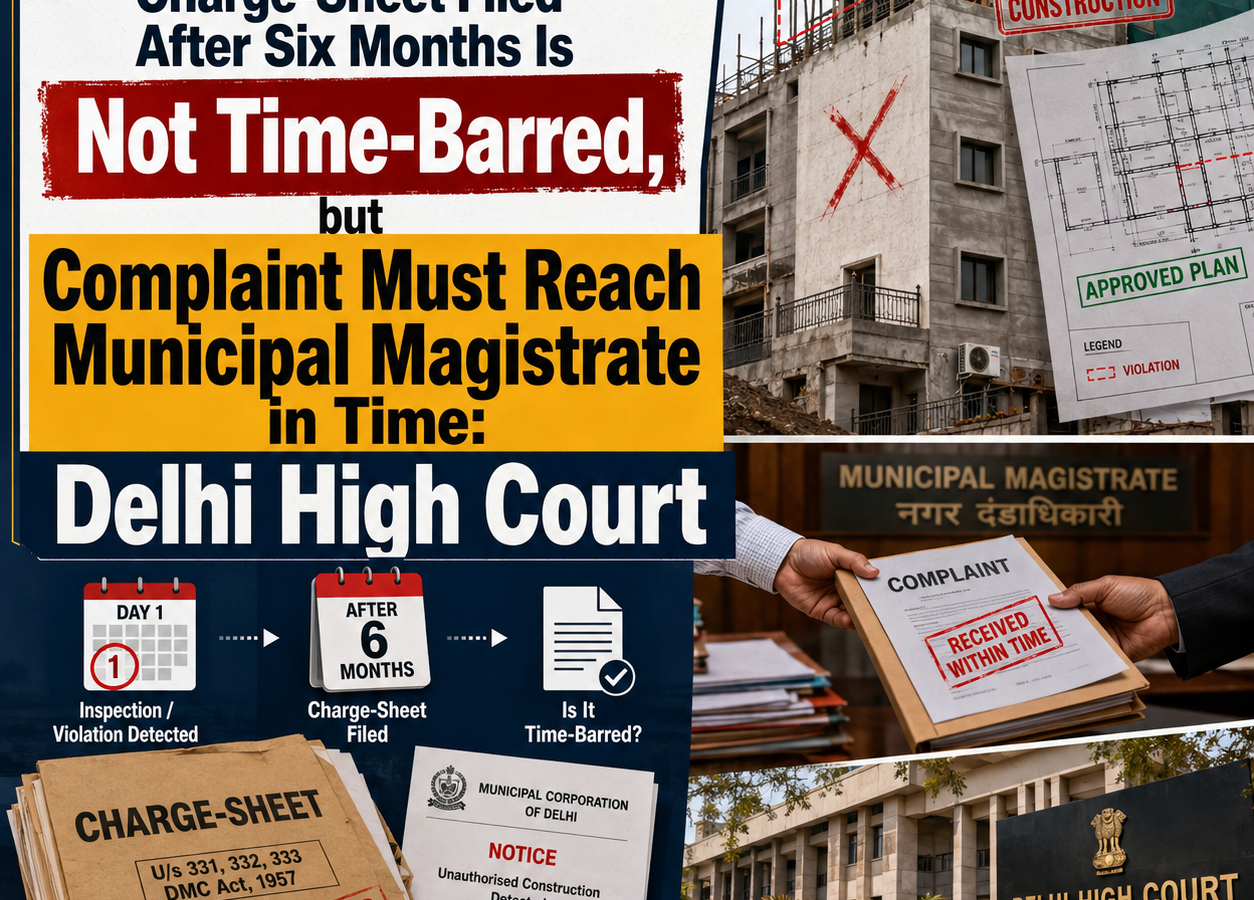
No Six-Month Deadline for Charge-Sheet in Unauthorised Construction Cases; Delhi High Court Makes Timely Complaint to Municipal Magistrate Mandatory
Facts
The matter arose from a criminal reference made by a Metropolitan Magistrate under Section 395(2) of the Code of Criminal Procedure, seeking authoritative clarification on limitation in prosecutions under the Delhi Municipal Corporation Act, 1957.
The reference originated from State v. Amir Singh, arising out of FIR No. 432 of 2015. During an inspection on 16 April 2015, a Junior Engineer of the South Delhi Municipal Corporation allegedly found that unauthorised construction had been carried out without the Commissioner’s prior sanction.
On the basis of a complaint forwarded by the Deputy Commissioner of the Municipal Corporation, FIR No. 432 of 2015 was registered on 2 May 2015 under Sections 332, 461 and 466 of the DMC Act. The police completed the investigation and filed the charge-sheet on 30 November 2016.
The accused applied under Section 258 CrPC for dropping the proceedings. He argued that the charge-sheet had been filed more than six months after the Corporation became aware of the alleged violation and was therefore barred by Section 471 of the DMC Act.
The Referral Court noticed that similar applications were being filed in numerous municipal prosecutions and that proceedings had sometimes been dropped merely because the charge-sheet was filed beyond six months. It therefore referred five questions concerning the meaning and effect of Sections 466-A, 467 and 471 of the DMC Act to the Delhi High Court.
Issues
- Whether Section 471 of the DMC Act prescribes a six-month period for completing the investigation or filing the charge-sheet.
- Whether a Municipal Magistrate is barred from taking cognizance under Section 332 of the DMC Act after six months from the date of the offence or the Corporation’s knowledge of it.
- Whether the complaint of the competent municipal officer must reach the Municipal Magistrate within six months even where the prosecution ultimately proceeds on a police report.
- Whether sending the FIR to an ordinary jurisdictional or area Magistrate amounts to compliance with Section 471.
- Whether failure to send the complaint or information to the designated Municipal Magistrate within six months is a curable procedural defect or whether it invalidates the prosecution.
Petitioner’s Arguments
Since this was a reference instituted by the Court on its own motion, there was no conventional contesting petitioner. The arguments assisting the reference were principally advanced by the Amicus Curiae.
The Amicus Curiae submitted that the DMC Act is not a complete procedural code and that the CrPC applies to investigation, inquiry and trial through Section 4(2) CrPC and Section 466-A of the DMC Act.
He argued that:
- Section 471 does not prescribe any period for completing the investigation or filing a charge-sheet.
- The six-month period applies to making the complaint before the Municipal Magistrate.
- Filing of a complaint and taking cognizance are distinct stages.
- A charge-sheet filed after six months is not barred merely on account of the delay.
- The expression “complaint” in Section 471 cannot be equated with a police report under Section 173 CrPC.
- Transmission of the FIR to an ordinary jurisdictional Magistrate is not sufficient where designated Municipal Magistrates have been appointed.
- Failure to transmit the complaint or information to the Municipal Magistrate within six months is fatal to the prosecution and is not merely a technical irregularity.
Respondent’s Arguments
Municipal Corporation of Delhi
The MCD agreed that Section 471 does not prescribe any time limit for completing the investigation or filing the charge-sheet.
It submitted that the six-month limitation relates to commencement of the prosecution and not to the Magistrate taking cognizance. According to the MCD, once the Deputy Commissioner sends a complaint to the police within six months and an FIR is registered, the requirement should be treated as satisfied because the FIR is immediately transmitted to the jurisdictional Magistrate under Section 157 CrPC.
The MCD further argued that, where the identity of the owner, occupier or builder was initially unknown, police assistance might be necessary to identify the offender. The limitation should not defeat the prosecution merely because the investigation required additional time.
State of Delhi
The State also submitted that no statutory deadline existed for completing the investigation or filing the charge-sheet.
It maintained that filing of the complaint within six months was mandatory, but argued that transmission of the FIR containing sufficient information about the alleged offence to the jurisdictional Magistrate should constitute compliance with Section 471.
Alternatively, the State contended that where the Deputy Commissioner’s original complaint eventually accompanies the charge-sheet, failure to transmit it earlier could be treated as a formal or technical defect rather than a ground to invalidate the entire prosecution.
Analysis of the Law
Applicability of the CrPC to DMC Act Offences
The High Court held that the DMC Act does not provide a complete and exclusive procedure for investigating and trying municipal offences.
Section 466-A expressly applies the CrPC to specified DMC Act offences, including an offence under Section 332, as though they were cognizable offences for investigation and other purposes, subject to the statutory restrictions concerning arrest and the requirement of information from an authorised municipal officer.
Accordingly, the Deputy Commissioner may initiate proceedings in either of two ways:
- By filing a complaint directly before the designated Municipal Magistrate; or
- By sending the complaint to the police, resulting in registration of an FIR, investigation and filing of a police report.
No Six-Month Deadline for Investigation or Charge-Sheet
The Court held that Section 471 does not impose a six-month limit on:
- Completion of the police investigation;
- Filing of the charge-sheet; or
- Taking cognizance by the Magistrate.
The expression used in Section 471 is “complaint,” not “charge-sheet” or “police report.” These concepts are legally distinct and cannot be treated as interchangeable.
Therefore, a charge-sheet cannot be treated as time-barred merely because it is filed more than six months after the offence or the Corporation’s knowledge of it.
What Must Happen Within Six Months
Section 471 provides that no person can be punished for an offence under the DMC Act unless the complaint concerning the offence is made before a Municipal Magistrate within six months from:
- The date of commission of the offence; or
- The date on which the offence first came to the notice of the authorised complainant.
Thus, what is material is whether the complaint or information from the competent municipal officer reached the designated Municipal Magistrate within six months.
Once that requirement is satisfied, the period for subsequently taking cognizance is governed by Section 468 CrPC and the related provisions of Chapter XXXVI of the CrPC.
FIR Can Constitute Transmission of Information
The High Court held that the requirement of Sections 467 and 471 can be satisfied even where the Deputy Commissioner does not personally file a complaint before the Municipal Magistrate.
Where the Deputy Commissioner’s complaint is sent to the police, converted into an FIR and the FIR is forwarded under Section 157 CrPC to the designated Municipal Magistrate within six months, the statutory requirement is satisfied.
The Municipal Magistrate may therefore receive the authorised officer’s information either:
- Directly from the municipal officer; or
- Through the police.
FIR Sent to an Ordinary Area Magistrate Is Insufficient
The Court distinguished between a jurisdictional or area Magistrate and a Municipal Magistrate appointed under Section 469 of the DMC Act.
Once Municipal Magistrates have been appointed, they possess exclusive jurisdiction to try offences under the DMC Act. Therefore, sending the FIR only to an ordinary area or ilaqa Magistrate does not stop the limitation period unless that Magistrate is also the designated Municipal Magistrate.
Failure to Comply Is Fatal
The Court held that the requirement under Section 471 is substantive and mandatory, not merely procedural.
Where neither the complaint nor information regarding the offence reaches the designated Municipal Magistrate within six months:
- The entire prosecution stands vitiated;
- The defect cannot subsequently be cured by attaching the Deputy Commissioner’s complaint to the charge-sheet;
- The DMC Act does not provide any power to condone the delay; and
- The accused cannot be made liable to punishment under the Act.
Precedent Analysis
Deepa Singh v. State, 1998 SCC OnLine Del 162
The Delhi High Court had held that a prosecution under Section 332 of the DMC Act can be initiated through an FIR registered on information supplied by an authorised municipal officer.
It further recognised that information from the Corporation may reach the court through the police report and need not necessarily be filed directly by the municipal officer.
The present Bench accepted this principle but clarified that, once designated Municipal Magistrates have been appointed, the complaint or information must reach that Magistrate within the period prescribed by Section 471.
Bimla Gupta v. State, 2006:DHC:17539
This decision, rendered in the context of the Electricity Act, recognised that a statutory provision permitting cognizance upon a complaint does not necessarily exclude police investigation into a cognizable offence.
The Court applied the same reasoning to DMC Act prosecutions.
Abhay Tyagi v. State (NCT of Delhi), 2009:DHC:978-DB
The Division Bench held that special legislation requiring a complaint by specified authorities does not eliminate the police’s statutory power to investigate a cognizable offence unless the legislation expressly excludes that power.
The present judgment relied upon this principle to affirm that an FIR and police investigation are permissible under the DMC Act.
Vishal Agrawal v. Chhattisgarh State Electricity Board, (2014) 3 SCC 696
The Supreme Court approved the reasoning in Abhay Tyagi. It held that a provision enabling specified persons to file a complaint before a court does not necessarily prevent the lodging and investigation of an FIR.
The Delhi High Court relied upon this authority while recognising the two permissible methods of initiating a DMC Act prosecution.
Municipal Corporation of Delhi v. Ravindra Kumar Mahindra, 1990 SCC OnLine Del 124
This decision held that Section 471 prescribes a special limitation period for initiating proceedings for DMC Act offences.
The present judgment clarified that this special limitation governs the filing or transmission of the complaint and does not prescribe a time limit for filing the charge-sheet or taking cognizance.
Municipal Corporation of Delhi v. Sunil Sabharwal, 1995 SCC OnLine Del 264
The Court had held that the six-month period begins when the alleged offence comes to the knowledge of the municipal officer competent to act as complainant.
The present Bench reaffirmed that the Corporation’s knowledge must be assessed with reference to the authorised officer and not merely any employee of the Corporation.
Sarah Mathew v. Institute of Cardio Vascular Diseases, (2014) 2 SCC 62
The Supreme Court distinguished between the complainant initiating proceedings within limitation and a court taking cognizance later.
The principle supported the conclusion that a prosecution should not fail merely because investigation or judicial processing continues beyond the prescribed period, provided the legally required complaint was instituted within time.
Court’s Reasoning
The Court reasoned that Section 471 could not be interpreted as requiring the police to complete an investigation within six months because the provision contains no such language.
Equating a “complaint” with a “charge-sheet” would disregard the separate legal meanings assigned to those expressions under criminal procedure.
At the same time, the statutory requirement that the complaint be made before the Municipal Magistrate could not be reduced to an empty formality. Sections 469 and 470 confer specialised jurisdiction on Municipal Magistrates, and once such Magistrates are appointed, information sent only to an ordinary jurisdictional Magistrate is insufficient.
The Court therefore adopted a balanced interpretation:
- Police investigation may continue beyond six months.
- The charge-sheet may be filed after six months.
- Cognizance may also be taken after six months, subject to the CrPC.
- However, the competent municipal officer’s complaint or information must reach the designated Municipal Magistrate within six months.
This interpretation preserves the police’s power to investigate while also giving full effect to the special and mandatory limitation enacted in Section 471.
Conclusion
The Delhi High Court answered the reference as follows:
- There is no six-month deadline under the DMC Act for completing the investigation or filing the charge-sheet.
- Section 471 does not prohibit the Municipal Magistrate from taking cognizance after six months, provided the complaint or information was transmitted within the prescribed six-month period.
- The Deputy Commissioner’s complaint may be filed directly before the Municipal Magistrate or transmitted through the police under Section 157 CrPC.
- Transmission of the FIR to the designated Municipal Magistrate within six months constitutes sufficient compliance.
- Transmission only to an ordinary jurisdictional or ilaqa Magistrate is insufficient where Municipal Magistrates have been appointed, unless that Magistrate is also the designated Municipal Magistrate.
- Failure to transmit the complaint or information to the Municipal Magistrate within six months automatically vitiates the prosecution. The defect is substantive, mandatory and incapable of being cured later.
The criminal reference was accordingly disposed of, and the judgment was directed to be communicated to the Referral Court and other Municipal Magistrates.
Case Details
Case: Court on Its Own Motion v. State of Delhi
Court: High Court of Delhi at New Delhi
Case Number: Criminal Reference No. 1 of 2024
Judges: Hon’ble Mr. Justice Navin Chawla and Hon’ble Mr. Justice Ravinder Dudeja
Date: 18 June 2026
Result: Criminal reference disposed of; Court held that there is no six-month limit for investigation or filing a charge-sheet under the DMC Act, but the authorised complaint or information must reach the designated Municipal Magistrate within six months, failing which the prosecution stands vitiated.