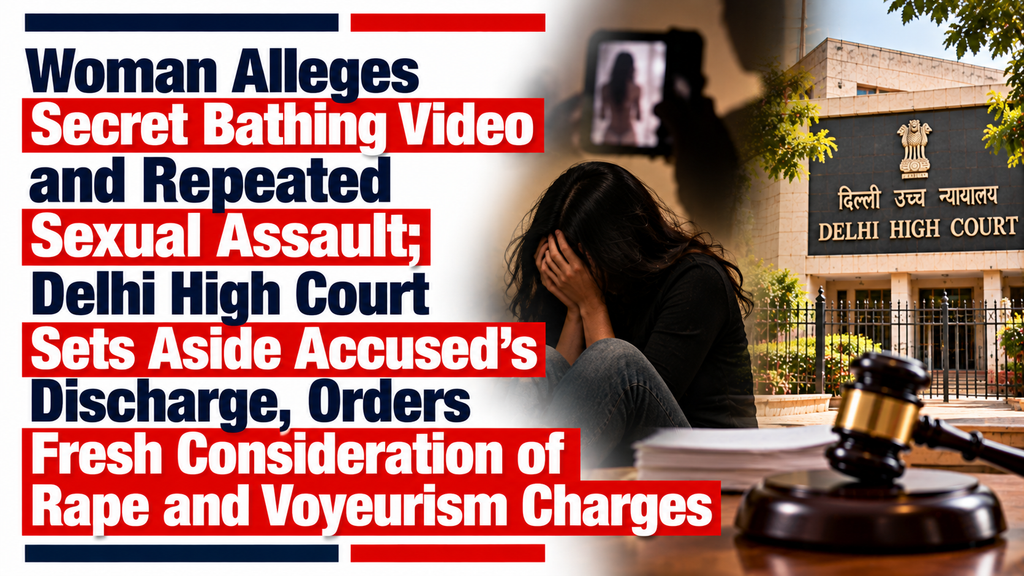
Woman Alleges Secret Bathing Video and Repeated Sexual Assault; Delhi High Court Sets Aside Accused’s Discharge, Orders Fresh Consideration of Rape and Voyeurism Charges

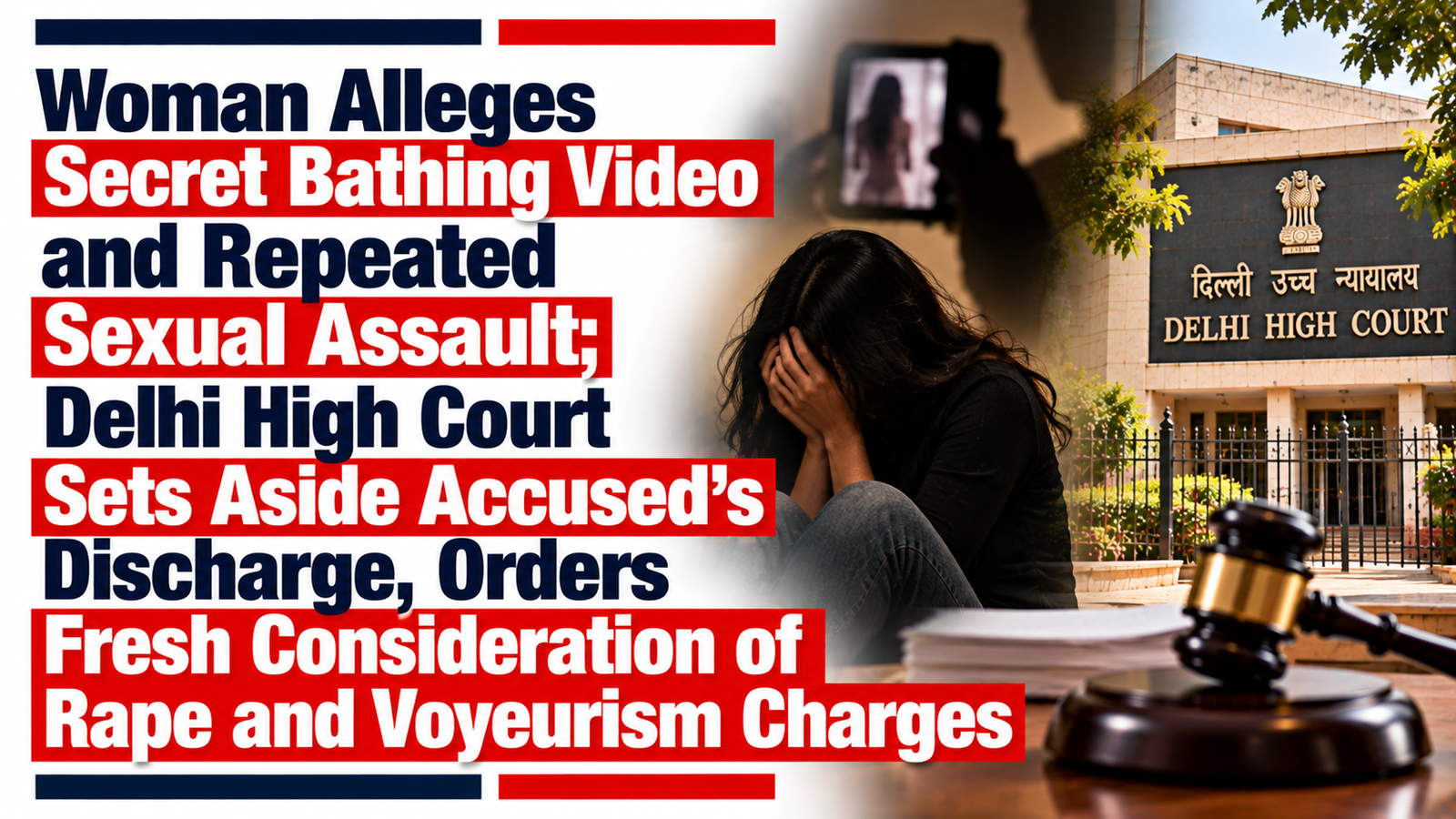
Woman Alleges Secret Bathing Video Used for Sexual Blackmail; Delhi High Court Sets Aside Discharge for Premature Credibility Findings and Orders Fresh Review of Charges
Facts
The prosecutrix alleged that her neighbour, Moseen, secretly filmed her while she was bathing at her Delhi home in November 2016 and threatened to circulate the recording online. According to her complaint, he used those threats to compel repeated sexual relations against her will and pressured her to initiate divorce proceedings. FIR No. 716/2017 was registered at Police Station Gokulpuri under Sections 354C and 376 IPC. Her statements were recorded under Sections 161 and 164 Cr.P.C., and a charge-sheet was filed. An Apple iPhone used by the accused was not recovered; forensic examination of two other phones yielded no retrievable data because they could not be powered on. On 9 June 2023, the Additional Sessions Judge discharged the accused, relying partly on the missing video, the surrounding circumstances and the prosecutrix’s conduct. She challenged that discharge in revision.
Issues
Whether the Sessions Court exceeded the limited scope of Sections 227 and 228 Cr.P.C. by evaluating the prosecutrix’s credibility and deciding contested facts at the stage of charge; whether non-recovery of the alleged video justified discharge; and whether the case required fresh consideration of framing charges.
Petitioner’s Arguments
The prosecutrix submitted that her allegations, especially her statement under Section 164 Cr.P.C., disclosed grave suspicion warranting a trial-stage examination rather than discharge. She argued that the Sessions Court conducted an impermissible mini-trial, speculated about how the alleged recording could have occurred, and disbelieved her merely because the video was not recovered. She also challenged the Court’s observations about her character, divorce proceedings and conduct as irrelevant to the threshold question of charge.
Respondent’s Arguments
The State pointed to the investigative record, including the non-recovery of the alleged recording and the inability to retrieve data from the examined phones, and invited assessment under the established discharge principles. Respondent No. 2 supported the discharge, maintaining that the account contained inconsistencies and improbabilities and that the material did not justify framing charges. He sought dismissal of the revision petition.
Analysis of the Law
Sections 227 and 228 Cr.P.C. require the Court to determine whether the record furnishes sufficient ground to proceed, not whether conviction is assured. Limited sifting of the prosecution material is permissible, but detailed credibility findings and resolution of disputed facts belong to trial. Grave suspicion, if supported by the record and not satisfactorily explained, may justify framing a charge. The Court also invoked Section 53A of the Indian Evidence Act, 1872: in prosecutions for specified sexual offences, evidence of the victim’s character or previous sexual experience is irrelevant when determining consent.
Precedent Analysis
In Sajjan Kumar v. CBI, (2010) 9 SCC 368, the Supreme Court explained that grave suspicion can justify framing charges without examining probative value as at trial. CBI v. Aryan Singh, (2023) 18 SCC 399, reiterated the prohibition against a mini-trial at the charge stage. The petitioner also cited State of Rajasthan v. Ashok Kumar Kashyap, (2021) 11 SCC 191. The High Court relied on State v. Mohd. Javed Nasir, 2022 SCC OnLine Del 3974, to reinforce that alleged inconsistencies in the prosecutrix’s statements should not be finally adjudicated while considering charge.
Court’s Reasoning
The High Court held that the Sessions Court had gone beyond screening for a prima facie case: it treated assumptions about the bathroom, the family’s presence and the prosecutrix’s expected reactions as grounds to reject her version. The untraced video and missing iPhone were relevant circumstances but proved neither that the recording existed nor that it did not. Similarly, filing for divorce or the existence of other allegations could not conclusively establish consent. The observations concerning alleged immorality were inappropriate and irrelevant to consent. By effectively resolving credibility and factual disputes, the discharge order misapplied the statutory test.
Conclusion
The Delhi High Court allowed the criminal revision petition and set aside the discharge order dated 9 June 2023. It remanded the matter to the Trial Court for fresh, independent consideration of whether charges should be framed against respondent No. 2 under the correct legal standards. The High Court expressly clarified that it had not determined the accused’s guilt or innocence, and its observations should not influence the Trial Court’s decision on the merits.
Case: Prosecutrix v. State of NCT of Delhi & Anr. (State v. Moseen, underlying Sessions case)
Court: High Court of Delhi, New Delhi
Case Number: CRL.REV.P. 1152/2023; arising from SC No. 2608/2018 and FIR No. 716/2017, PS Gokulpuri
Judge: Hon’ble Ms. Justice Madhu Jain
Date: 13 October 2026 (reserved on 25 September 2026)
Result: Revision allowed; order discharging accused set aside; matter remanded for fresh consideration of framing charges; no finding on guilt or innocence.