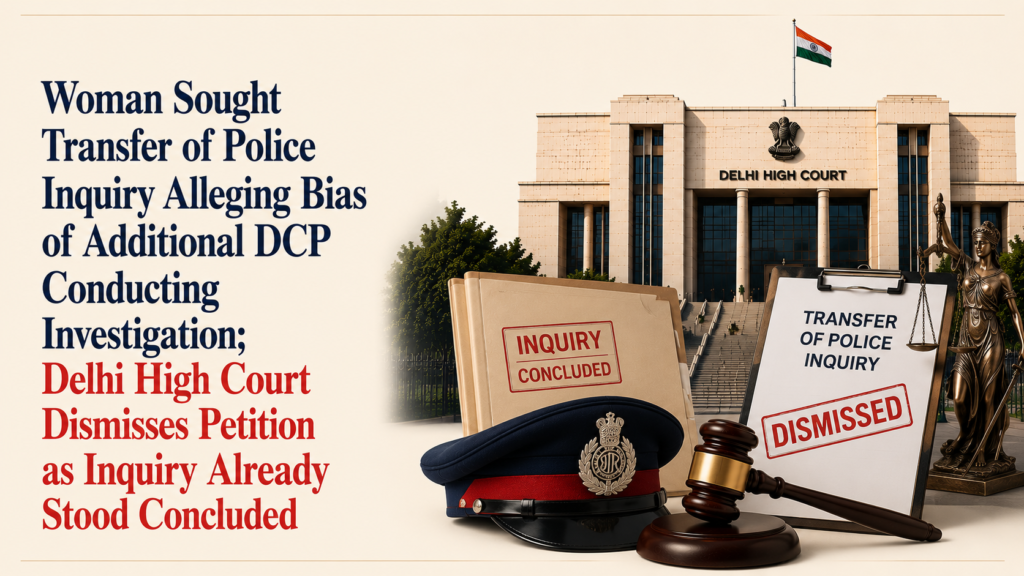
Woman Sought Transfer of Police Inquiry Alleging Bias of Additional DCP Conducting Investigation; Delhi High Court Dismisses Petition as Inquiry Already Stood Concluded

Petitioner Alleged Bias Against Inquiry Officer and Sought Fresh Investigation; Delhi High Court Dismisses Petition After Inquiry Concludes
Facts
The petitioner approached the Delhi High Court seeking transfer of an inquiry relating to her allegation of unlawful police detention during the intervening night of 24/25 March 2025. She sought a direction that the inquiry, which had been entrusted to the Additional Deputy Commissioner of Police (North-East District), be withdrawn from his supervision and assigned to a senior police officer posted outside the district with no prior connection to the matter. She also requested preservation and consideration of CCTV footage, Daily Diary entries, police records and other contemporaneous evidence while conducting a fresh and impartial inquiry.
The petition was founded on the apprehension that the designated Inquiry Officer would not conduct the inquiry fairly. During the hearing, however, the State informed the Court that the inquiry had already been completed, the petitioner’s statement had been recorded, and the matter had been forwarded to the competent authority for an appropriate decision.
Issues
- Whether the inquiry should be transferred from the Additional DCP to an independent senior police officer.
- Whether the petitioner’s apprehension of bias justified judicial interference in the ongoing inquiry.
- Whether any relief survived after the inquiry had already been concluded.
Petitioner’s Arguments
The petitioner argued that the inquiry ought not to continue under the supervision of the Additional DCP because there existed a reasonable apprehension of bias. She relied upon media reports alleging that the officer had recently slapped a woman during a public demonstration, asserting that these reports undermined confidence in the fairness and impartiality of the inquiry.
She therefore sought appointment of an independent officer of at least the rank of Deputy Commissioner of Police from outside the North-East District. She also requested that the newly appointed officer independently examine CCTV footage, Daily Diary entries, police records and other relevant evidence before submitting a reasoned report.
Respondent’s Arguments
The State, on instructions from the Investigating Officer, informed the Court that the inquiry had already been concluded before the matter was taken up for hearing. It submitted that the petitioner’s statement had already been recorded during the inquiry and that the complete record had been forwarded to the competent authority for taking a final decision.
Since the inquiry no longer remained pending, the respondents contended that the relief sought by the petitioner had become purely academic and that no direction transferring the inquiry could now be granted.
Analysis of the Law
The High Court applied the settled principle that writ jurisdiction is ordinarily exercised only where an effective and live controversy continues to exist. Once the administrative action sought to be restrained or transferred has already been completed, the Court will generally decline to issue directions that have become incapable of implementation.
Since the inquiry had already concluded and the report had been forwarded to the competent authority, the Court found that the principal relief sought—namely transfer of the inquiry to another officer—had become incapable of being granted. Consequently, the writ petition no longer presented a subsisting cause requiring judicial intervention.
Precedent Analysis
- No judicial precedent was relied upon or discussed in the judgment. The Court disposed of the matter solely on the factual ground that the inquiry had already been completed, rendering the petition infructuous.
Court’s Reasoning
The Court noted that the entire basis of the petition was the petitioner’s request to replace the existing Inquiry Officer before completion of the inquiry. However, the State unequivocally informed the Court that the inquiry had already concluded, the petitioner’s statement had been recorded, and the matter had been transmitted to the competent authority for a final decision. The petitioner did not dispute this factual position.
In these circumstances, the Court held that no effective relief could be granted. Since the inquiry itself had already been completed, any direction replacing the Inquiry Officer or requiring a fresh inquiry under another officer would amount to adjudicating an issue that had ceased to exist in its original form. The Court therefore declined to examine the petitioner’s apprehension of bias on merits.
Accordingly, the Court concluded that the writ petition had become infructuous and required no further adjudication, while observing that the competent authority would communicate its decision to the petitioner in due course.
Conclusion
The Delhi High Court dismissed the writ petition as infructuous after recording the State’s statement that the impugned inquiry had already been completed and forwarded to the competent authority for a final decision. Since the relief sought—transfer of the inquiry to another officer—could no longer be effectively granted, the Court declined to interfere.
Case Details
- Case: Zarnigar Fatima v. Commissioner of Police, Delhi & Ors.
- Court: Delhi High Court
- Case Number: W.P.(CRL) 2227/2026
- Judge: Justice Girish Kathpalia
- Date: 28 July 2026
- Result: Writ petition dismissed as infructuous