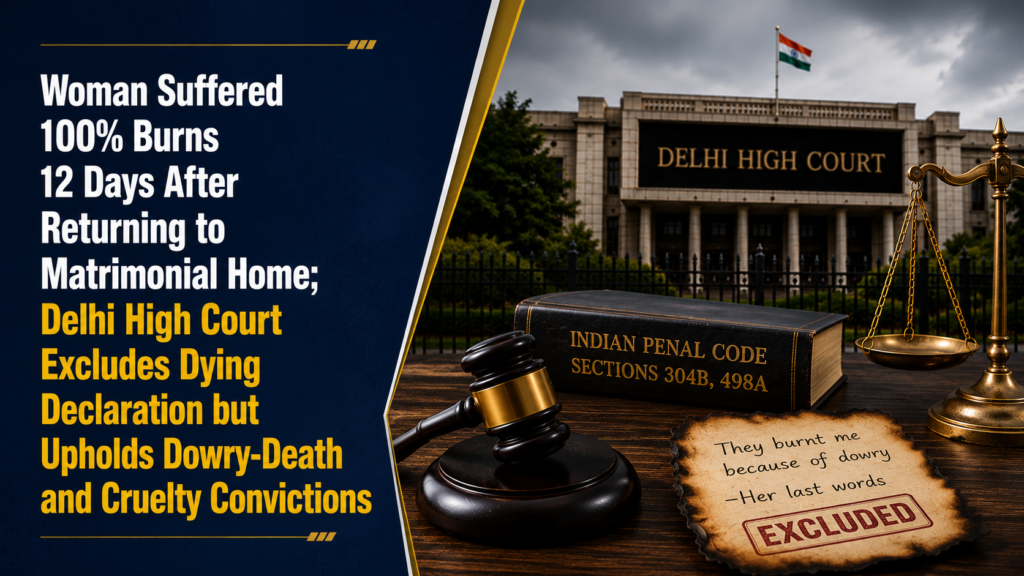
Woman Suffered 100% Burns 12 Days After Returning to Matrimonial Home; Delhi High Court Excludes Dying Declaration but Upholds Dowry-Death and Cruelty Convictions

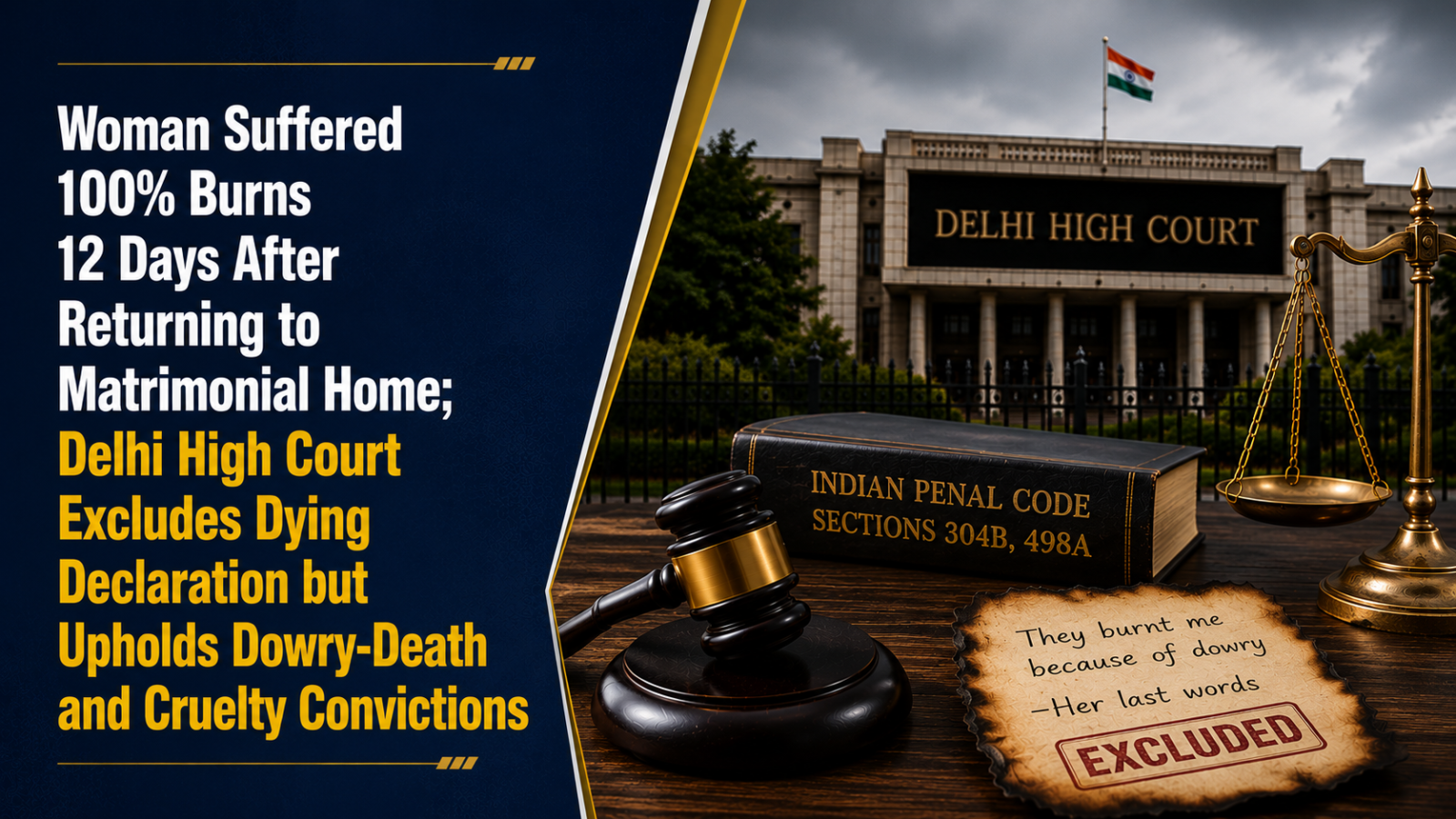
Dying Declaration Naming Mother-in-Law Was Not Put to Accused Under Section 313; Delhi High Court Disregards It Yet Upholds Convictions on Independent Evidence
Facts
- Arti married Nanak Chand alias Devender on 21 April 2000. Veermati was Nanak Chand’s mother and Arti’s mother-in-law.
- According to Arti’s father and uncle, she was subjected to beatings and harassment after marriage over demands for:
- ₹50,000; or
- A plot measuring approximately 100 square yards.
- Arti allegedly left her matrimonial home and lived with her parents from February 2002 because of the harassment.
- After intervention by a Panchayat and assurances from the matrimonial family, she returned to her matrimonial home approximately 12–13 days before the incident.
- On 4 October 2002, the police received information that a daughter-in-law had been burnt by her in-laws at Tajpur Pahari, Badarpur.
- Arti was taken to Safdarjung Hospital with 100% burn injuries.
- After a doctor certified her fit to make a statement, the Sub-Divisional Magistrate recorded her statement at approximately 11:50 AM.
- In that statement, Arti allegedly said:
- Veermati poured kerosene oil over her and set her on fire;
- Her husband used to beat her; and
- Her husband demanded money and dowry.
- The medical record also recorded a history that the mother-in-law had poured kerosene over Arti and set her on fire.
- Arti died from her injuries during the night of 4–5 October 2002.
- The police recovered from the house:
- A burnt and melted plastic can;
- A partially burnt matchbox; and
- A pair of burnt rubber gloves.
- The forensic report detected kerosene residue in the recovered burnt material and in Arti’s hair sample.
- Nanak Chand and Veermati were allegedly not found at the house or hospital and were later apprehended near the Badarpur Border.
- The prosecution examined 15 witnesses, including Arti’s father and uncle, the SDM, doctors and investigating officers.
- The defence examined two witnesses. It claimed that the matrimonial dispute concerned Arti’s frequent visits to her parental home rather than dowry demands.
- On 2 August 2003, the Trial Court convicted:
- Nanak Chand and Veermati under Section 498-A IPC; and
- Veermati additionally under Section 304-B IPC.
- Both were sentenced to three years’ rigorous imprisonment and a fine of ₹10,000 each under Section 498-A IPC.
- Veermati was additionally sentenced to imprisonment for life under Section 304-B IPC.
- Although Veermati had alternatively been charged under Section 302 IPC, she was not convicted of murder. The State did not challenge that part of the judgment.
- Nanak Chand and Veermati filed separate appeals before the Delhi High Court.
Issues
- Whether the dying declaration could be relied upon when its incriminating contents were not specifically put to the appellants during examination under Section 313 CrPC.
- Whether merely referring to the dying declaration as an exhibit gave the appellants a meaningful opportunity to explain its contents.
- Whether omission of the material allegation from the Section 313 examination caused serious prejudice.
- Whether the remaining evidence independently proved cruelty and dowry death after excluding the dying declaration.
- Whether the evidence of Arti’s father and uncle contained only vague and general allegations.
- Whether the absence of exact dates for each dowry demand or a previous police complaint weakened the prosecution case.
- Whether non-examination of the doctor who prepared the MLC, the PCR driver, Panchayat members and certain relatives was fatal.
- Whether the prosecution established the essential ingredients of dowry death under Section 304-B IPC.
- Whether the defence evidence provided a credible alternative explanation consistent with innocence.
Appellants’ Arguments
- The testimonies of Arti’s father and uncle contained vague and general allegations of dowry demand.
- Although they referred to a demand for ₹50,000 or a 100-square-yard plot, they did not specify:
- The exact date of each demand;
- The time when it was made; or
- Which accused raised each particular demand.
- Arti’s father made material improvements during his trial testimony by alleging that she had been sent to her parental home after beatings.
- Despite the alleged continuing harassment, no complaint was made to the police or any authority during Arti’s lifetime.
- No independent member of the Panchayat was examined to prove the alleged reconciliation.
- Arti’s uncle had not personally witnessed any dowry demand. His testimony was based on what Arti and her father had told him.
- The dying declarations recorded in the medical record and by the SDM were not specifically put to the appellants during their Section 313 examination.
- The appellants were only asked generally about the recording of the statement and were not confronted with the allegation that Veermati had poured kerosene and set Arti on fire.
- Veermati was illiterate and could not have understood a question merely referring to an exhibit number.
- This omission caused serious prejudice and made the dying declaration legally unusable against the appellants.
- The prosecution failed to examine material witnesses, including:
- The PCR driver;
- The doctor who initially prepared the MLC;
- Panchayat members;
- Neighbours; and
- Other family members.
- A defence witness stated that Veermati was found weeping with Arti’s head in her lap. This conduct was claimed to be inconsistent with guilt.
- Another defence witness suggested that the dispute concerned Arti’s frequent visits to her parental home and not dowry.
Respondent’s Arguments
- The State argued that the oral, medical, scientific and circumstantial evidence conclusively established the prosecution case.
- Arti had returned to her matrimonial home only 10–12 days before suffering fatal burns.
- Her father and uncle consistently proved harassment over the demand for ₹50,000 or a plot.
- The burnt plastic can, matchbox and rubber gloves recovered from the house supported the prosecution version.
- The SDM recorded Arti’s statement only after a doctor certified her fit to speak.
- The SDM had not been informed beforehand about how Arti sustained the burns, reducing the possibility of tutoring.
- The dying declaration selectively implicated Veermati in setting Arti on fire while not assigning that act to Nanak Chand. This was said to show absence of an intention to falsely implicate the family indiscriminately.
- The appellants had extensively cross-examined the witnesses concerning the dying declaration and therefore suffered no prejudice.
- The Section 313 objection was described as an afterthought.
- The appellants’ absence from the house and hospital and their apprehension near the Badarpur Border constituted relevant incriminating conduct.
- Veermati had no burn injury and had apparently made no attempt to rescue Arti.
Analysis of the Law
Ingredients of dowry death
Section 304-B IPC, now substantially reflected in Section 80 of the Bharatiya Nyaya Sanhita, requires proof that:
- A woman died due to burns, bodily injury or otherwise than under normal circumstances;
- Her death occurred within seven years of marriage;
- Soon before her death, she was subjected to cruelty or harassment by her husband or his relative; and
- Such cruelty or harassment was connected with a demand for dowry.
In the present case:
- Arti died from 100% burn injuries;
- Her death occurred approximately two-and-a-half years after marriage;
- Evidence showed repeated cruelty and harassment; and
- The harassment was connected with specific demands for money or property.
Importance of Section 313 CrPC
- Section 313 is not an empty procedural formality.
- Every material circumstance on which the prosecution seeks conviction must be put to the accused specifically, separately and intelligibly.
- The purpose is to provide a fair and meaningful opportunity to explain the evidence.
- A general reference to an exhibit does not necessarily communicate its incriminating contents, particularly where the accused is illiterate.
- A circumstance not put to the accused ordinarily has to be excluded from consideration.
- Where the omission causes serious prejudice, the evidence cannot be used to sustain conviction.
Effect of excluding one item of evidence
- Exclusion of an important item of evidence does not automatically result in acquittal.
- The Court must examine whether the remaining evidence independently establishes guilt beyond reasonable doubt.
- If reliable oral, medical, scientific and circumstantial evidence remains available, conviction may still be sustained.
Evidence of related witnesses
- Testimony cannot be discarded merely because the witness is related to the deceased.
- Close family members are often best placed to know about matrimonial cruelty and dowry demands taking place within the privacy of the matrimonial relationship.
- Their evidence must be examined carefully, but relationship alone does not make it unreliable.
Continuing cruelty and exact dates
- Matrimonial cruelty may continue over an extended period.
- Human memory cannot be expected to preserve the exact date and time of every demand or beating.
- Where witnesses consistently identify the nature of the demand and its effect on the matrimonial relationship, inability to recall precise dates does not make the allegations vague.
Absence of a previous police complaint
- Families may initially avoid police intervention in matrimonial disputes in the hope of preserving the marriage.
- Fear that criminal proceedings may permanently damage the relationship provides a natural explanation for not immediately approaching the police.
- Absence of a prior complaint was therefore not fatal.
Non-examination of every witness
- The prosecution is required to prove its case through reliable evidence, not by examining every person connected with the investigation.
- Non-examination becomes material only where the accused shows resulting prejudice or demonstrates that the missing witness was indispensable.
Proof of the MLC
- A medical record prepared in the regular course of hospital work can be proved by another doctor who identifies the handwriting and signature of the doctor who prepared it.
- The MLC does not become inadmissible merely because its author has left the hospital or cannot be traced.
Precedent Analysis
- Karan Singh v. State of Haryana, 2025 INSC 133
- The Supreme Court reiterated the four essential ingredients of dowry death under Section 304-B IPC.
- There must be an unnatural death within seven years of marriage and dowry-related cruelty or harassment soon before death.
- The Delhi High Court applied these ingredients and found them satisfied.
- Sujit Biswas v. State of Assam, (2013) 12 SCC 406
- A circumstance not put to the accused during examination under Section 313 CrPC cannot be used against him.
- Such a circumstance must ordinarily be excluded from consideration.
- The Court applied this principle to exclude the incriminating contents of Arti’s SDM-recorded dying declaration.
- Raj Kumar v. State (NCT of Delhi), (2023) 17 SCC 95
- The Supreme Court held that every material circumstance must be put to the accused specifically, distinctly and separately.
- Failure to do so is a serious irregularity and may vitiate the trial if prejudice is caused.
- Depending on the circumstances, an appellate court may cure the defect by questioning the accused or remanding the matter.
- Passage of time is relevant while deciding whether such a course remains practical.
- Here, the Court found actual prejudice and excluded the dying declaration rather than relying upon it.
- Aejaz Ahmad Sheikh v. State of Uttar Pradesh, 2025 SCC OnLine SC 913
- Where a dying declaration was not put to the accused under Section 313 CrPC, the accused was denied an opportunity to explain it.
- The resulting prejudice required the dying declaration to be kept out of consideration.
- This directly supported exclusion of the dying declaration in the present appeals.
- Goverdhan v. State of Chhattisgarh, (2025) 3 SCC 378
- Exclusion of one piece of evidence does not necessarily demolish the prosecution case.
- If the remaining evidence, read cumulatively, establishes the accused’s role beyond reasonable doubt, criminal liability may still be sustained.
- The Court relied on this principle to examine the dowry evidence, medical material, recoveries and conduct independently.
- Sanjay D. Jain v. State of Maharashtra, 2025 INSC 1168
- Criminal proceedings based only on vague and omnibus allegations without satisfying the statutory ingredients cannot be sustained.
- The Delhi High Court distinguished that principle because Arti’s father and uncle identified specific demands for ₹50,000 or a plot and explained the resulting cruelty and separation.
- Kamlesh v. State, Criminal Appeal No. 481 of 2019, decided on 5 January 2023
- An MLC is an authenticated record prepared in the regular course of hospital work.
- It may be proved by another doctor who identifies the handwriting and signature of its author.
- Personal examination of the original doctor is not indispensable where the record is otherwise properly proved.
Court’s Reasoning
Dying declaration could not be used
- The SDM-recorded dying declaration attributed the fatal act directly to Veermati.
- During Section 313 examination, however, the appellants were asked only about the fact that the SDM had recorded a statement.
- They were not specifically told that Arti had alleged that Veermati poured kerosene over her and set her on fire.
- This allegation formed a fundamental part of the prosecution case and had to be specifically put to the appellants.
- Veermati was stated to be illiterate, making a bare reference to an exhibit particularly insufficient.
- The omission deprived the appellants of a meaningful opportunity to explain the allegation and caused clear prejudice.
- The Court therefore excluded the dying declaration from consideration.
Independent evidence proved cruelty and dowry demand
- Arti’s father consistently stated that the appellants demanded ₹50,000 or a 100-square-yard plot.
- He explained that Arti had been beaten and sent to her parental home in February 2002.
- She remained there until September 2002 and returned only after a Panchayat and family assurances.
- Arti died within 10–12 days of returning to the matrimonial home.
- The inability to identify the date and time of each individual demand did not destroy the evidence of continuing cruelty.
- Arti’s uncle materially corroborated:
- The demands;
- The prolonged matrimonial discord;
- The Panchayat intervention; and
- The circumstances of Arti’s return.
- Their evidence was natural, consistent and trustworthy.
No previous complaint was understandable
- The Court accepted that parents of a married woman may initially avoid filing criminal complaints in the hope that the matrimonial dispute will be resolved.
- The absence of an earlier police complaint did not show that the dowry allegations were fabricated.
Medical and scientific evidence
- Arti suffered 100% antemortem flame burns and died from shock caused by those burns.
- The MLC recorded the history that her mother-in-law had poured kerosene and set her on fire.
- The Court treated the medical record and surrounding physical evidence as providing assurance to the prosecution case.
- A burnt plastic can, partially burnt matchbox and burnt rubber gloves were recovered from the house.
- The forensic report detected kerosene residue on the burnt articles and Arti’s hair.
- The presence of burnt rubber gloves in the kitchen was considered unusual and suggestive of an attempt to avoid direct contact with kerosene.
Defence evidence was insufficient
- The claim that Veermati was seen holding Arti’s head and crying did not outweigh the remaining evidence.
- Even accepting that account, her first response was allegedly to ask for Nanak Chand rather than call an ambulance, inform the police or accompany Arti to hospital.
- The alternative theory that the marital disagreement concerned Arti’s visits to her parental home did not negate the evidence of dowry demands.
Subsequent conduct of appellants
- Neither appellant was found at the house or hospital when the police arrived.
- They were apprehended near the Badarpur Border.
- Abscondence by itself did not conclusively establish guilt, but it was a relevant circumstance when considered with the recoveries and dowry-related evidence.
Cumulative conclusion
- The Court held that exclusion of the dying declaration did not destroy the entire prosecution case.
- Independent evidence established:
- Dowry demands;
- Continuing cruelty;
- Arti’s prolonged stay at her parental home;
- Her return shortly before death;
- Unnatural death within two-and-a-half years of marriage;
- Medical and forensic circumstances; and
- Suspicious post-incident conduct.
- The Trial Court’s findings under Sections 498-A and 304-B IPC therefore remained sustainable.
Conclusion
The Delhi High Court held that Arti’s dying declaration could not be used against the appellants because its incriminating contents were not specifically put to them during their examination under Section 313 CrPC. The omission caused serious prejudice, particularly because Veermati was illiterate and the dying declaration directly attributed the fatal act to her.
However, the prosecution case did not collapse. The testimony of Arti’s father and uncle, the specific demands for ₹50,000 or a plot, the evidence of continuing cruelty, her return to the matrimonial home shortly before death, the medical and forensic evidence, the recoveries and the appellants’ subsequent conduct independently sustained the convictions.
The Court accordingly:
- Dismissed both criminal appeals;
- Upheld Nanak Chand and Veermati’s convictions and sentences under Section 498-A IPC;
- Upheld Veermati’s conviction and life sentence under Section 304-B IPC;
- Directed both appellants to surrender before the concerned Jail Superintendent within two weeks; and
- Directed that, on failure to surrender, steps be taken to arrest them for serving the remaining sentence.
Case Details
Case: Nanak Chand alias Devender v. State and Veermati v. State
Court: High Court of Delhi at New Delhi
Case Numbers: Criminal Appeal Nos. 583 of 2003 and 661 of 2003
Trial Case: Sessions Case No. 4 of 2003 arising from FIR No. 550 of 2002, Police Station Badarpur
Judges: Justice Navin Chawla and Justice Ravinder Dudeja
Judgment authored by: Justice Ravinder Dudeja
Reserved on: 29 April 2026
Pronounced on: 22 July 2026
Result: Appeals dismissed; convictions and sentences upheld; both appellants directed to surrender within two weeks.