
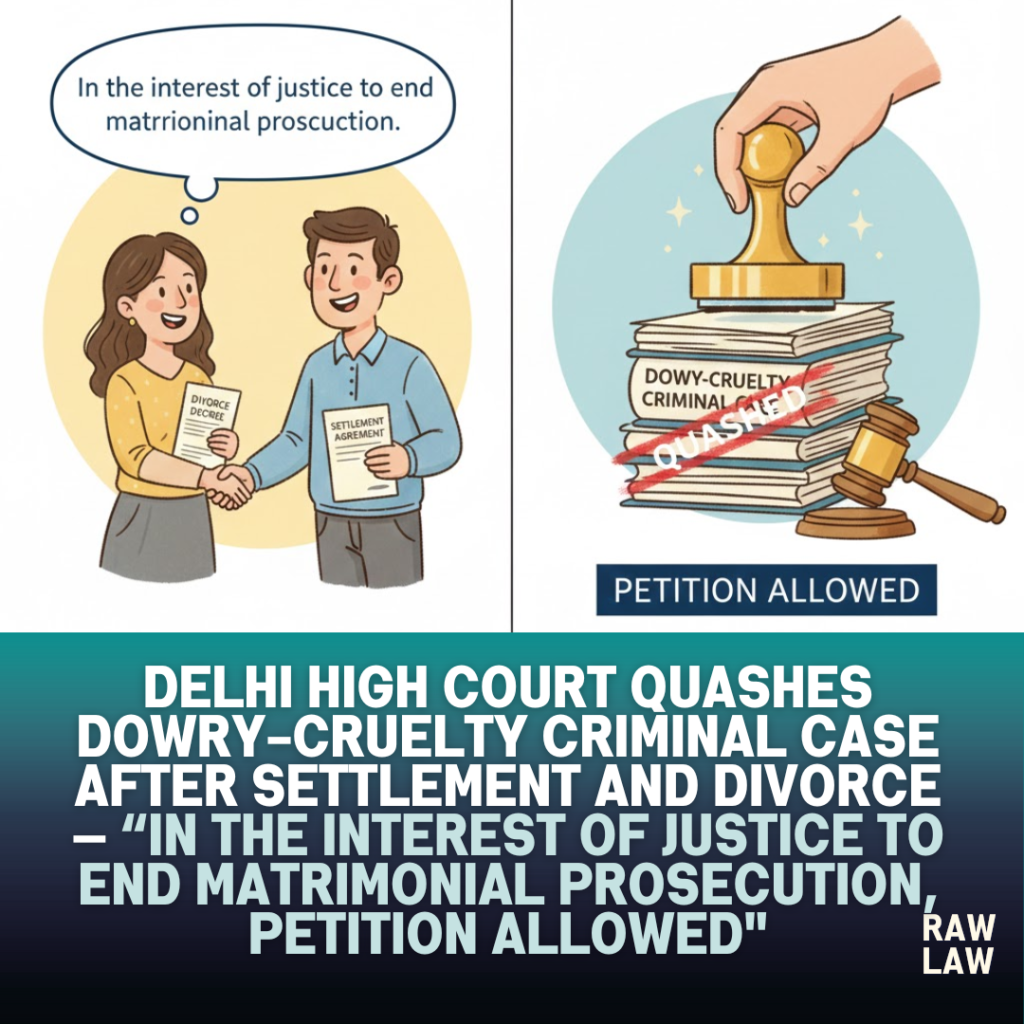

1. Court’s decision
The Delhi High Court quashed the criminal case arising from a matrimonial dispute after recording that the spouses had amicably settled all their differences, the agreed settlement money had been fully paid, and the complainant had no objection to closure of the case. Exercising its quashing jurisdiction under the Bharatiya Nagarik Suraksha Sanhita (the provision invoked in the petition) and the court’s inherent powers principles, the Court held that continuing the prosecution would not serve any meaningful purpose once the parties had voluntarily resolved their disputes. The petition was allowed and all consequential proceedings were terminated.
2. Facts
The dispute stemmed from a marriage solemnised in January 2013 according to Christian rites and ceremonies. One child was born from the wedlock. The spouses began living separately from April 2017 due to “temperamental differences”. In March 2019, the complainant lodged a criminal complaint alleging physical and mental harassment linked to dowry demands, along with allegations relating to retention of her articles, leading to registration of a criminal case and filing of a police report against the husband and his relatives. During the pendency of the criminal proceedings, the parties negotiated a settlement and reduced it into writing.
3. Issues
The key issue before the High Court was whether the criminal proceedings—originating from allegations typically associated with matrimonial cruelty and misappropriation of matrimonial property—should be quashed because the parties had arrived at a voluntary settlement. A second, practical issue was whether the settlement appeared genuine and fully acted upon, including payment of the full settlement amount and clarity on child custody and visitation. The Court also had to consider the State’s position and ensure that quashing would not undermine the administration of justice, given that the offences invoked are generally non-compoundable but frequently litigated in the context of family settlements.
4. Petitioner’s arguments
The petitioners (the husband and his relatives) sought quashing of the criminal case on the ground that the matrimonial dispute had been fully resolved through an amicable settlement recorded in a written settlement deed executed in February 2025. They submitted that the complainant had already obtained a divorce decree in January 2023, that the entire agreed settlement sum of ₹4,00,000 had been paid, and that the parties had also agreed on child custody and visitation arrangements. In these circumstances, they argued that continuation of the criminal prosecution would amount to an abuse of process and should be brought to an end.
5. Respondent’s arguments
The complainant appeared before the Court and confirmed that the settlement had been reached voluntarily, without force, fear, or coercion. She affirmed that she had received the entire settlement amount and had no objection to the criminal case being quashed against the accused persons. The State, represented by the public prosecutor, also stated that it had no objection to quashing in view of the settlement between the parties. The investigating officer identified the appearing parties. This alignment—complainant’s consent and the State’s lack of opposition—narrowed the matter to whether quashing would serve the ends of justice in a settled matrimonial dispute.
6. Analysis of the law
The judgment proceeds on a well-settled principle: High Courts possess power to quash criminal proceedings to secure the ends of justice and to prevent abuse of process, even where the offences are not formally compoundable, provided the nature of the dispute and settlement justify such relief. Matrimonial offences involving allegations of cruelty or disputes over matrimonial articles are often treated by constitutional courts as suitable for quashing once the parties have genuinely settled and separated, because the criminal process is not meant to perpetuate conflict after reconciliation or lawful separation. The Court’s legal lens focuses on voluntariness of settlement, completeness of performance, and the larger justice interest.
7. Precedent analysis
The Court relied on Supreme Court guidance recognising the importance of amicable settlement in matrimonial disputes and the permissibility of quashing criminal proceedings to give quietus to such conflicts. It referred to decisions emphasising that when disputes are essentially private and personal, and when parties have resolved them freely, courts may facilitate closure to avoid unnecessary continuation of prosecution. The order specifically cited authorities that have repeatedly affirmed quashing in matrimonial cases after settlement, subject to the court’s satisfaction that the compromise is genuine and not a product of coercion or collusion that would harm public interest. These precedents provide the doctrinal basis for the Court’s conclusion that quashing would be appropriate here.
8. Court’s reasoning
The High Court recorded multiple safeguards before granting relief. It noted that the settlement terms were captured in a written settlement deed, that the complainant confirmed full receipt of ₹4,00,000, and that she expressly stated she had no objection to quashing. It also recorded that the custody arrangement placed the child with the complainant, with visitation rights to the husband as per settlement, indicating that the family consequences had been addressed. The Court treated the settlement as voluntary and complete, and observed that in such circumstances, it would be in the interest of justice to terminate the criminal proceedings, rather than allow a settled matrimonial dispute to continue as a criminal prosecution.
9. Conclusion
Having satisfied itself on voluntariness, completion of settlement payment, and the complainant’s unequivocal consent, the High Court allowed the petition and quashed the criminal case and all consequential proceedings. The order reflects the court’s consistent approach that where matrimonial parties have separated, resolved financial and custody-related issues, and no longer wish to pursue criminal litigation, continuing the case often becomes counterproductive and burdens the criminal justice system without advancing accountability. The Court therefore exercised its quashing power to bring finality to the dispute and disposed of the petition and pending applications.
10. Implications
This ruling reinforces a practical pathway in matrimonial criminal litigation: when parties reach a genuine settlement that resolves monetary claims, divorce status, and child custody arrangements, the High Court may quash criminal proceedings to prevent abuse of process and ensure finality. For complainants, the decision underscores the importance of clear consent recorded before the court and confirmation of full settlement compliance. For accused persons, it highlights the need for demonstrable performance of settlement obligations before seeking quashing. For the system, it signals judicial preference for decongesting criminal dockets where prosecution no longer serves a live dispute and where settlement reduces the likelihood of hostile testimony, prolonged trial, and continuing family trauma.
Case law references
- Rangappa Javoor v. State of Karnataka and another
- Held: Encouraged resolution of disputes through amicable settlement, supporting quashing where continuation would not serve justice.
- Applied here: Used to reinforce that settlement-led closure is desirable in matrimonial disputes once parties have voluntarily resolved differences.
- Jitendra Raghuvanshi and others v. Babita Raghuvanshi and another
- Held: Matrimonial disputes, when genuinely settled, may be quashed to secure the ends of justice.
- Applied here: Supported the Court’s view that family disputes should be given quietus after compromise.
- Gian Singh v. State of Punjab
- Held: High Courts can quash non-compoundable offences in appropriate cases, especially where disputes are predominantly private and settlement serves justice.
- Applied here: Provided the doctrinal foundation for quashing despite the offences being generally non-compoundable.
- Held: Courts may quash proceedings arising from matrimonial differences when settlement is reached, to prevent abuse of process.
- Applied here: Cited as the immediate principle that matrimonial prosecutions should not be mechanically continued after settlement.
FAQs
1) Can the High Court quash a dowry-cruelty criminal case after settlement?
Yes. This order reiterates that the High Court can quash criminal proceedings arising from matrimonial disputes after confirming a voluntary settlement, full compliance with settlement terms, and the complainant’s no-objection, to secure the ends of justice.
2) Does divorce and payment of settlement amount strengthen a quashing request in matrimonial cases?
It often does. Here, the Court noted that divorce had already been granted and the entire settlement amount of ₹4,00,000 was paid, which supported the conclusion that no useful purpose would be served by continuing the prosecution.
3) What does the court check before quashing criminal proceedings on the basis of compromise?
The court typically checks voluntariness (no force or coercion), completeness of settlement performance (such as payment), identification of parties, and whether quashing would serve justice given the nature of the offence and dispute.


