

HEADNOTE
S and S Construction Co. v. Union of India
Court: High Court of Delhi
Bench: Hon’ble Mr. Justice Avneesh Jhingan
Date of Judgment: January 21, 2026
Case Number: O.M.P. (COMM) 337/2023
Laws Involved:
Section 34, Arbitration and Conciliation Act, 1996; Section 73, Indian Contract Act, 1872; General Conditions of Contract (Clauses 2, 6, 10B, 10CA, 10CC, 17)
Keywords: Section 34 arbitration, arbitral award challenge, limited scope of interference, proof of damages, CPWD contracts
Summary
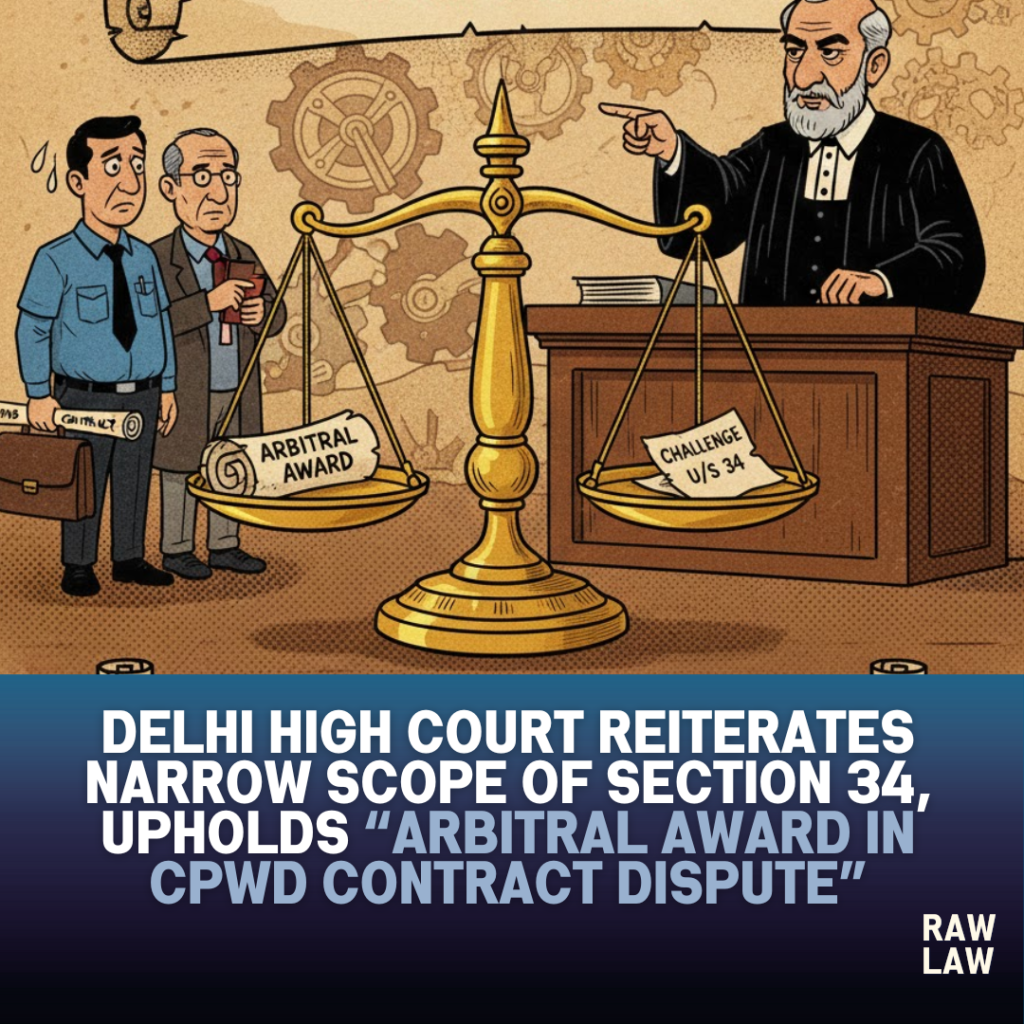
The Delhi High Court dismissed a Section 34 petition challenging an arbitral award arising out of a CPWD construction contract, reiterating the extremely limited scope of judicial interference with arbitral awards. Justice Avneesh Jhingan held that the arbitrator’s rejection of multiple monetary claims was based on plausible reasoning and absence of proof of actual damages. The Court emphasised that claims for escalation, overheads, extra work, or damages under Section 73 of the Contract Act must be supported by credible evidence and cannot rest on unsubstantiated head-wise calculations. It was further held that re-appreciation of evidence is impermissible under Section 34 and an arbitral award cannot be set aside merely because another view is possible. Finding no patent illegality, perversity, or violation of public policy, the Court upheld the arbitral award in its entirety.
Court’s decision
The Delhi High Court dismissed the petition filed under Section 34 of the Arbitration and Conciliation Act, 1996, challenging the arbitral award dated 18 April 2023. The Court held that the arbitral award did not suffer from patent illegality, perversity, or violation of public policy of India. It was observed that the arbitrator had given cogent reasons for rejecting the claims and the conclusions reached were plausible on the basis of the evidence on record. Consequently, no interference was warranted.
Facts
The petitioner was awarded a CPWD contract in June 2010 for construction works with an estimated value of approximately ₹19.43 crore. The project experienced delays and disputes arose between the parties relating to withheld amounts, mobilisation advance interest, milestone payments, escalation, overheads due to prolongation, alleged extra work, and restoration works following a natural disaster. Arbitration was invoked under Clause 25 of the GCC, resulting in an award allowing some claims and rejecting others. Aggrieved by rejection of seven claims, the petitioner approached the High Court under Section 34 of the Arbitration Act.
Issues
The principal issue before the Court was whether the arbitral award rejecting various monetary claims suffered from patent illegality, perversity, or violation of fundamental policy of Indian law so as to warrant interference under Section 34 of the Arbitration and Conciliation Act, 1996.
Petitioner’s arguments
The petitioner contended that several amounts were illegally withheld without notice, that interest on mobilisation advance was wrongly recovered, and that milestone-linked deductions ought to have been rescheduled upon extension of time. It was further argued that claims for escalation, overheads, and damages were wrongly rejected despite being maintainable under Section 73 of the Contract Act. The petitioner also challenged rejection of claims for extra work and disaster-related restoration works, asserting that measurements submitted by it ought to have been accepted. The arbitral award was alleged to be non-speaking and perverse.
Respondent’s arguments
The Union of India opposed the petition, contending that deductions were made strictly in accordance with the GCC after issuance of notices. It was argued that mobilisation advance was a contractual loan carrying interest and that no interest was payable on withheld milestone amounts due to an express contractual bar. The respondent submitted that the petitioner failed to prove actual damages or extra work through cogent evidence and that the arbitrator’s findings were based on appreciation of material on record, which could not be revisited under Section 34.
Analysis of the law
The Court reiterated that proceedings under Section 34 are not appellate in nature and do not permit re-appreciation of evidence. Interference is permissible only on limited grounds such as patent illegality, perversity, or violation of public policy. The Court emphasised that claims under Section 73 of the Contract Act require proof of actual loss or damage and cannot be sustained on the basis of mere calculations or assertions. Contractual bars on payment of interest and agreed mechanisms under the GCC were held to be binding on the parties.
Precedent analysis
The Court relied on multiple Supreme Court decisions reaffirming the narrow scope of Section 34, including rulings holding that even erroneous findings of fact or law do not justify interference unless they go to the root of the matter. The Court also relied on precedent clarifying that loss of profit or damages claims must be supported by credible evidence, and that arbitral awards based on a possible view must be allowed to stand.
Court’s reasoning
Justice Avneesh Jhingan held that each rejected claim was supported by rational reasoning. Deductions for defects were upheld under Clause 17 of the GCC, interest on mobilisation advance was found contractually justified, and claims barred by Clause 2 of the GCC were rightly rejected. The Court found that the petitioner failed to prove actual damages for escalation, overheads, and extra work, and that absence of joint measurements fatally undermined certain claims. The arbitrator’s view was held to be plausible and free from perversity.
Conclusion
The Court concluded that the arbitral award did not warrant interference under Section 34 of the Arbitration and Conciliation Act, 1996. The petition was dismissed along with all pending applications.
Implications
This judgment reinforces the consistently strict approach adopted by courts while examining challenges to arbitral awards. It serves as a reminder that Section 34 is a supervisory remedy and not a forum for rehearing disputes. The ruling underscores the importance of contractual clauses and the necessity of proving actual damages with credible evidence in construction and infrastructure arbitrations.
Case law references
- Unibros v. All India Radio – Held that loss of profit claims require strict proof of actual damage. Applied.
- Sepco Electric Power Construction Corp. v. GMR Kamalanga Energy Ltd. – Reiterated minimal judicial interference with arbitral awards. Relied upon.
- Ramesh Kumar Jain v. BALCO – Clarified narrow scope of Section 34 jurisdiction. Followed.
- PSA Sical Terminals Pvt. Ltd. v. V.O. Chidambranar Port Trust – Reaffirmed principles governing public policy and patent illegality. Applied.
FAQs
1. Can courts re-appreciate evidence under Section 34 of the Arbitration Act?
No. Re-appreciation of evidence is impermissible unless the award is patently illegal or perverse.
2. Are head-wise calculations sufficient to claim damages under Section 73?
No. Actual loss or damage must be proved through credible evidence.
3. Why was the arbitral award upheld in this case?
Because the arbitrator’s findings were plausible, reasoned, and free from patent illegality or public policy violations.
Also Read: Delhi High Court sets aside CAT’s direction imposing costs and APAR entries on police officers


