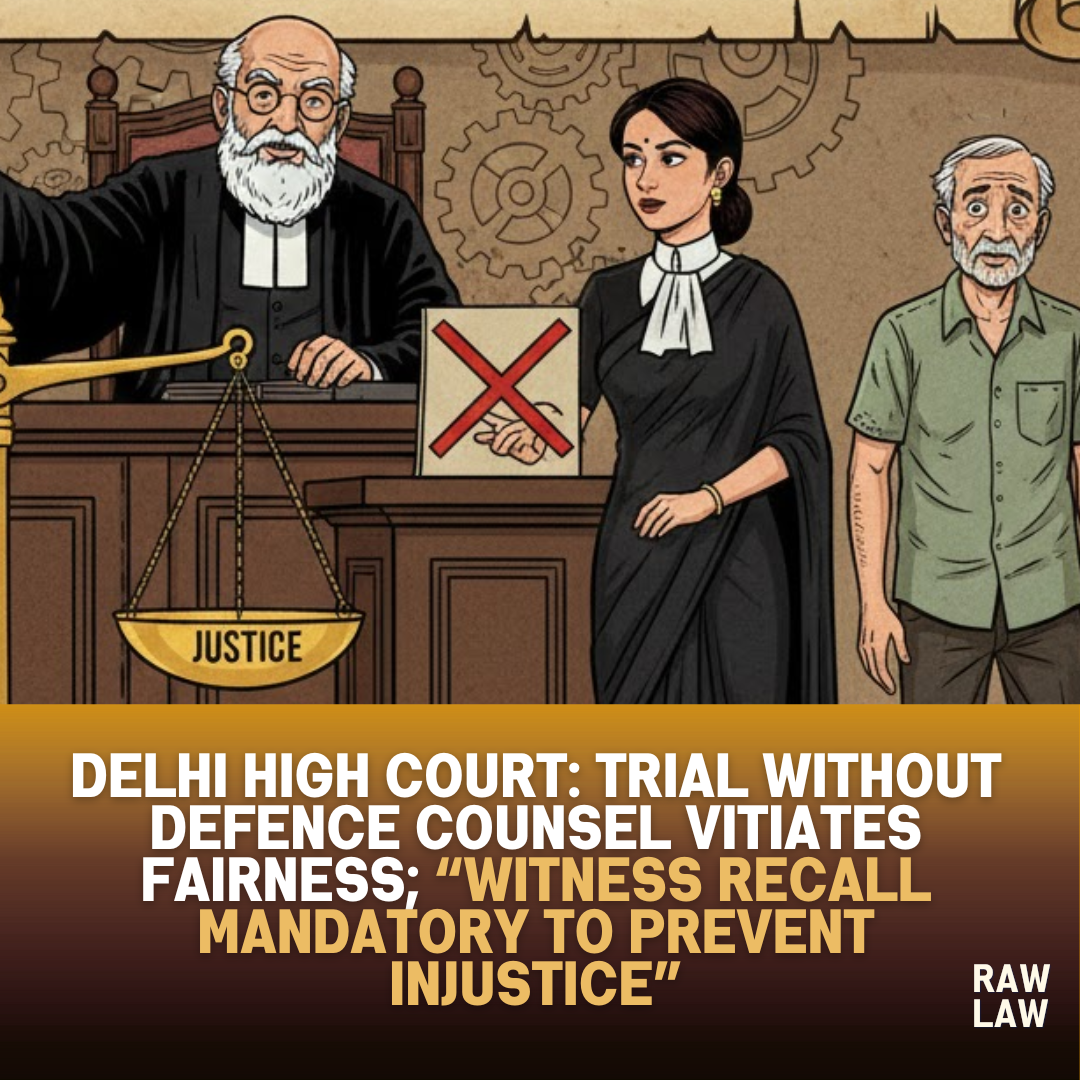
Delhi High Court: Trial without defence counsel vitiates fairness; witness recall mandatory to prevent injustice

HEADNOTE
Ram Swaroop Gupta & Ors. v. State (NCT of Delhi)
Court: High Court of Delhi
Bench: Hon’ble Mr. Justice Girish Kathpalia
Date of Decision: January 21, 2026
Case Number: CRL.M.C. 537/2026 with CRL.M.A. 2162/2026 & 2161/2026
Laws Involved:
Section 311, Code of Criminal Procedure, 1973; Section 348, Bharatiya Nagarik Suraksha Sanhita, 2023; Section 438(2), BNSS; Article 21, Constitution of India
Keywords: Section 311 CrPC, recall of witness, fair trial, absence of counsel, inherent powers, Section 482 CrPC
Summary
The Delhi High Court set aside a trial court order refusing recall of a prosecution witness for further cross-examination, holding that denial of legal assistance to accused persons during trial proceedings amounts to gross injustice and vitiates the fairness of the trial. Justice Girish Kathpalia ruled that although rejection of an application under Section 311 CrPC is an interlocutory order ordinarily not amenable to challenge, the High Court can invoke its inherent powers where failure to do so would result in grave injustice. The Court held that compelling unrepresented accused persons to cross-examine a prosecution witness strikes at the very core of a fair trial guaranteed under Article 21. The trial court was directed to grant a fresh opportunity for cross-examination and the order was directed to be circulated across criminal courts in Delhi to prevent recurrence.
Court’s decision
The Delhi High Court allowed the petition and set aside the trial court’s order dismissing the application for recall of PW-1 for further cross-examination. The Court directed the trial court to grant another opportunity to the accused persons to cross-examine the witness through their counsel. It was further directed that the matter be taken up on a fresh date in accordance with the trial court’s calendar. The Court also ordered circulation of the judgment to all criminal courts in Delhi to ensure that similar situations do not arise in future trials.
Facts
The petitioners were facing criminal trial before the trial court, during which PW-1 Jagmohan Gupta appeared for cross-examination on 02.09.2023. On that date, the accused persons were not accompanied by their counsel, nor was any proxy counsel present. Despite this, they were called upon to cross-examine the witness. Being laypersons, the accused were unable to conduct cross-examination, following which the trial court closed the testimony of PW-1 by recording “Nil. Opportunity given.” Subsequently, the accused filed an application under Section 311 CrPC seeking recall of PW-1, which was dismissed by the trial court, leading to the present petition.
Issues
The primary issue before the High Court was whether dismissal of an application for recall of a witness under Section 311 CrPC, when the accused were earlier denied effective legal assistance, amounted to gross injustice warranting exercise of inherent powers despite the bar against interference with interlocutory orders.
Petitioners’ arguments
The petitioners argued that the denial of an effective opportunity to cross-examine PW-1 was a direct consequence of the absence of defence counsel on the relevant date. It was contended that compelling unrepresented accused persons to cross-examine a prosecution witness violated the principles of natural justice and the right to a fair trial. The petitioners submitted that the trial court failed to exercise its discretion judiciously and ought to have recalled the witness to prevent serious prejudice to the defence.
Respondent’s arguments
The State, in a fair stand, did not oppose the petition. The learned APP accepted that the circumstances disclosed a serious procedural lapse and that denial of an opportunity for proper cross-examination could result in injustice to the accused. The private complainant was deleted from the array of parties as he was not a necessary party to the proceedings.
Analysis of the law
The Court analysed the scope of Section 311 CrPC (now Section 348 BNSS), reiterating that the provision empowers the trial court to summon or recall witnesses at any stage to ensure a just decision. The Court acknowledged that rejection of such an application is ordinarily interlocutory and barred from revision. However, it clarified that this bar is not absolute and does not restrict the High Court’s inherent powers where refusal to intervene would perpetuate grave injustice. The Court emphasised that inherent powers are coupled with a duty to secure the ends of justice.
Precedent analysis
While the Court did not rely on specific case citations, it reiterated well-settled principles governing fair trial jurisprudence, particularly that the presence of legal assistance is a core component of a valid criminal trial. The Court’s reasoning aligns with established Supreme Court jurisprudence recognising denial of effective legal representation as fatal to trial fairness.
Court’s reasoning
Justice Girish Kathpalia held that the injustice in the present case was not limited to the accused alone but extended to the integrity of the trial itself. The Court observed that when an accused is unrepresented, the trial court should either appoint an amicus curiae or request legal aid counsel instead of compelling the accused to cross-examine witnesses. The Court further noted that expeditious trial cannot come at the cost of fairness and truth-seeking, which are foundational to criminal justice.
Conclusion
The High Court concluded that refusal to recall PW-1 had resulted in gross injustice and undermined the fairness of the trial. Accordingly, the impugned order was set aside and directions were issued for fresh cross-examination of the witness through counsel.
Implications
This judgment serves as a strong reminder that trial courts must prioritise fairness over procedural rigidity. It reinforces that denial of legal assistance to accused persons can vitiate trial proceedings and that courts must proactively safeguard the right to a fair trial. The direction to circulate the judgment across criminal courts underscores its institutional significance.
Case law references
- Principles under Section 311 CrPC / Section 348 BNSS – Courts must recall witnesses if necessary to prevent miscarriage of justice. Applied.
- Fair trial jurisprudence under Article 21 – Presence of legal assistance is fundamental to criminal trials. Reaffirmed.
FAQs
1. Can the High Court interfere with interlocutory orders under Section 311 CrPC?
Yes, if refusal to interfere would result in gross injustice, the High Court can invoke inherent powers.
2. Is cross-examination without a defence counsel permissible?
Compelling an unrepresented accused to cross-examine witnesses undermines the fairness of trial.
3. What should a trial court do if defence counsel is absent?
The court should appoint an amicus curiae or seek legal aid rather than proceed unfairly.
Also Read: Delhi High Court restrains enforcement of allegedly fabricated MOAs, cites cheque issuance mismatch