

HEADNOTE
Walmark Holdings Limited v. Fortis Healthcare Limited
Court: High Court of Delhi
Bench: Hon’ble Mr. Justice Amit Bansal
Date of Decision: January 21, 2026
Case Number: O.M.P.(I) (COMM.) 170/2019 (Application under Section 340 CrPC)
Laws Involved:
Section 340 read with Section 195, Code of Criminal Procedure, 1973; Sections 193, 196, 199, 200, 209, 464 IPC; Section 9, Arbitration and Conciliation Act, 1996
Keywords: Section 340 CrPC, perjury, forged document, false affidavit, fraud on court, arbitration proceedings
Summary
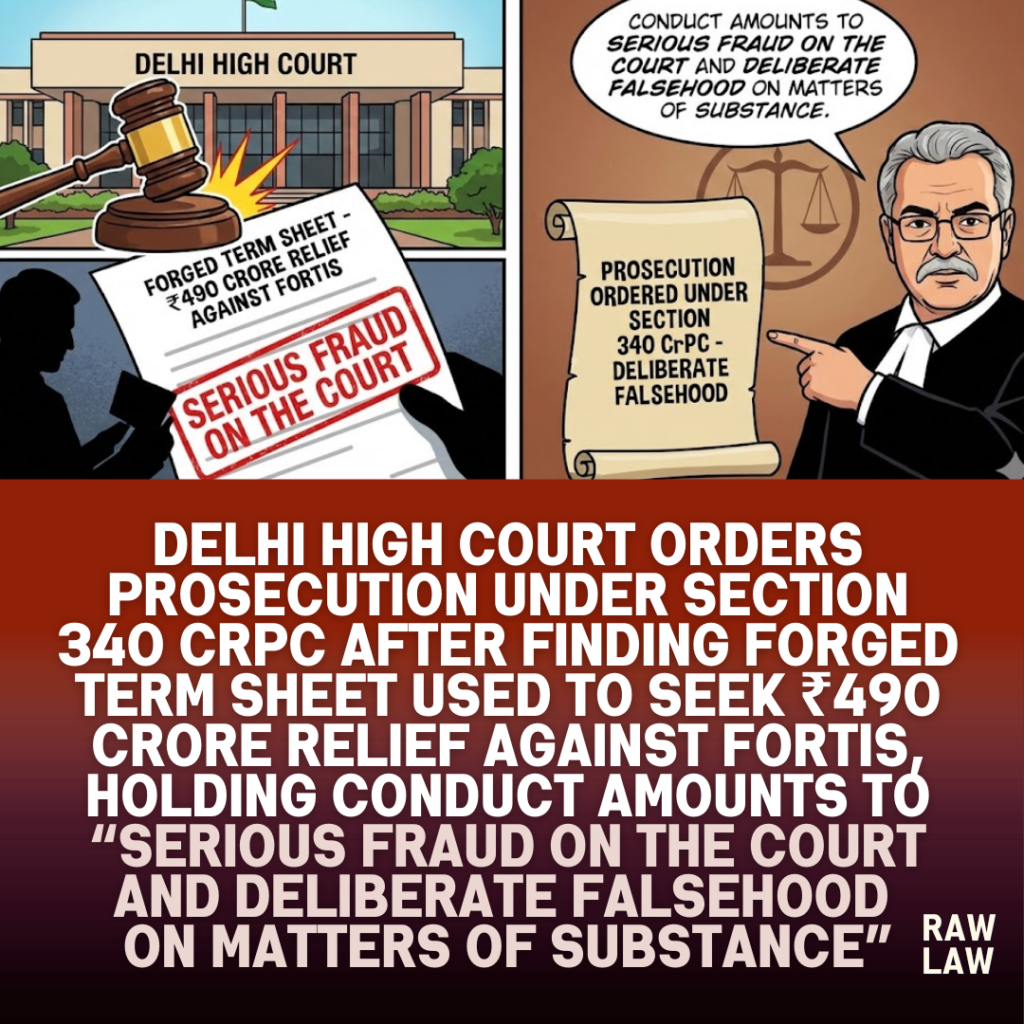
The Delhi High Court directed initiation of criminal proceedings for perjury and forgery against officials of Walmark Holdings Limited, holding that they had prima facie played a “serious fraud on this Court” by relying upon a forged and fabricated Term Sheet to obtain interim reliefs under Section 9 of the Arbitration and Conciliation Act. Justice Amit Bansal found that despite clear knowledge that the Term Sheet was never executed by Fortis Healthcare Limited, Walmark and its officials filed false pleadings and affidavits, including claims seeking security of ₹490 crores. Applying Supreme Court jurisprudence on Section 340 CrPC, the Court held that the conduct disclosed deliberate falsehood on matters of substance and that it was expedient in the interests of justice to prosecute the delinquent parties. The Registrar General was directed to lodge a criminal complaint before the jurisdictional Magistrate.
Court’s decision
The Delhi High Court allowed the application filed by Fortis Healthcare Limited under Section 340 CrPC and directed the Registrar General to lodge a criminal complaint against non-applicant officials of Walmark Holdings Limited. The Court held that a prima facie case of perjury and use of forged documents was made out and that prosecution was expedient in the interest of justice.
Facts
Walmark initiated proceedings under Section 9 of the Arbitration and Conciliation Act against Fortis on the basis of an alleged Term Sheet dated 6 December 2017 and accompanying Side Letters. Fortis consistently denied execution of these documents. Evidence on record showed that the Term Sheet was never signed by Fortis’ authorised signatory and that a version containing forged signatures surfaced only later. Walmark ultimately withdrew the Section 9 petition, following which Fortis sought action under Section 340 CrPC.
Issues
Whether Walmark and its officials knowingly relied on forged documents and false affidavits in judicial proceedings, thereby committing offences under Sections 193–209 IPC, and whether it was expedient in the interest of justice to direct prosecution under Section 340 CrPC.
Applicant’s arguments (Fortis)
Fortis contended that Walmark deliberately relied upon a forged Term Sheet to obtain interim reliefs, despite admissions that the document was never executed. It was argued that false pleadings and affidavits were filed to mislead the Court and that the conduct squarely attracted offences of perjury, forgery, and fraud on the court.
Non-applicants’ position (Walmark officials)
Certain officials distanced themselves from the execution of the Term Sheet, while others failed to appear or file replies despite service. The Court noted this conduct while assessing prima facie culpability.
Analysis of the law
The Court analysed the scope of Section 340 CrPC in light of Supreme Court precedent, particularly James Kunjwal v. State of Uttarakhand. It reiterated that prosecution is warranted only where there is deliberate falsehood on a matter of substance and where action is expedient in the interest of justice, not for mere inaccuracies.
Precedent analysis
The Court relied on James Kunjwal v. State of Uttarakhand and Pritish v. State of Maharashtra to reiterate that a preliminary inquiry is not mandatory and that the court’s satisfaction regarding expediency and prima facie falsehood is sufficient to direct prosecution.
Court’s reasoning
Justice Amit Bansal held that documentary evidence, admissions on record, and prior judicial findings clearly established that the Term Sheet was never executed by Fortis. Despite this, Walmark sought substantial interim reliefs on its basis. The Court found that the false statements were made knowingly, were material, and were intended to obtain favourable judicial orders, warranting criminal prosecution.
Conclusion
The Court concluded that the conduct of the non-applicants constituted a serious fraud on the court and directed the Registrar General to file a criminal complaint before the competent Magistrate within four weeks.
Implications
The judgment sends a strong signal that abuse of judicial process through forged documents and false affidavits—particularly in high-stakes commercial and arbitration matters—will invite criminal consequences. It reinforces judicial intolerance for perjury and fraud on courts.
Case law references
- James Kunjwal v. State of Uttarakhand – Laid down governing principles for prosecution under Section 340 CrPC. Applied.
- Pritish v. State of Maharashtra – Clarified scope and purpose of preliminary inquiry under Section 340 CrPC. Relied upon.
FAQs
1. When can courts initiate action under Section 340 CrPC?
When deliberate falsehood on a material issue is made in judicial proceedings and prosecution is expedient in the interest of justice.
2. Is a preliminary inquiry mandatory before ordering prosecution?
No. Courts may order prosecution without a preliminary inquiry if satisfied on the material before them.
3. Why is this judgment significant?
It reinforces zero tolerance for fraud, perjury, and forged documents in commercial and arbitration litigation.


