

HEADNOTE
M/s Punjab Steel Works v. Shambhu Saran Singh
Court: High Court of Delhi
Bench: Justice Chandrasekharan Sudha
Date of Judgment: 11 December 2025
Citation: W.P.(C) 6264/2019
Laws / Sections Involved: Articles 226 & 227 Constitution of India; Section 25F Industrial Disputes Act, 1947; Section 114(g) Indian Evidence Act, 1872
Keywords: Illegal termination, Section 25F ID Act, adverse inference, non-production of records, reinstatement with back wages, Labour Court award, scope of writ jurisdiction
Summary:
The Delhi High Court dismissed a writ petition filed by the management challenging a Labour Court award directing reinstatement of a workman with 50% back wages or, in the alternative, lump-sum compensation of ₹3 lakh. Upholding the award, the Court held that the management failed to rebut the workman’s claim of continuous employment since 2010 and illegally terminated his services in November 2012 without complying with Section 25F of the Industrial Disputes Act. The Court drew an adverse inference against the employer for non-production of statutory employment records and for failing to subject its witness to cross-examination. Reiterating the limited scope of judicial review under Article 226, the Court refused to reappreciate evidence and found no perversity or illegality in the Labour Court’s findings.
Court’s decision
The Delhi High Court dismissed the writ petition and upheld the Labour Court’s award dated 4 December 2018. The Court held that the management had failed to demonstrate any perversity, illegality, or jurisdictional error in the Labour Court’s conclusion that the termination of the workman was illegal. Consequently, the direction granting reinstatement with continuity of service and 50% back wages, or alternatively lump-sum compensation of ₹3,00,000 in lieu of reinstatement, was affirmed. All pending applications were disposed of.
Facts
The claimant-workman asserted that he was employed as a “Helper” with the management since 8 July 2010 at monthly wages of ₹7,200. He alleged that the management failed to provide statutory benefits such as appointment letter, wage slips, and attendance records. According to him, wages for September to November 2012 were withheld, and when he demanded payment, his services were terminated on 26 November 2012 without notice, enquiry, or compliance with Section 25F of the Industrial Disputes Act.
The management denied long-term employment and claimed that the workman was engaged only for a few days between 4 November and 25 November 2012 as a daily wager, after which he allegedly abandoned service. The Labour Court rejected this defence and passed the impugned award, leading to the present writ petition.
Issues
The primary issue before the High Court was whether the Labour Court’s finding of illegal termination suffered from perversity or non-consideration of material evidence, warranting interference under Articles 226 and 227 of the Constitution. A connected issue was whether the management had successfully rebutted the workman’s claim of continuous service and discharged its burden as custodian of statutory employment records.
Petitioner’s arguments (Management)
The management contended that the workman failed to produce documentary proof of employment since 2010 and relied on inconsistencies in his testimony. It argued that muster rolls and an ESI declaration form showed the date of appointment as 4 November 2012. The management also submitted that no contemporaneous complaints were made by the workman regarding denial of statutory benefits, and that awarding ₹3 lakh compensation for a short period of alleged service was excessive. The writ petition urged reappreciation of evidence and setting aside of the award.
Respondent’s arguments (Workman)
The workman argued that his testimony remained unrebutted and that once he discharged the initial burden, the onus shifted to the management to produce statutory records. It was submitted that the management failed to produce muster rolls, wage registers, or ESI/PF records before the Labour Inspector and that its witness never subjected himself to cross-examination, justifying adverse inference under Section 114(g) of the Evidence Act. The workman emphasised that writ jurisdiction could not be invoked for reappreciation of evidence.
Analysis of the law
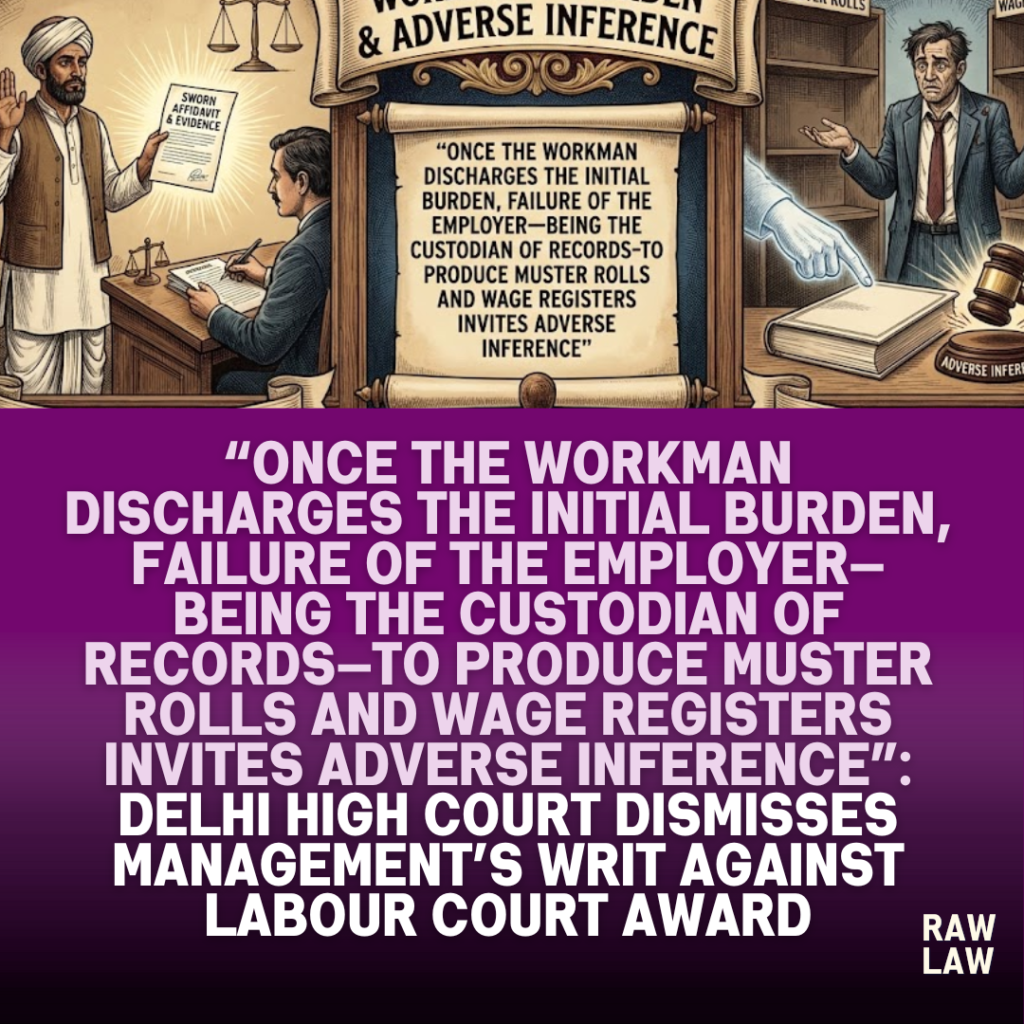
The Court reiterated settled principles governing industrial adjudication: the workman bears the initial burden to prove employment, after which the burden shifts to the employer to produce statutory records. Non-production of such records permits drawing of adverse inference. The Court further reiterated that compliance with Section 25F of the Industrial Disputes Act is mandatory and termination without notice, retrenchment compensation, or enquiry is illegal. In writ proceedings, the High Court exercises supervisory—not appellate—jurisdiction.
Precedent analysis
The Court relied on established jurisprudence including Gopal Krishnaji Ketkar v. Mohamed Haji Latif on adverse inference for withholding evidence, and Krishnanand v. Deputy Director of Consolidation and Shalini Shyam Shetty v. Rajendra Shankar Patil, which limit reappreciation of facts in writ jurisdiction. These principles guided refusal to interfere with concurrent factual findings of the Labour Court.
Court’s reasoning
Justice Chandrasekharan Sudha noted that it was undisputed that the workman worked with the management in November 2012 and that no notice, enquiry, or compliance with Section 25F preceded cessation of service. The management’s reliance on an ESI declaration form was held insufficient to disprove earlier employment. Crucially, the management failed to produce statutory records when called upon and its witness avoided cross-examination, rendering the defence unproved. The Labour Court’s conclusions were therefore based on evidence and not perverse.
Conclusion
The High Court found the writ petition devoid of merit and dismissed it. The Labour Court’s award directing reinstatement with back wages or alternative compensation was upheld in toto.
Implications
The judgment reinforces that employers, as custodians of employment records, bear a heavy burden in termination disputes. Failure to produce statutory documents can decisively tilt adjudication in favour of workmen. The ruling also reiterates that writ courts will not substitute their own view for that of labour adjudicators absent perversity, thereby strengthening finality of Labour Court awards.
CASE LAW REFERENCES
• Gopal Krishnaji Ketkar v. Mohamed Haji Latif – Adverse inference for non-production of evidence
• Krishnanand v. Deputy Director of Consolidation – No reappreciation of facts under Article 226
• Shalini Shyam Shetty v. Rajendra Shankar Patil – Supervisory, not appellate, writ jurisdiction
FAQs
Q1. Can Labour Court awards be interfered with under Article 226?
Only if findings are perverse or illegal; reappreciation of evidence is impermissible.
Q2. What happens if an employer does not produce employment records?
Courts may draw adverse inference against the employer.
Q3. Is compliance with Section 25F mandatory?
Yes. Non-compliance renders termination illegal.


