

Court’s decision
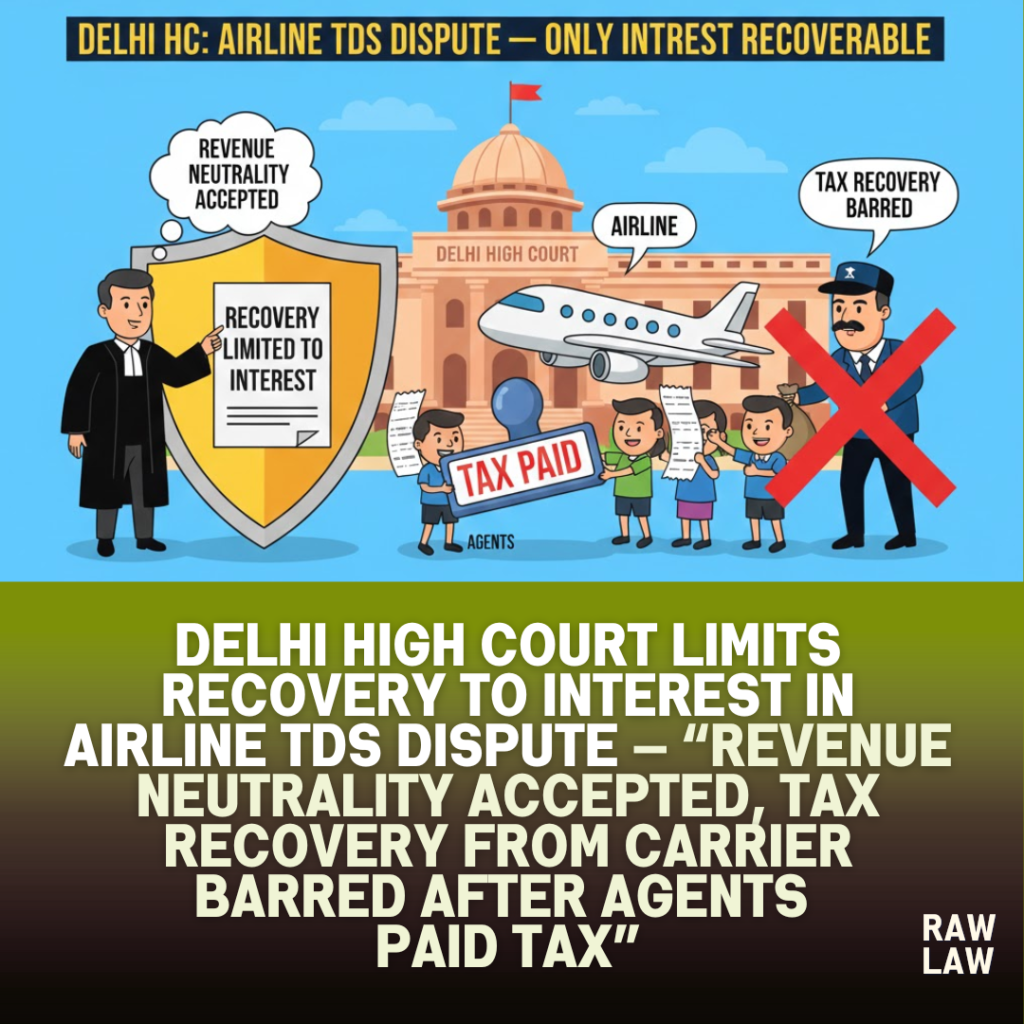
The Delhi High Court disposed of a long-pending income tax appeal involving tax deduction at source on airline commission by holding that while the legal issue stands conclusively in favour of the Revenue, recovery of the principal tax amount from the airline is impermissible once the travel agents have already paid income tax on the same income. The Court confined the Revenue’s entitlement strictly to levy of interest under the Income-tax Act and barred any further enquiry into whether agents had deposited tax, thereby bringing finality to a two-decade-old controversy.
Court’s decision
The Division Bench accepted that supplementary commission paid by an international airline to its agents attracted tax deduction at source. However, recognising the principle of revenue neutrality and the practical impossibility of reopening agent-level assessments after more than ten years, the Court directed that only interest on the delayed deduction could be demanded from the airline. The appeal was thus disposed of in terms of binding Supreme Court precedent, with clear operational directions to the Assessing Officer.
Facts
The appeal arose from an assessment dispute concerning tax deduction at source on supplementary commission paid by an international airline to its travel agents operating in India. The Revenue contended that the airline failed to deduct tax at source on commission, thereby attracting liability under the Income-tax Act. The assessee airline resisted the appeal on the ground of low tax effect and further contended that the commission income had already been offered to tax by its agents. Given that the airline’s operations in India had ceased years earlier, it argued that requiring proof of agent-level tax compliance would be practically impossible.
Issues
The central issue before the Court was whether the Revenue could recover the principal tax amount from the airline for failure to deduct tax at source on commission, despite the fact that the travel agents had already paid income tax on that income. An ancillary issue was whether the appeal was maintainable in view of the monetary limits prescribed by Central Board of Direct Taxes circulars, and if so, what relief could lawfully be granted to the Revenue.
Appellant’s arguments
The Revenue argued that the issue was squarely covered in its favour by earlier judgments holding that airline commission attracts tax deduction at source. It submitted that the appeal fell within the exception to the low tax effect circulars, as the dispute involved tax deduction between two parties. The Revenue urged that in light of authoritative judicial precedent, the appeal ought to be allowed on merits, affirming the airline’s liability under the statutory provisions governing tax deduction at source.
Respondent’s arguments
The airline contended that the appeal should be dismissed on account of low tax effect in terms of binding CBDT circulars. Alternatively, it urged that even if the legal issue was decided against it, recovery should be limited strictly in line with Supreme Court directions recognising revenue neutrality. It was submitted that the agents had already paid tax on the commission income and that, given the lapse of time and cessation of Indian operations, it would be impossible for the airline to furnish proof of such payments. The airline sought protection from reopening settled matters.
Analysis of the law
The Court examined the settled legal position on tax deduction at source on commission earned by travel agents. It noted that the Supreme Court has conclusively held that such commission attracts tax deduction at source due to the principal–agent relationship between airlines and agents. At the same time, the apex court has recognised that once tax has been paid by the recipient of income, the Revenue cannot recover the same tax again from the deductor, though interest for delay remains payable. This balances statutory compliance with fairness and avoids double recovery.
Precedent analysis
The Bench relied on binding Supreme Court precedent which held that airline commission is subject to tax deduction at source, but also clarified that where agents have already discharged their tax liability, the matter becomes revenue neutral. In such circumstances, recovery of principal tax from the airline is barred, and the Revenue’s remedy is confined to levy of interest for the period of default. The High Court adopted this approach to bring quietus to prolonged litigation.
Court’s reasoning
The Court accepted that, on merits, the Revenue’s legal position was correct. However, it gave decisive weight to the practical reality that more than a decade had elapsed since the transactions, making it unreasonable to expect the airline to prove agent-level tax payments. It therefore directed the Assessing Officer to issue demand only for applicable interest on the tax amount that ought to have been deducted, without reopening questions of principal tax recovery. The Court also clarified that responsibility for ensuring tax compliance of agents lies with their respective assessing authorities, not with the airline at this stage.
Conclusion
The High Court disposed of the appeal by limiting the Revenue’s recovery strictly to interest on delayed tax deduction. It expressly prohibited any enquiry into whether the agents had paid tax and directed that interest demand be raised and complied with within a fixed time-frame. By doing so, the Court ensured finality to a dispute that had persisted for nearly two decades while maintaining consistency with Supreme Court jurisprudence.
Implications
This ruling reinforces the principle of revenue neutrality in tax deduction disputes and provides critical certainty to non-resident airlines and similar assessees. While affirming strict statutory obligations to deduct tax at source, the judgment prevents double recovery once income has already been taxed in the hands of recipients. It also underscores judicial reluctance to reopen settled matters after prolonged delays, offering clarity on how legacy TDS disputes should be resolved.
Case law references
- Tax deduction on airline commission: Commission paid to travel agents attracts TDS due to principal–agent relationship. Applied to decide the issue on merits in favour of the Revenue.
- Revenue neutrality doctrine: Once tax is paid by the recipient, recovery of principal tax from the deductor is barred. Applied to restrict recovery to interest only.
- Scope of interest liability: Interest under the Income-tax Act remains payable for delay in deduction even where principal tax recovery is barred. Applied to direct limited demand.
FAQs
1. Can the Revenue recover tax again if agents have already paid income tax?
No. Courts have held that once tax is paid by the recipient, recovery from the deductor is barred, though interest may still be levied.
2. Is airline commission subject to tax deduction at source?
Yes. Courts have consistently held that supplementary commission paid to travel agents attracts TDS due to a principal–agent relationship.
3. What relief can be granted in long-pending TDS disputes?
Courts may confine recovery to interest only, especially where principal tax has already been paid and reopening old matters is impractical.


