

Court’s decision
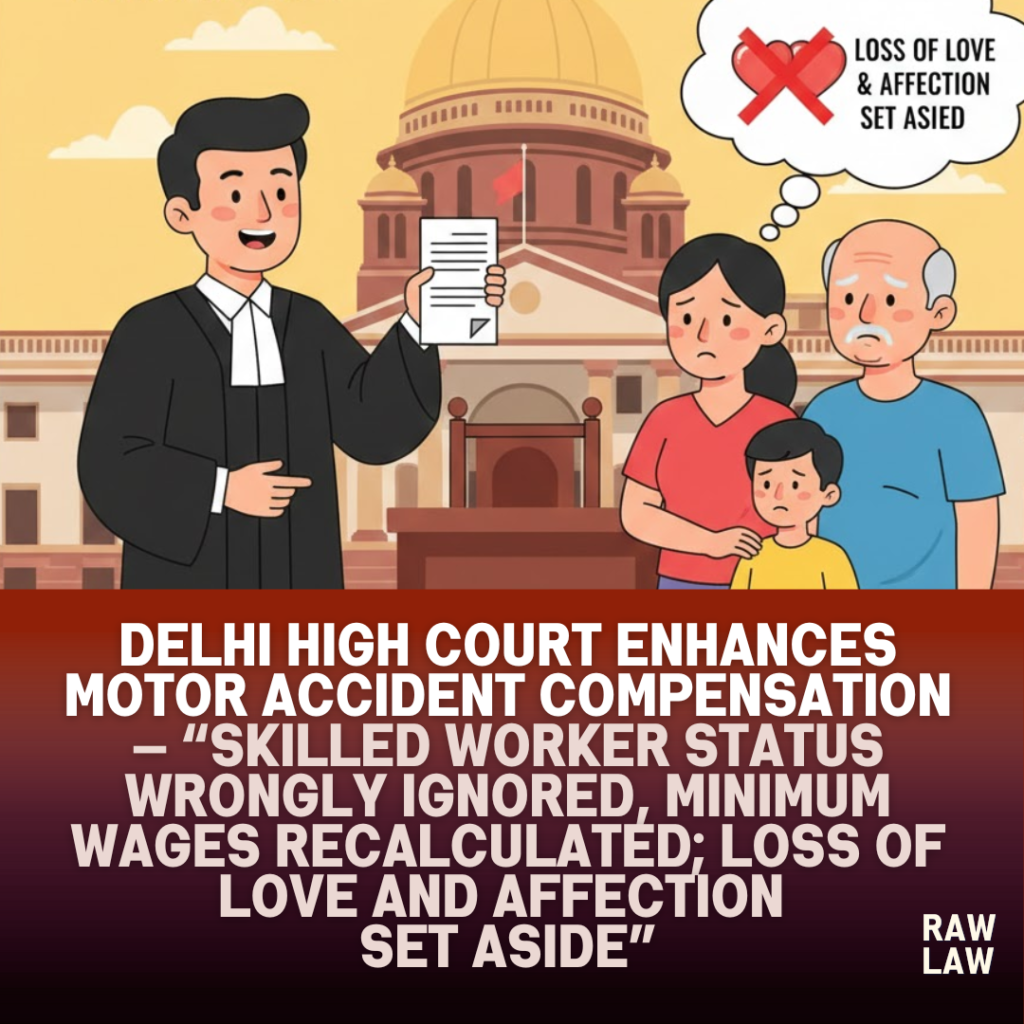
The Delhi High Court partly allowed a motor accident compensation appeal and enhanced the award granted to the legal heirs of a deceased motorcyclist, holding that the Motor Accident Claims Tribunal erred in treating the deceased as an unskilled worker despite uncontroverted evidence of skilled employment. Recomputing income on the basis of minimum wages for skilled labour and correcting non-pecuniary heads in line with settled Supreme Court law, the Court increased the compensation while deleting impermissible amounts granted towards loss of love and affection.
Court’s decision
Justice Anish Dayal recalculated the compensation payable to the widow, children and mother of the deceased and enhanced the total award from ₹32,68,800 to ₹39,65,214 with interest at 9% per annum. The Court held that documentary material forming part of the Detailed Accident Report could not be ignored and that tribunals must adopt a realistic approach while assessing income of persons engaged in the unorganised or semi-skilled sector. The appeal was disposed of with directions to the Tribunal for compliance.
Facts
The fatal accident occurred in April 2019 near the ITO red light in Delhi when a motorcycle driven by the deceased was hit by an ambulance being driven on the wrong side of the road. The deceased sustained grievous injuries and later succumbed in hospital. An FIR was registered for rash and negligent driving and a charge-sheet was filed. The claimants, being the wife, two minor children and mother of the deceased, filed a claim petition under the Motor Vehicles Act. The Tribunal held the driver negligent and awarded compensation, but assessed the deceased’s income as that of an unskilled worker, leading to the present appeal seeking enhancement.
Issues
The principal issue before the High Court was whether the Tribunal had erred in assessing the income of the deceased at the level of an unskilled labourer despite evidence suggesting that he was a skilled air-conditioning technician. A connected issue was whether certain heads of compensation, particularly loss of love and affection, were legally sustainable in view of binding precedent governing motor accident compensation.
Appellants’ arguments
The claimants contended that the deceased was working as a skilled technician with an authorised service centre and earning substantially more than minimum wages for unskilled labour. They relied on an identity card and a training participation certificate forming part of the Detailed Accident Report, both of which were verified by the investigating officer and remained uncontroverted. It was argued that strict proof of salary slips cannot be insisted upon in cases involving workers in the unorganised sector and that the Tribunal adopted an unduly rigid approach resulting in an unjustly low award.
Respondents’ arguments
The insurer opposed the enhancement, submitting that no employer was examined and no payslips or bank statements were produced to prove the claimed monthly income. It was argued that in the absence of documentary proof of salary, the Tribunal was justified in falling back on minimum wages. The insurer also contended that the Tribunal had already awarded amounts under non-pecuniary heads which were contrary to settled law and should not be further enhanced.
Analysis of the law
The Court examined the principles governing assessment of income in motor accident claims, particularly for persons working in the unorganised sector. It reiterated that tribunals cannot apply strict rules of evidence and must take a pragmatic view based on available material. Documents forming part of the Detailed Accident Report carry a presumption of correctness unless rebutted. The Court also revisited settled law on conventional heads of compensation, clarifying that only consortium, loss of estate and funeral expenses are permissible, and that loss of love and affection is no longer a recognised head.
Precedent analysis
The Court relied on earlier decisions of the Delhi High Court recognising the difficulty faced by families of unorganised sector workers in producing formal income proof and holding that minimum wages must be assessed realistically based on skill level. It also followed binding Supreme Court precedent which standardised non-pecuniary compensation and expressly disallowed separate awards for loss of love and affection. These precedents guided both enhancement and rationalisation of the award.
Court’s reasoning
After examining the identity card and training certificate on record, the Court found no justification for treating the deceased as an unskilled worker. It held that, at the very least, he ought to have been classified as a skilled worker and his income computed on that basis. Using the notified minimum wages for skilled labour applicable at the time of the accident, the Court recomputed loss of dependency by adding future prospects, applying the correct multiplier, and deducting personal expenses. It also awarded a modest amount towards medical-related incidental expenses and corrected the non-pecuniary heads in conformity with law.
Conclusion
The High Court enhanced the compensation payable to the claimants to ₹39,65,214 with interest at 9% per annum, deleted the award towards loss of love and affection, and granted consortium to each eligible dependent. The Tribunal was directed to carry out the revised computation and disbursement, and the parties were directed to appear before it on a specified date. The appeal was disposed of accordingly.
Implications
This judgment reinforces the duty of Motor Accident Claims Tribunals to assess income realistically, particularly for skilled and semi-skilled workers in the unorganised sector. It reiterates that documentary material in the Detailed Accident Report cannot be brushed aside lightly and that tribunals must keep pace with settled Supreme Court jurisprudence on non-pecuniary compensation. The ruling provides important guidance for future claims seeking just compensation without being defeated by rigid evidentiary standards.
Case law references
- Assessment of income in unorganised sector: Strict proof of salary not mandatory; tribunals must adopt a pragmatic approach. Applied to reclassify the deceased as a skilled worker.
- Minimum wages as benchmark: Skill level must be correctly identified while applying minimum wages. Applied to enhance loss of dependency.
- Non-pecuniary heads of compensation: Loss of love and affection impermissible; only consortium, loss of estate and funeral expenses allowed. Applied to delete and modify certain heads.
FAQs
1. Can compensation be enhanced if the deceased was wrongly treated as an unskilled worker?
Yes. Courts can reassess income based on evidence indicating skilled or semi-skilled employment and recompute compensation accordingly.
2. Is strict proof of salary mandatory in motor accident claims?
No. Courts recognise that workers in the unorganised sector often lack formal records and adopt a pragmatic evidentiary approach.
3. Is compensation for loss of love and affection still allowed?
No. As per settled Supreme Court law, this head has been discontinued; compensation is limited to consortium, loss of estate and funeral expenses.


