

Court’s decision
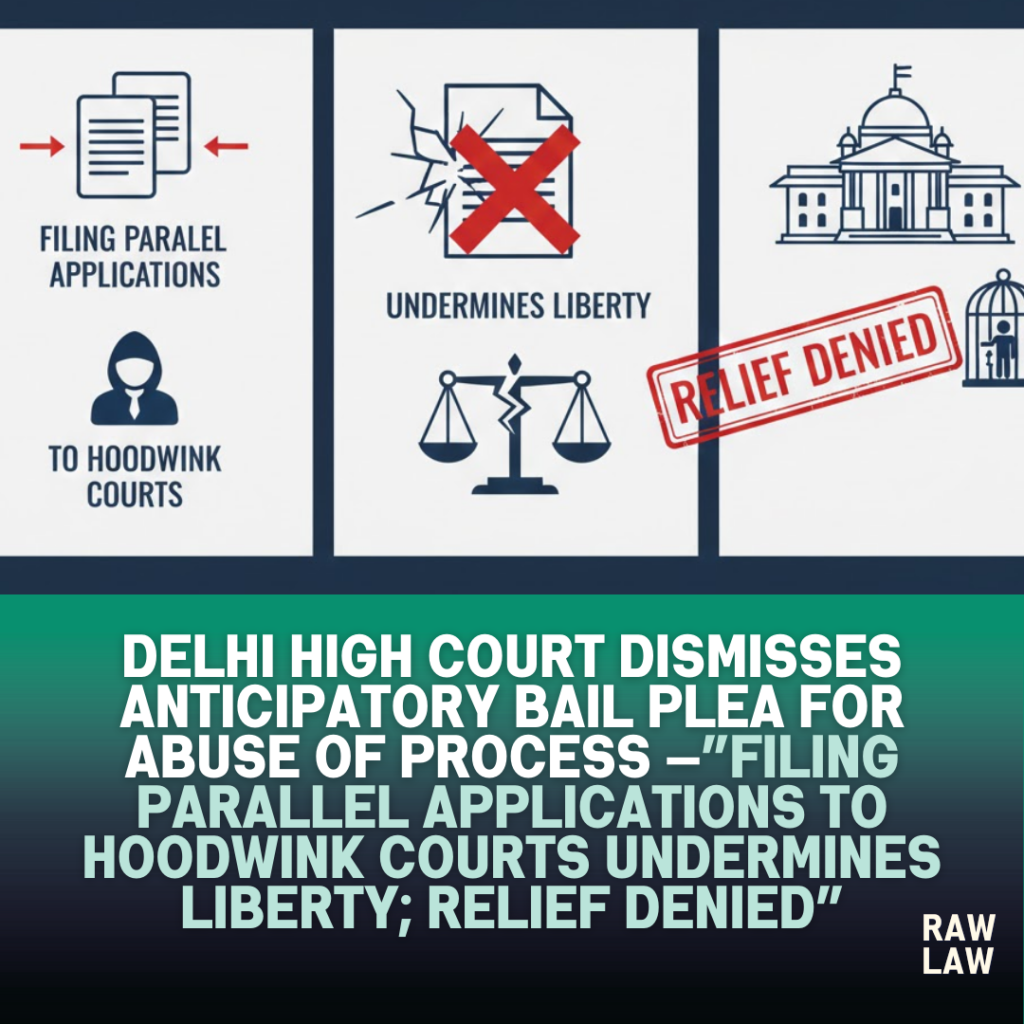
The Delhi High Court dismissed an anticipatory bail application after finding that the accused had simultaneously filed two identical bail pleas before two different courts, terming the conduct a clear abuse of judicial process. The Court held that liberty cannot be invoked as a shield for forum shopping or deception, and that an accused who attempts to mislead courts forfeits discretionary relief — “this is nothing but an effort to hoodwink the court”; anticipatory bail rejected.
Court’s decision
Justice Girish Kathpalia refused to entertain the anticipatory bail application after it emerged that another anticipatory bail plea filed by the same accused was being heard on the very same day by the Sessions Court. The Court dismissed both the bail application and the accompanying miscellaneous application, holding that filing parallel proceedings through different counsel without disclosure strikes at the integrity of the justice delivery system.
Facts
The accused approached the Delhi High Court seeking anticipatory bail in a criminal case registered at Police Station Bhalswa Dairy. During the hearing, the State produced a copy of another anticipatory bail application filed by the same accused before the Court of Sessions, bearing an official stamp indicating that it was listed and being heard on the same day.
The High Court noted that the Sessions Court application named a different counsel, while the High Court application was filed through another set of advocates. Both applications were signed by the accused himself and supported by his affidavits. The accused was also present before the High Court through video conferencing.
Issues
The core issue before the Court was whether an accused who files parallel anticipatory bail applications before different courts, without disclosure and through different counsel, is entitled to discretionary relief of anticipatory bail. The Court also examined whether such conduct amounts to abuse of process sufficient to warrant outright dismissal of the bail plea.
Petitioner’s arguments
Counsel for the accused submitted that she was unaware of the anticipatory bail application filed before the Sessions Court and claimed that she had been instructed by the accused’s mother to move the High Court. It was argued that there was no deliberate intention on the part of the accused to mislead the Court and that the filing of two applications was inadvertent. The accused himself attempted to distance himself from responsibility by stating that everything had been done by his mother and that he had no knowledge of the parallel proceedings.
Respondent’s arguments
The State opposed the application, pointing out that both anticipatory bail applications were signed by the accused and supported by his sworn affidavits. It was submitted that the accused was fully aware of the proceedings before both courts and was attempting to secure relief by approaching multiple fora simultaneously. The State urged the Court to treat this conduct as a serious abuse of process warranting dismissal of the bail plea.
Analysis of the law
The Court reiterated that anticipatory bail is a discretionary and equitable relief, not a matter of right. Such discretion must be exercised in favour of an applicant who approaches the court with clean hands and full disclosure. Filing parallel proceedings before different courts, particularly on the same day and without disclosure, undermines judicial discipline and amounts to forum shopping. Courts are duty-bound to protect the sanctity of their process and to prevent litigants from manipulating procedural remedies in the name of personal liberty.
Precedent analysis
While the order was brief and oral, it reflects settled principles that suppression of material facts and abuse of process disentitle a litigant from discretionary relief. Courts have consistently held that equitable remedies like anticipatory bail cannot be claimed by a party who attempts to mislead or deceive the judicial system. The High Court applied these principles to deny relief without entering into the merits of the underlying criminal allegations.
Court’s reasoning
The Court found the explanation offered by the accused and his counsel to be wholly unacceptable. It noted that not only the vakalatnama but also both bail applications and affidavits bore the accused’s signatures, making it impossible to accept the claim of ignorance. The accused’s evasive responses during video conferencing further reinforced the Court’s conclusion that the conduct was deliberate. The Court held that such an attempt to “hoodwink the court” amounts to abuse of process and cannot be condoned under the guise of seeking liberty.
Conclusion
Holding that the accused had abused the process of law by filing multiple anticipatory bail applications simultaneously, the Delhi High Court dismissed the bail application along with all connected applications. The Court made it clear that discretionary relief will not be extended to litigants who attempt to manipulate the judicial process.
Implications
This decision sends a strong message against forum shopping and procedural deception in criminal proceedings. It reinforces that anticipatory bail, being a discretionary relief rooted in equity, demands utmost candour from applicants. For practitioners and litigants, the ruling underscores the necessity of full disclosure and procedural discipline, failing which courts may summarily reject relief without examining merits.
Case law references
- Anticipatory bail as discretionary relief: Bail is not a right and can be denied for abuse of process. Applied to dismiss the plea outright.
- Forum shopping and suppression: Filing parallel applications before different courts disentitles an applicant from equitable relief. Applied to hold conduct impermissible.
- Clean hands doctrine: A litigant seeking discretionary relief must approach the court with candour and honesty. Applied to reject explanations offered.
FAQs
1. Can an accused file anticipatory bail applications in two courts simultaneously?
No. Filing parallel bail applications without disclosure amounts to abuse of process and can lead to dismissal.
2. Is anticipatory bail a matter of right?
No. It is a discretionary and equitable relief, granted only when the applicant approaches the court with clean hands.
3. Will courts examine merits if abuse of process is found?
Not necessarily. Courts may dismiss bail pleas outright if the applicant’s conduct itself disentitles them from relief.


