

Court’s decision
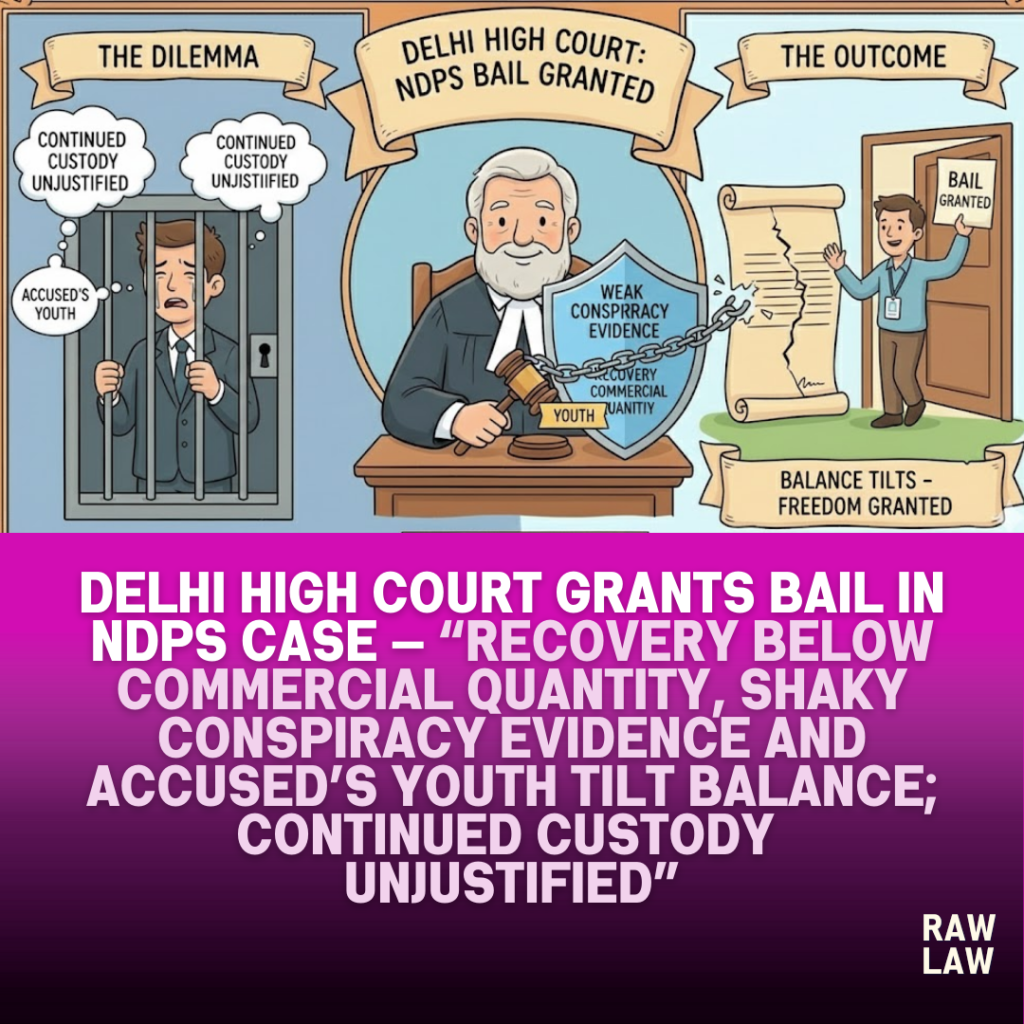
The Delhi High Court granted regular bail to a 19-year-old accused booked under the Narcotic Drugs and Psychotropic Substances Act, holding that the recovery attributed to him was below commercial quantity and that the prosecution failed to place cogent material establishing conspiracy to attract the rigours of Section 37. The Court ruled that vague digital clips, minor money transfers, and bare call detail records could not justify continued incarceration — bail allowed with conditions.
Court’s decision
Justice Girish Kathpalia allowed the bail application and directed release of the accused on furnishing a personal bond of ₹10,000 with one surety. The Court clarified that its observations were confined to the bail stage and would not prejudice the trial on merits.
Facts
The case arose from an FIR registered by the Crime Branch alleging recovery of ganja pursuant to secret information. In the night intervening 11–12 April 2025, police apprehended a co-accused riding a scooter and allegedly recovered 23.900 kg ganja from a plastic bag placed on the footrest. On the disclosure of the co-accused, the present applicant was arrested on 13 April 2025. From a bag allegedly carried by him, 12.235 kg ganja was stated to have been recovered.
The applicant remained in judicial custody since his arrest. He approached the High Court seeking regular bail, asserting false implication, planting of contraband, and absence of material to invoke conspiracy under the NDPS Act.
Issues
The principal issue before the High Court was whether the applicant was entitled to bail in light of Section 37 of the NDPS Act when the quantity recovered from him was below commercial quantity and the prosecution relied on alleged conspiracy with a co-accused to aggregate recoveries. A connected issue was whether the digital and financial material relied upon by the prosecution constituted prima facie evidence of conspiracy under Section 29.
Petitioner’s arguments
The applicant contended that no incriminating substance was genuinely recovered from him and that the alleged ganja was planted. It was argued that even as per the prosecution, the quantity attributed to him was not commercial, and therefore the statutory embargo under Section 37 could not apply unless a clear conspiracy was established.
The defence emphasised that the applicant was only 19 years old, had no criminal antecedents, and had been in custody since April 2025. It was further submitted that the prosecution’s reliance on digital material and alleged financial transactions was misleading and incapable of establishing any narcotics conspiracy.
Respondent’s arguments
The State opposed bail, submitting that the recovered substance had been certified as ganja by the forensic laboratory. It was argued that bail to the co-accused, from whom commercial quantity was recovered, had already been rejected, and parity demanded rejection of the present application as well.
The prosecution relied on an alleged video chat in which the applicant was stated to be showing ganja to the co-accused, along with call detail records and money transfers between them, to contend that there was a criminal conspiracy attracting Sections 25 and 29 of the NDPS Act.
Analysis of the law
The Court reiterated that for applying the rigours of Section 37, each accused is ordinarily answerable for the quantity recovered from him, unless the prosecution places cogent material demonstrating conspiracy that justifies clubbing of recoveries. Mere allegations of association or contact are insufficient.
The Court also underscored that at the bail stage, the prosecution must show reasonable grounds for believing that the accused is guilty of an offence involving commercial quantity, failing which continued detention would offend the principle of personal liberty.
Precedent analysis
Though no specific judgments were cited, the order reflects settled NDPS jurisprudence that call detail records showing telephonic connectivity, minor financial transfers, or ambiguous digital content do not, by themselves, establish conspiracy. Courts have consistently required clear and credible material linking accused persons to joint possession or coordinated trafficking before aggregating quantities to deny bail.
Court’s reasoning
The Court found that the recovery from the applicant — 12.235 kg ganja — was admittedly not commercial quantity. It examined the prosecution’s attempt to invoke conspiracy to aggregate recoveries and found the material wanting.
The alleged video chat, when produced, turned out to be a brief clip of some bush-like material in a plastic bag, with the investigating officer conceding that it was not a video chat between the applicant and the co-accused. The purported financial transactions were to the tune of about ₹20,000, which the Court held could not reasonably be linked to trafficking of contraband of the alleged scale. Call detail records, the Court observed, merely showed telephonic connectivity and revealed nothing about the content of conversations.
Considering the applicant’s young age, absence of antecedents, the fact that all witnesses were police witnesses, and the lack of credible conspiracy material, the Court held that further deprivation of liberty was unwarranted.
Conclusion
The Delhi High Court allowed the bail application and directed release of the applicant on bail on furnishing a personal bond of ₹10,000 with one surety. The Court clarified that its observations were limited to the bail stage and would not influence the trial.
Implications
This order reinforces the principle that the NDPS Act’s stringent bail conditions cannot be mechanically applied by loosely alleging conspiracy. It underscores judicial insistence on credible, substantive material before aggregating recoveries across accused persons. The ruling also highlights a rights-sensitive approach where young, first-time accused facing non-commercial quantity recoveries are concerned, reaffirming that pre-trial detention cannot become punitive.
Case law references
- Section 37 NDPS Act: Rigours apply primarily where commercial quantity is involved; conspiracy must be cogently established to aggregate recoveries. Applied to grant bail.
- Conspiracy under Section 29 NDPS Act: Requires substantive material beyond calls or minor transactions. Applied to reject prosecution plea.
- Bail jurisprudence: Youth, lack of antecedents, and weak evidence favour liberty. Applied to release the applicant.
FAQs
1. Can recoveries from different accused be clubbed to deny bail under NDPS Act?
Only if there is clear and cogent evidence of conspiracy linking the accused.
2. Do call detail records alone prove NDPS conspiracy?
No. CDRs merely show connectivity and not the substance of communication.
3. Does non-commercial quantity weaken the prosecution’s bail opposition?
Yes. In the absence of strong conspiracy evidence, non-commercial quantity favours grant of bail.


