

Court’s decision
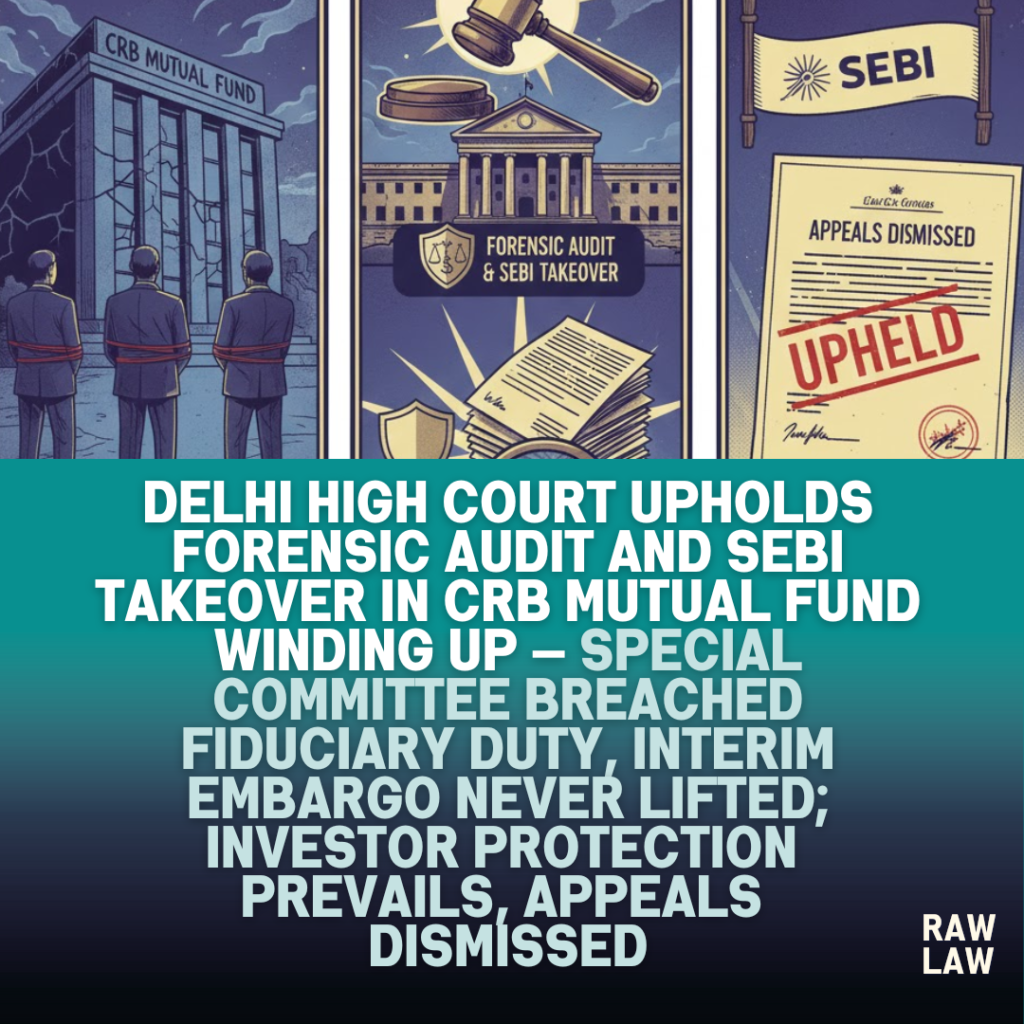
The Delhi High Court dismissed two company appeals filed by former members of a court-appointed Special Committee and CRB Group entities, upholding far-reaching directions for a forensic audit, recovery scrutiny, and transfer of control to the Securities and Exchange Board of India in the long-pending winding up of a mutual fund scheme. The Court held that the Special Committee acted in breach of fiduciary obligations by disbursing substantial funds to excluded CRB Group entities despite a subsisting judicial embargo — “trustee-like powers demand trustee-like restraint”; investor protection and transparency override claims of finality and merger.
Court’s decision
A Division Bench of Justice Anil Kshetarpal and Justice Harish Vaidyanathan Shankar affirmed the judgment dated 1 September 2025 of the Company Judge, holding that the doctrine of merger did not efface the Bombay High Court’s 1999 interim embargo excluding CRB Group entities from payments. The Court upheld directions for a forensic audit under the Securities and Exchange Board of India Act, constitution of a Special Cell of the regulator to complete winding up, restraint on further payments to CRB-linked entities, and transfer of unclaimed amounts to the Investor Protection and Education Fund. Both appeals were dismissed.
Facts
The litigation traces back to the collapse of a mutual fund scheme launched in the mid-1990s by a group company. Following regulatory violations, resignations of trustees, and initiation of winding-up proceedings, courts stepped in to protect unit holders. In 1999, the Bombay High Court approved a premature repayment scheme for small investors while expressly excluding entities belonging to the sponsor group and persons associated with its promoter from receiving any payments.
After transfer of proceedings to Delhi, and upon the death of the court-appointed Provisional Administrator, the Delhi High Court in 2013 constituted a three-member Special Committee with trustee-like powers to wind up the scheme under regulatory norms. The Committee, which included a nominee of the ex-management, was expected to complete the task within one year and file periodic reports.
Instead, the Committee functioned for over a decade, seeking repeated extensions. Interim reports filed before the Court disclosed aggregate disbursements but not beneficiary-wise details. Allegations later surfaced that more than sixty per cent of the recovered corpus had been disbursed to entities linked to the sponsor group, contrary to the 1999 embargo. Applications were moved by the regulator and an investor entity seeking forensic audit, recovery scrutiny, and regulator-led completion of winding up. These culminated in the impugned judgment directing a forensic audit and transferring control to the regulator.
Issues
The key issues were whether the 1999 interim order excluding sponsor-linked entities had merged into or stood superseded by the 2013 order constituting the Special Committee; whether the Committee had the authority to disburse funds to CRB Group entities; whether directions for a forensic audit and SEBI takeover were legally sustainable; and whether former Committee members had locus to appeal against supervisory directions of the Company Court.
Appellants’ arguments
The appellants contended that the 2013 order was a final, consent-based order directing distribution to “all unit holders,” thereby superseding earlier interim directions. They argued that the doctrine of merger applied, extinguishing the 1999 embargo. It was submitted that the Special Committee acted strictly within its mandate, that inclusion of an ex-management nominee was court-sanctioned, and that interim reports were accepted for years without objection.
The appellants assailed the forensic audit as disproportionate, asserting that accounts were statutorily audited and no concrete instance of misappropriation was shown. They also challenged the regulator’s Special Cell as ultra vires the mutual fund regulations and argued that review-like directions could not be issued a decade after final disposal.
Respondents’ arguments
The regulator and the investor respondent argued that the Special Committee functioned as a fiduciary extension of the Court and was bound by all subsisting judicial directions, including the 1999 embargo. They contended that massive disbursements to sponsor-linked entities, lack of transparency in reports, and decade-long delay justified strict intervention.
It was submitted that the doctrine of merger did not apply because the 2013 order neither considered nor expressly lifted the embargo. The regulator defended its statutory authority to conduct a forensic audit and assume control to safeguard investor interests, emphasising that public money of thousands of unit holders remained at stake.
Analysis of the law
The Court analysed the doctrine of merger, reiterating that merger is not automatic and depends on the nature and scope of the later order. An interim order determining a specific issue does not merge if the final order does not consciously deal with or override it. Judicial orders must be read contextually, not as statutes.
The Court also examined fiduciary principles applicable to court-appointed trustees, holding that such appointees owe duties of utmost good faith, transparency, and loyalty to beneficiaries. Any ambiguity in mandate must be resolved by seeking clarification from the Court, not by unilateral interpretation.
Precedent analysis
Relying on Supreme Court authority on interpretation of judgments and fiduciary obligations, the Bench emphasised that observations must be read in context and that fiduciaries cannot profit errant parties. Precedent on trustee duties was applied to hold that disbursements benefiting excluded entities undermine the very purpose of court intervention.
Court’s reasoning
The Court held that the 2013 order, though comprehensive, was passed without advertence to the 1999 embargo and therefore could not be read as lifting it. The Special Committee’s assumption that payments could be made to sponsor-linked entities was unjustified; prudence demanded seeking clarification.
The Bench found that the Committee failed to complete winding up within the stipulated time, did not submit a final report, and filed interim reports lacking beneficiary-wise transparency. Given allegations that over ₹131 crore was disbursed to excluded entities, the direction for a forensic audit was held necessary and proportionate.
The Court rejected challenges to SEBI’s Special Cell, holding that the regulator’s statutory powers justified assuming control to complete winding up and protect investors. Former Committee members were held to have limited standing to contest supervisory directions that did not impose personal liability.
Conclusion
The Delhi High Court dismissed both appeals, upheld the forensic audit, regulator-led completion of winding up, restraint on payments to CRB-linked entities, and directions regarding unclaimed amounts. The Court reaffirmed that investor protection and judicial oversight prevail over claims of finality and managerial discretion.
Implications
The ruling sends a strong message on accountability of court-appointed committees and trustees in long-running financial litigations. It clarifies limits of the doctrine of merger, reinforces fiduciary discipline, and affirms the regulator’s central role in safeguarding investor interests. The judgment will shape future supervision of mutual fund wind-ups and court-mandated administrations involving public money.
Case law references
- Doctrine of merger: Not automatic; interim embargo survives unless expressly lifted. Applied to sustain 1999 exclusion.
- Fiduciary duty of court appointees: Trustee-like powers impose strict duties of transparency and restraint; breach justifies audit.
- Regulatory intervention: Statutory powers permit SEBI to assume control to protect investors. Applied to uphold Special Cell.
FAQs
1. Does a later court order always override earlier interim directions?
No. Earlier directions survive unless consciously considered and expressly superseded.
2. Can a court-appointed committee be subjected to a forensic audit?
Yes, where transparency lapses or fiduciary breaches affecting public funds are alleged.
3. Why was SEBI allowed to take over the winding up?
To ensure investor protection and timely completion using statutory regulatory powers.


